
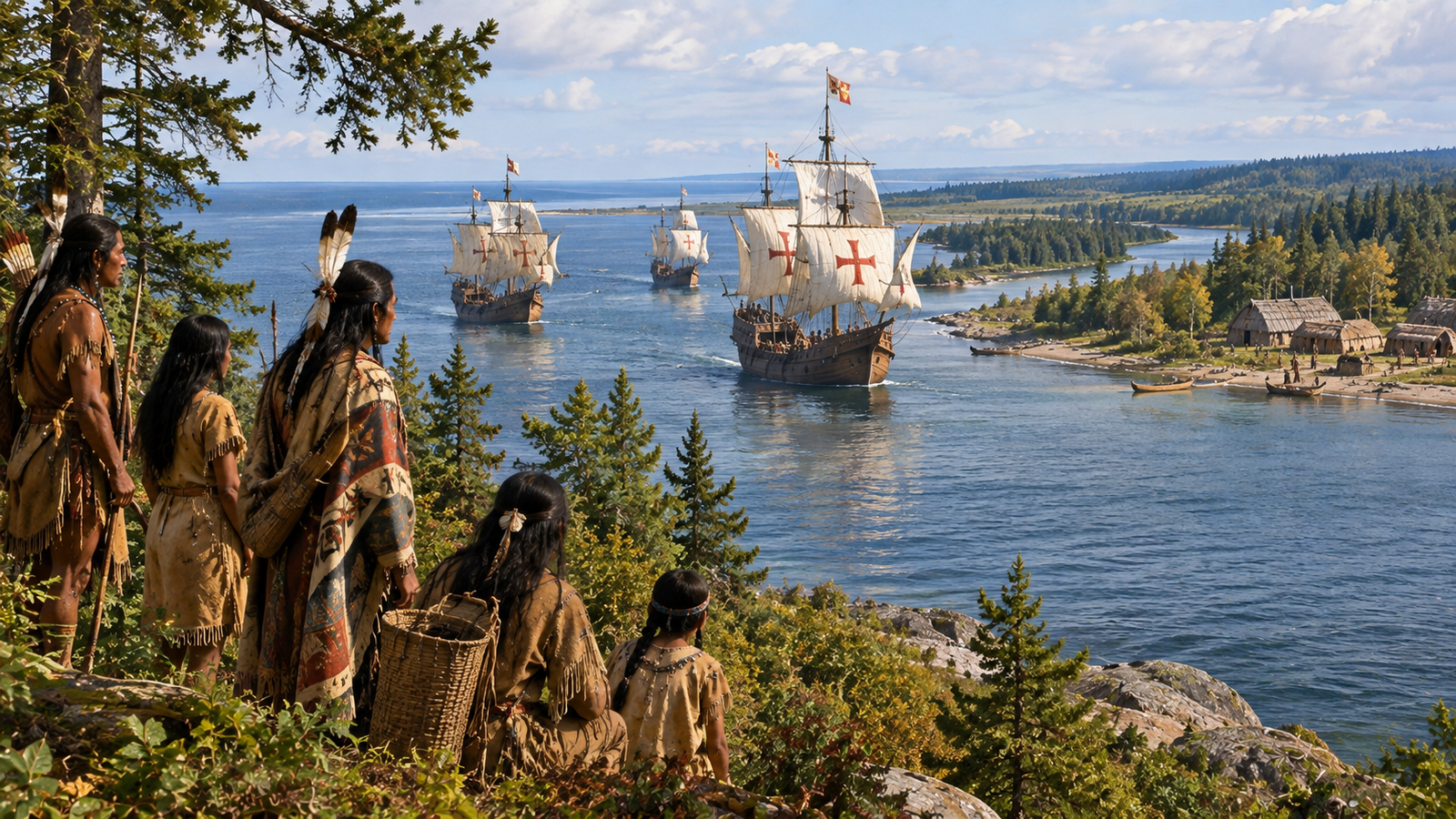
Long before European ships reached the shores of North America, the continent was already home to hundreds of Indigenous nations and communities. These societies had their own languages, political systems, economies, cultures, and traditions that had developed over thousands of years.
The arrival of European explorers during the late 15th and early 16th centuries began a major transformation in the history of North America. Europeans came for different reasons, including the search for new trade routes, valuable resources, land, religious opportunities, and political influence. Their arrival eventually led to permanent European settlements and the development of European colonies.
However, European exploration was not simply the story of Europeans discovering an unknown continent. North America was already inhabited. The arrival of Europeans created new relationships between Indigenous peoples, European powers, and later African populations brought to the Americas through the transatlantic slave trade.
Understanding this period is important because it marks the beginning of changes that eventually contributed to the formation of the United States.
European Interest in Finding New Trade Routes
During the 15th century, European kingdoms were increasingly interested in finding new routes to Asia. Asian goods such as spices, silk, and other valuable products were highly desirable in European markets.
Existing trade routes were long and complicated, and European rulers and merchants wanted more direct access to Asian markets. Improvements in shipbuilding, navigation, and mapmaking made longer ocean voyages increasingly possible.
Portugal and Spain became leading powers in early European exploration. Their sailors traveled along the African coast and into the Atlantic, while European monarchies supported expeditions intended to expand trade and political influence.
This competition eventually brought European explorers into contact with the Americas.
Christopher Columbus and the Atlantic Voyage
In 1492, Christopher Columbus sailed west across the Atlantic with support from Ferdinand and Isabella of Spain. Columbus believed that sailing west could provide a route to Asia.
Instead, his expedition reached islands in the Caribbean.
Columbus did not reach what is now the mainland United States, but his voyage had enormous consequences for the history of the Americas. It encouraged further European exploration and eventually led to permanent European colonization in different parts of North America.
The encounters also had devastating consequences for many Indigenous communities, including warfare, forced labor, displacement, and the spread of diseases to populations that had little or no previous exposure to them.
European Exploration of North America
After Columbus’s voyages, European countries increased their efforts to explore North America.
Spanish, French, English, and Dutch explorers traveled through different parts of the continent. They mapped coastlines, rivers, and territories and searched for resources and potential locations for settlements.
Explorers often relied on information obtained from Indigenous peoples. Indigenous knowledge of geography, waterways, food sources, weather, and local environments could be extremely valuable to European expeditions.
European exploration therefore involved interaction between people from very different societies.
The Spanish in North America
Spain became one of the earliest European powers to establish settlements in what is now the United States.
Spanish explorers traveled through parts of the southeastern United States, the Southwest, Florida, and other regions.
Juan Ponce de León explored Florida in the early 16th century. Later Spanish expeditions traveled much farther into the interior of North America.
One of the most famous expeditions was led by Hernando de Soto during the 1530s. His expedition traveled through parts of what are now Florida, Georgia, Alabama, Mississippi, Arkansas, Tennessee, and other areas.
Spanish exploration was followed by attempts to establish permanent settlements and missions.
In 1565, the Spanish established St. Augustine in Florida. It became an important Spanish settlement and is widely recognized as the oldest continuously inhabited European-established settlement in what is now the continental United States.
The French in North America
France also became interested in North America, particularly in the northern regions and the interior waterways.
French explorers and traders became heavily involved in the fur trade. Animal furs were valuable in European markets, and French traders developed relationships with various Indigenous nations.
In 1534, Jacques Cartier explored parts of the northeastern region of North America, including the St. Lawrence River.
French exploration later expanded through the Great Lakes and the Mississippi River system.
The French established settlements and trading posts in areas that became part of Canada and the central regions of North America. Their presence eventually extended toward the Mississippi River and the Gulf of Mexico.
French colonization generally relied heavily on trade and alliances with Indigenous nations.
The English Begin Establishing Colonies
England entered the competition for North American territory somewhat later than Spain and France.
English explorers made several attempts to establish settlements. One of the most famous early efforts was the Roanoke Colony, established on Roanoke Island in the late 1580s.
The settlement became known as the “Lost Colony” because the colonists disappeared before a permanent English settlement could be successfully established there.
Although Roanoke failed, England continued its efforts to establish colonies in North America.
These efforts eventually resulted in the establishment of Jamestown in Virginia in 1607.
The Founding of Jamestown
Jamestown was established by the Virginia Company in 1607. It became the first permanent English settlement in what would become the United States.
Life in the early settlement was extremely difficult.
The colonists faced problems including disease, food shortages, unfamiliar environmental conditions, and conflicts with nearby Indigenous communities.
The Powhatan Confederacy, led by Wahunsenacah, commonly known as Chief Powhatan, controlled a large area of the region.
The relationship between the English settlers and Powhatan communities included trade and cooperation but also growing tensions and violence.
Jamestown survived through difficult early years and eventually became an important center of English colonization.
The Arrival of the Pilgrims
Another important stage in English colonization occurred in 1620, when the Mayflower carried English settlers across the Atlantic.
The group commonly known as the Pilgrims established Plymouth Colony in present-day Massachusetts.
The settlers were seeking a place where they could practice their religion according to their beliefs.
Their early years were difficult, and many settlers died from disease, hunger, and harsh conditions.
The colonists also interacted with Indigenous peoples in the region. One important figure was Tisquantum, commonly known as Squanto, a member of the Patuxet people. He helped the settlers learn about local agriculture and survival in their new environment.
The popular Thanksgiving story often simplifies these relationships. In reality, relations between English settlers and Indigenous nations were complex and changed over time.
The Growth of the English Colonies
During the 17th century, England established additional colonies along the Atlantic coast.
These colonies developed different economies and societies.
Virginia and other southern colonies increasingly relied on agriculture. Tobacco became an important cash crop in Virginia, creating demand for large amounts of labor.
In New England, communities developed economies based on farming, fishing, shipbuilding, trade, and other activities.
The Middle Colonies developed diverse agricultural and commercial economies.
Over time, these settlements grew into larger communities connected by trade and migration.
The Expansion of Colonial Settlement
As European populations increased, settlers moved farther into territories occupied by Indigenous nations.
This expansion created competition over land and resources.
Indigenous nations responded in different ways. Some formed alliances with European powers, some traded with settlers, and others resisted European expansion.
Conflicts occurred in many parts of eastern North America.
One major conflict was the Pequot War in the 1630s. Another was King Philip’s War from 1675 to 1676, which involved several Indigenous nations and English colonists in New England.
These conflicts caused significant loss of life and contributed to major changes in the balance of power between Indigenous nations and European settlers.
The Impact of European Diseases
One of the most devastating consequences of European contact was the spread of infectious diseases.
Diseases such as smallpox, measles, and influenza were introduced to Indigenous populations that had not previously experienced many of these illnesses.
Because populations had different levels of previous exposure to these diseases, epidemics could cause extremely high death rates in some Indigenous communities.
The demographic consequences were enormous.
Population losses weakened some Indigenous nations and disrupted communities, political structures, economies, and cultural traditions.
Disease was not the only cause of Indigenous population decline. Warfare, displacement, forced labor, famine, and other effects of colonization also played major roles.
The Growth of the Atlantic Slave Trade
The development of European colonies was also connected to the forced movement of African people across the Atlantic.
As plantation agriculture expanded, European colonists increasingly sought large labor forces.
Millions of Africans were forcibly transported to the Americas through the transatlantic slave trade. Enslaved Africans were forced to work under brutal conditions in plantations, farms, households, mines, and other industries.
In the English colonies that later became the United States, slavery became particularly important to the economies of the southern colonies.
The development of slavery would have a profound impact on American history for centuries.
Indigenous-European Relations
Relationships between Indigenous peoples and Europeans were not identical everywhere.
Some Indigenous nations traded extensively with European settlers and benefited temporarily from access to European goods and technologies.
European goods such as metal tools, firearms, cloth, and other manufactured products could become important in Indigenous economies.
At the same time, European settlement threatened Indigenous land and political independence.
Some Indigenous leaders attempted to maintain peaceful relationships through diplomacy. Others resisted European expansion.
Indigenous nations were active participants in these historical events rather than simply passive observers.
Competition Between European Powers
European powers also competed against one another for control of North American territory.
Spain, France, England, and the Netherlands all established settlements or claimed territories.
Their competition sometimes led to military conflicts.
The English and French eventually became major rivals in North America. Their competition over territory and trade contributed to the French and Indian War in the 18th century.
The conflict was part of a larger global war between Britain and France.
Britain’s victory changed the balance of power in North America and helped create conditions that later contributed to the American Revolution.
The Development of Colonial Society
By the 18th century, the British colonies along the Atlantic coast had developed into increasingly large and diverse societies.
People came from different parts of Europe, while millions of Africans and their descendants became part of colonial society, many through slavery.
Colonial societies developed their own local institutions, churches, businesses, schools, and governments.
Although the colonies were controlled by Britain, many colonists became accustomed to managing local affairs.
This experience would later become important when disagreements with the British government increased.
Why European Colonization Matters to U.S. History
The arrival of Europeans permanently changed the history of North America.
European colonization brought new populations, political systems, religions, technologies, crops, animals, and economic networks.
It also brought warfare, forced displacement, slavery, disease, and the loss of Indigenous lands.
The colonies that developed along the Atlantic coast eventually became the foundation for the United States.
However, the story of colonial America cannot be understood from the perspective of European settlers alone. Indigenous peoples and Africans were also central to the development of North American societies.
By the 18th century, the colonies had grown significantly, and tensions between British authorities and American colonists were beginning to develop.
Leave a Reply