Why These Speakers Are Different?
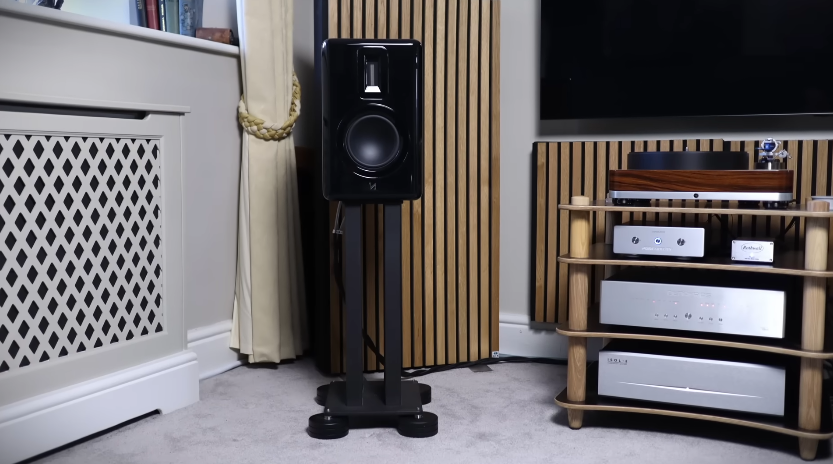
Table of Contents
Introduction :
We’ve said this before, but we want to reiterate. We don’t review many floor-standing speakers below. They tend to give up too much fidelity for the price of stand mounts. Above, the pendulum swings back in their favor. It’s that middle three to 5,000 range where everything’s up for grabs.
That’s why we’ve reviewed speakers over. Our current favorite modern-day stand mount speakers below are the excellent Quadrella ones, featuring a pure ribbon tweeter and a doped wood pulp midwoofer. Giant killing isn’t something that we tend to talk about because it hardly ever happens. When the Quadrolla ones can compete favorably with speakers twice their price, you could call that giant killing. We were curious about their big brothers.
Have designers messed things up by putting additional drivers in a larger box or built on the strength of the stand mount?
Design & features :
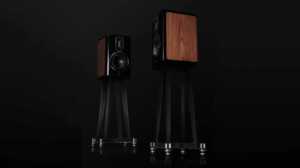
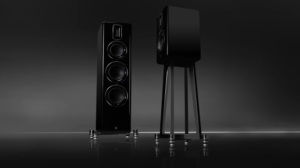
The Quadroverta 2Os are three-way floor-standing speakers that retail in the UK for mid-range prices for a pair. An all-black finish is available, but we prefer the Realwood walnut veneer that wraps around the back and sides. These are no shrinking violets, measuring 965 x 350 x 325 mm and weighing 31.8 kg. That’s 38 by 13.8 by 12.8 8 in and 70 lb.
The fitting finish is faultless all the way from the heavily chrome spikes on wide outrigger feet right to the top. To our eye, the high gloss finish suits the stature of the floor stander better than the stand mounts. The Roller Twos have two 165 mm 6 1/2 in woofers handling bass frequencies specified at a minus 3dB point of 40 Hz up to 650 Hz. The cone material named reveal is a wood pulp infused with pararamids to add stiffness and damping. The drivers were developed from scratch, not just a new cone material, but a substantial magnet structure, all housed in a heavy diecast chassis.
This is one reason why the speakers are heavier than many competitors. The same materials and technologies are deployed in the mid-range unit, which is smaller at 150 mm or 6 in. It caters to frequencies between 650 and 3,800 hertz. The crossovers utilize acoustic Butterworth filter networks. The 60 mm 2.4 in pure ribbon tweeter is identical to the one found in the Rella 1 stand mounts, but doesn’t have to play down as low due to the three-way implementation of the floor standers.
Quad has used ribbon tweeters for many years. This particular design has evolved from the model found in the Junior Z series. The magnet structure and waveguide have been improved to increase bandwidth and linearity whilst lowering distortion. By amping and by wiring, enthusiasts may be disappointed to find a single set of speaker binding posts, but they are of higher quality. Twin flared rear ports are responsible for extending the low-frequency range. The cabinets are internally heavily braced to reduce resonances.
They also have large radius corners to minimize edge defraction issues that can adversely impact the sound staging and imaging abilities of larger speakers.
Sound Quality :
These speakers have a lot to live up to, given that we’re currently using the Revela ones as our reference speakers below, but the Revela twos don’t disappoint. The 1,800 lb stand mounts are clean and dynamic. They produce exceptionally tight bass for a ported speaker. The ribbon tweeter is superbly detailed, and the mid-range is amongst the most revealing in its class.
The tunnel balance of the Rea 2 is a little bit different. There’s a bit more base weight, but quite a bit more base extension. Clearly, Peter Ko and his design team have gone for quality over quantity, but the mid-range characteristics have also been altered. This is almost certainly due to the revised driver arrangement and crossover. One great advantage a three-way has over a two-way is that a dedicated driver is covering the mid-range frequencies where our hearing is most sensitive.
The result is that the REA 2 sounds more open and relaxed with vocals and lead instruments. In comparison, the REA ones are a little bit forward in the upper mid-range, although never harsh. In comparison, the Rela Twos are ever so slightly on the polite side. Perhaps the most remarkable thing about these floor standers is how free they sound. Normally, resonances and edge refraction issues tie the sound to the enclosures to some extent. However, the RE two sonically disappear as if they were much smaller speakers.
They’re capable of creating a wide and deep sound stage with solid imagery. That ability to localize performers is dependent on the preservation of high frequencies. That’s another area where the Quadrolla 2 shines. The Tweeter benefits from having fewer frequencies to cover than when performing the same duties with the two-way stand mounts. The detail, refinement, and sense of air all step up a level from its junior sibling.
Okay, time for this week’s music suggestion. With correct positioning and amplification, the placement of Bill Evans Trio playing Nardis was exemplary. So was the weight and texture of each note on Sam Jones’ double bass, the tambourine to Bill’s piano, and the light brush work of Philly Joe Jones on drums. There are a few competitor speakers we’d like to mention. They’re not here, so no detailed comparisons, just our general listening impressions. The Scan Sonic MB 2.5Bs retail for a mid-range price.
They have a similar, slightly warm tone and highly capable sound staging and imaging capabilities. However, the bass is heavier, and the mid-range isn’t quite as open as the quads. Even stand-mount speakers with impressive bass weight and extension can’t dig as deep as the Revela 2s. The Circa mid-range Bukar E50s have even better imaging, but a more polite upper mid-range. For just under mid-range in passive form, the ATC SEM20s provide greater mid-range texture and tonal shading with a tighter bass.
However, these sealed box speakers won’t compete with the floor standards for dynamics, bass extension, and expression in the top octaves. The Neite Classics are the same price as the Quadrilla 2os in a real wood finish. Similarities don’t end there. The Elite shares the same slightly warm tonal balance, well-controlled bass, and articulate high frequencies. It’s been a long time since we reviewed the Elites, and we think they might do better in this room, where we can get them closer to walls for some boundary reinforcement, which tends to suit their presentation.
They’re smaller speakers, so they won’t shift as much air or dynamically, and in terms of bass extension, they compete with the quads. We also think that the Revela 2s are slightly more open in the mid-range thanks to that three-way design, but they’re also more fussy when it comes to amplification and speaker positioning. So, what do you need to know to get the best out of them?
Extracting Performance :
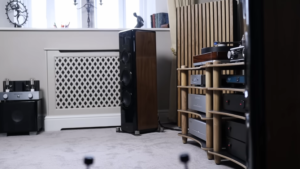
Ribbon tweeters typically have a wide horizontal dispersion but narrow vertical dispersion. So, it’s important that you get the tweeters close to ear height. It’s often easier to achieve this with floor standers than with stand mounts, unless you have stands at the correct height. Or go for the matching stands for the Revela ones for an additional range below. At mid range, that’s a grand cheaper than the Revela 2. The Revela 2 is ideally suited to rooms that are a little bit larger than mine, which is about 4.3×3.7 m or circa 14x 12 ft. We were able to get them to work by placing them just over 2.5 m, 8 ft apart, to ensure that the mid-range didn’t sound too thick.
We also pulled them 115 cm 45 in forward into the room, measuring from the center line of the front baffle. This kept the bass nice and tight. We tried a lot of amplifiers. Some definitely worked a lot better than others. It’s not that the Revela 2 is difficult to drive. Actually, the Revela ones are a lot more difficult to drive. The floor standards have an extra 3dB of sensitivity, which helps, but that’s not the whole story.
They’re rated officially at 89 dB into a 6ohm load, but we suspect that the Crossover is also electrically more forgiving. The Audio Lab 6000A Mark II, priced below range, provided a very good starting point. 50 W per channel into 8 ohms, backed up by a decent power supply, proved more than sufficient to get an idea of what the Quad Revela 2Os were about. The new quad platinum amplifier is mid-range and is most likely Bedfellow. The 200 W per channel powerhouse opened up the sound stage. Increased dynamics whilst imparting more resolution than the Audio Lab.
That’s a warm-sounding amplifier paired with slightly warm-sounding speakers. The result is, you guessed it, a warm sound. Synergy with our Exposure Premons and the Exposure 2510 was off. For some reason, they didn’t gel together. The sound was too muddy and soft for our liking. Our 3,250 Hegel H190 only fared slightly better. Not muddy and soft, but dynamically flat and rather boring. We were tempted to jump to the conclusion that maybe the speaker drivers were overdamped.
However, the Revela twos sprung into life with our Wilson R8. Normally, we run this with Tungst 6SN7s on the preamp stage and PSVain T2 collection CV181s and KT88s on the driving and power amp stages. However, PSVain has sent us their Summit series of tubes, which we rolled to replace the T2 tubes on the latter two stages. So, this is our advice regarding the new PS Veain Summit series tubes. If you’ve got a Wilson R8 or a similar quality tube amplifier, and you’re running it with decent tubes already, something like the PS Veain Art series T2 collections that we’ve been using for the last couple of years, we wouldn’t bust a gut and go out and buy the Summit series.
But if they’re coming to the end of their life or you’re running these tube amplifiers with the stock tubes that they tend to come with, especially the Chinese brands like Wilson and their various competitors, then absolutely go for the Summit series. They’ll justify the extra outlay over the Art series alone, which is about 30% for the extra clarity and focus that they bring.
Back to the review, even the single-ended Brunode Terra 300B amplifier sounded fabulous, proving that you don’t need a lot of wattage to drive these speakers to what most people would consider sensible listening levels in relatively average-sized listening rooms. If the Brunica was struggling, it would show in compressed dynamics and the softening of the leading edge of notes. There were no signs of these issues.
Quad does make some tube amplifiers, and we wonder if the Revela 2s, in part, have been designed with these kinds of amplifiers in mind. We suppose this is as good a point as any.
Conclusion :
To wrap things up, Peter Ko went back to the drawing board to design the Revela range with a new reveal material for the mid and woofer cones coupled to substantial motor structures. The ribbon tweeter evolved. There were new crossovers and cabinets with elaborate finishes. The result is two highly capable speakers, each with their own personalities. The Revela ones are fairly neutral, but need amplifiers with plenty of current to drive them. The Revela Twos are easy to drive, have a warmer tone, but also sound more open and relaxed.
They need a bit of space to breathe and are fussy about positioning. If the Relata Twos played nicely with a wider range of amplifiers, they’d get the top outstanding award. They absolutely shone with the valve amplifiers we tried, but the transistor amplifiers were a bit of a mixed bag. It’s worth putting the groundwork in with the Revela twos and trying lots of different amplifiers because the results can be staggering.
The Quadrilla 2os gets a very highly recommended. Sometimes, two products can gel together to produce extraordinary outcomes. We’re sure you know what to do by now. There are a couple of tiers you can access there.