Vivo X300 Pro Review
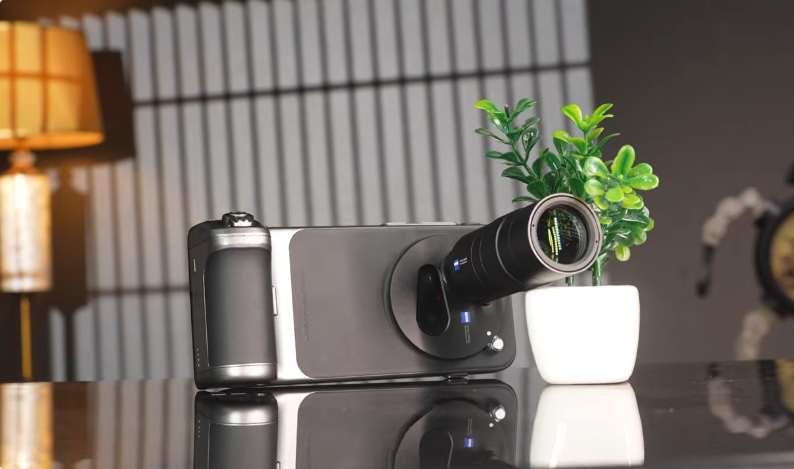
Table of Contents
Introduction:

The very first and biggest launch of the year, along with a major unboxing, is happening for the Vivo X300 Pro, and it’s going to set a huge trend. How’s everyone doing? This is the Vivo X300 Pro. We’re doing this unboxing before the launch event.
Why is this unboxing gonna be huge? Along with it, Vivo has also sent us their Telephoto Kit made in collaboration with Zee. So, let’s unbox it. Now, bro, we’ve got this big box here, and it even mentions the Vivo X300 Pro Photography Kit on it. Let’s open the box. Inside this big box, we find the X300 Pro like this. For now, let’s put this box aside. Regarding the rest of the box experience, we have a drawer at the bottom. After opening this drawer, inside we find a grip, next step three release hooks, and it comes with a 62mm filter adapter ring. You get two decorative rings, one pre-installed, along with a case. There’s also Vivo’s telephoto extender that offers 2.35x zoom. Now, talking about unboxing the F, this is how the box arrives for the X300 Pro from engineer V. Zais. As soon as you open the box, the first thing you see is the device. Then, you get two compartments at the bottom. In one, there’s a SIM ejector tool. In another compartment, you find a TPU case. This one is black, a matte black colour.
You’ll also see the phone in a dune brown colour. The silicone case that comes with it is probably a different colour. It has a Type-A to Type-C cable, and you get a 90-watt fast charger right out of the box. So, there’s a lot of stuff included in the box. But first, let’s talk about the phone itself. Then we’ll get into the extender kits. Speaking of the phone, we’ve already covered its Chinese variant. On the back, there’s a big camera module made of fiberglass.
You get that. This Phantom Black catches a few smudges, as we experienced with the Dual Brown. It showed fewer smudges overall. It has an aluminum frame. It’s rated IP6869, which means it’s flash and dust resistant. Besides that, the power button and volume rocker are on one side, along with the antenna bands. On the top side, you’ll find the speaker grill. On the other side, there’s an action button that you can customize. Like, if you want to turn on the torch or do anything else, you can set it up however you want.
Inside, there’s a SIM tray with Type-C connectivity. You’ll find antenna bands, a speaker grill, and a mic. The phone weighs around 230 grams. The camera bump is pretty big. But the good thing is, it has support—like when you put your finger on it, you get some grip from this side. The camera module comes with integrated 3D cold-curved glass, which looks better visually. So, it doesn’t feel too big when you look at it. Oh, and the camera bump has a ring-like feel to it.
The lenses on the LR really give you a noticeable texture—you can actually see and feel it. The old weight implementation is good too; even with such a big camera module, the phone doesn’t feel like it’s tipping over. Now, talking about the display, flagship phones overall give you a better experience. For example, you get a 6.78-inch LTPO 1.5K 80Hz panel, which is brighter. It has a peak brightness of 4500 nits and comes with an ultrasonic fingerprint sensor, making it more secure. As for the bezel experience, it’s about 1.1 mm.
It has an ultra-thin bezel around the screen. The screen-to-body ratio is over 92%, giving you a full bezel-less experience. It comes with Dolby Vision HDR, HDR 10 Plus certifications, and even TÜV Rheinland certification. The touch sampling rate is over 300 Hz, although the refresh rate supports up to 120 Hz. This means if you’re into gaming, you’ll get top-notch haptic feedback and a better touch response. The haptic motor feels much improved compared to before, giving you a really good response.
It’s way better. Besides that, the always-on display and the depth effect that came with the Origin OS 6 update let you customize the always-on display on the screen. That makes it way better and really makes the display look vibrant. It also supports Widevine L1. For protection, it comes with Armor Glass on the front, which is super secure. We’ve seen this in previous generations, too. So, the display here is a solid 10 out of 10.
We can explain this better. Like, first off, this is a Dimensity 9500+ 3nm chip. It comes with the whole fabrication process hardware. You get flagship-grade clock speeds, like 4.21 GHz. Then, there’s the GPU—an Arm G1 Ultra. Plus, Vivo’s V3 Plus chipset is also included. That’s the imaging chipset. You also get dedicated integration for some performance stuff. And the RAM type? It’s quad-channel here, coming with LPDDR 5X Ultra. Also, it supports UFS 4.1.
It comes with a new type of storage. Let us explain it to you in simple terms. Earlier, flagship phones used to come with dual-channel memory. This one offers double the performance compared to that. Like faster upload times or better control over animations, optimizing all that with the GPU – this phone handles it smoothly. By the way, it comes with Origin OS 6 right out of the box and runs on Android 16. Plus, you get 5 years of major Android updates and 7 years of security updates.
You’ll keep getting maintenance updates in this. But honestly, I’ve been using Origin OS 6 for quite a while now. Man, they’ve changed a lot. Like, if you check the dialer, call recording is now there. You’ll notice tons of changes. Also, the always-on display has a bunch of customization options. Talking about Origin OS again, and the Origin design, you get Origin Island. Along with that, the Origin Smooth Engine supports the Golden Trio. This comes with ultra, ultra cool computing.
Memory Fusion works with dual rendering. You get spring animations. Flipkart’s lock screen is available. You’ll see blur transitions and that glass-like UI feel. It’s really good on the first experience—officially launched. Before this, we were using the Vivo X2 FE and had a smooth experience with animations, app loading times, and rendering—it handles all that well. And if you’re considering it for gaming, it supports 120 FPS. We’ve already reviewed the gaming part.
So, it provides pretty stable FPS ranging from 100 to 120. And by the way, when we talk about liquid cooling here, you get an efficient cooling system. It comes with an ice vein capillary core design that keeps the phone cool. Now, if benchmark scores matter to you, this one offers scores above 3.4 million. So, definitely on the performance front, yeah, I’d say this is a way better flagship phone right now.
Performance :
Performance-wise, it’s solid. Plus, you get all the AI features, like Google’s Circle to Search option and Google Lens integration. There’s AI Retouch, AI Eraser, AI Ultra HD, and with AI, you can edit a bunch of pictures if you want. It also supports screen translation, AI call translation, AI meeting captions—all that good stuff. The AI engine is there too, and it even boosts performance a bit. So yeah, you get a fully loaded set of AI features. We’ll talk about the camera a bit later.
Speakers :
The dual speakers are great for multimedia. You’ll get about 40-50% performance. The top speaker does around 40%, and the bottom one does about 50%. It delivers really bold sound and handles things like controlling the treble and improving vocals really well. Plus, it also supports Dolby.
Connectivity:
Talking about connectivity, it covers all 5G bands, all 4G Plus bands, has an ultrasonic fingerprint sensor, and even an IR blaster. It also supports NFC. On top of that, you get USB 3.2 Gen 1. There are 19 bands in total.
5G brings this along. Meaning, when 5G starts in Pakistan, no matter which brand it is, the Vivo X300 Pro supports 19 bands.
Battery:
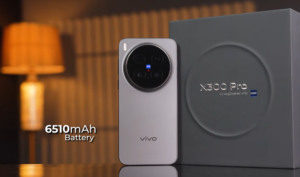
Plus, this phone has a big battery to handle everything. It comes with a 6510 mAh battery, supports 90W fast charging, 40W wireless charging, and reverse charging as well. It features fourth-generation silicon anode technology with semi-solid state battery tech.
So, if you watch YouTube for like 28 to 29 hours, that’s basically the total playback time it’s offering you in a whole day. The screen-on time is literally around 12 to 18 to even 20 hours, which is what this device is giving you. This is just our review, bro, telling you what’s real and what’s not.
Camera:
Now, talking about the camera part—on the front, there’s a 50-megapixel camera with an f/2.0 aperture. The field of view has been improved a lot compared to before. It can record 4K videos at 60fps from the front. And obviously, Vivo has always been the selfie master. The texture is good, natural, and way better.
Here’s what we’re seeing. From the recordings, this is the only phone we’ve experienced so far that does this. Because if you record video with the front camera, like if you’re vlogging in 4K at 60fps, it records really well. No other phone is currently doing this kind of video. The post-processing is really good. And like we said, this V3 chipset—what a thing! It completely controls the imaging technology. Basically, they’ve given a dedicated chipset, which makes the post-processing way better.
Before installing, let’s talk about some specifications. So, on the back, you get all the sensors you’d expect from a top-tier smartphone. First, the main sensor is a 50-megapixel Sony sensor, the Light A282, with optical stabilization and gimbal technology. Then, there’s a periscope telephoto lens that comes with Zeiss APO. Now, Zeiss APO—it’s basically a 200-megapixel camera sensor, but this Zeiss APO tech controls advanced APO chromatic aberration.
Here, you get chipset support that helps with image post-processing, meaning there’s a dedicated chipset to handle the camera’s tech operations. It comes with Vivo’s S1 chipset, which is used for pre-processing, and the V3 chipset, which is an imaging chipset that does better post-processing. So, all this tech is packed into the camera. Plus, you get an ultra-wide sensor—a 50-megapixel Samsung JN1—that offers a 119-degree field of view, which is pretty interesting.
The thing is, you can get an 8K video at 30fps from the rear camera. But I’ve already experienced the main sensor before. It also offers portrait mode at 4K 60fps. The dynamic range and post-processing are much better. Now, talking about the experience, when you attach the telephoto extender here, it literally replaces a DSLR. Because you get video options at different focal lengths, and photo options too. Plus, this phone’s telephoto lens already does optical zoom up to 3.5x.
When you attach this extender, you actually get an option called Telephoto Extender inside your phone. After that, the optical zoom with this extender goes up to around 10x, man. So, there’s a 2.35x zoom, and besides that, you also get about a 3.7x zoom. Literally, if you’re a cinematographer and want to capture photos, with videos or photos playing on the screen, honestly, the detail is amazing. It offers optical stabilization up to 200mm, and beyond that, it still provides really good detail up to 400mm, even 600mm.
This phone’s usable zoom ranges from 1600mm up to 5400mm with a telephoto extender, literally giving you that focal length. So, next level—like, I’m a creator. If we ever had to replace our DSLR, we’d definitely consider replacing it with this phone. Because this phone doesn’t just shoot 8K at 30fps, it also supports Dolby Vision videos and log videos. As you can see, log videos give you a huge amount of flexibility for colour grading.
If you ask us if there’s any phone that can replace something like a DSLR, we would definitely recommend this one. Here’s the thing: even if you don’t have that, if you take a photo with the telephoto lens, it can zoom up to 135mm. You’ll notice the depth of field and the blur effect. You can also get filters in those sizes, like Bio-tar or Sonar filters. These kinds of filters are available too. But after post-processing, it definitely balances skin tone and skin texture better than a DSLR.
If you capture photos and take them to your PC to edit, very few DSLRs can deliver ready-to-upload results like this. So definitely, nowadays, even if you use an extender to capture photos, this provides way better quality.
Opinion:
Even if you shoot videos, it offers really good quality these days because this phone comes with such great specs. Unboxing is just an initial review, and we’ve shared as many details as we could. So, that’s it. This is the Vivo X300 Pro.