
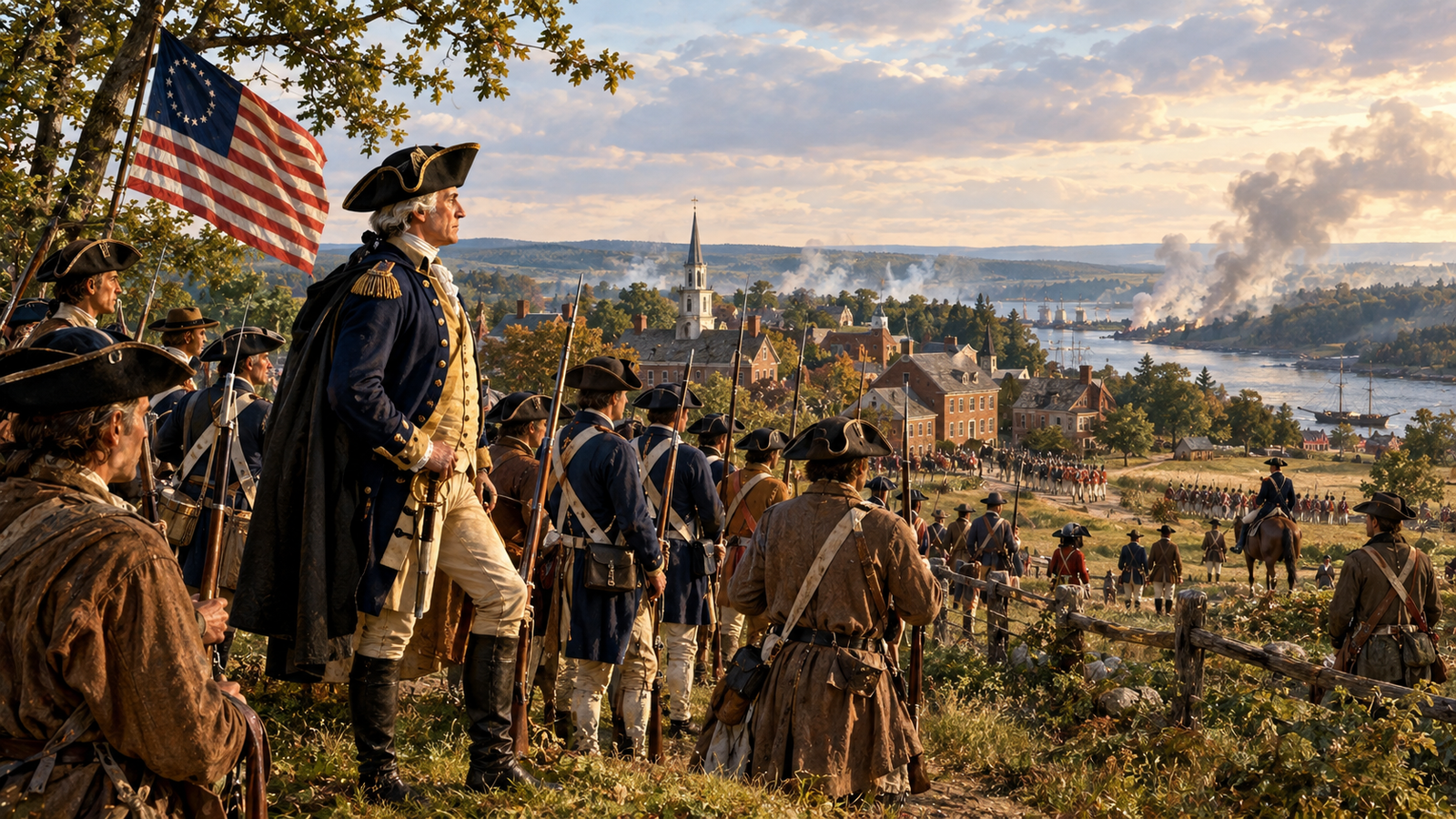
The American Revolution was one of the most important events in the history of the United States. It transformed thirteen British colonies in North America into an independent nation and introduced political ideas that influenced the development of the United States.
The Revolution did not happen suddenly. It developed over many years as disagreements between Britain and its American colonies became increasingly serious. Issues involving taxation, political representation, trade regulations, government authority, and individual rights gradually created distrust between the colonists and the British government.
The conflict eventually became a war. American colonists fought British forces and their supporters from 1775 until 1783. The war ended with British recognition of American independence, although the new nation still faced enormous challenges.
Life in the Colonies Before the Revolution
Before the Revolution, the thirteen colonies were part of the British Empire. Colonists were legally British subjects and participated in a large Atlantic economy connected to Britain, Europe, Africa, the Caribbean, and North America.
The colonies had their own local governments and elected assemblies. Many colonists were accustomed to making decisions about local taxes and laws through these institutions.
However, the colonies were still ultimately under British authority.
For much of the colonial period, Britain exercised its authority without creating a major crisis. Many colonists considered themselves loyal members of the British Empire.
That relationship began to change significantly after the French and Indian War.
The French and Indian War
The French and Indian War lasted from 1754 to 1763 and was part of a larger conflict between Britain and France.
Britain and France competed for control of territory and influence in North America. Various Indigenous nations also became involved, forming alliances with European powers according to their own interests.
Britain eventually won the war.
Although Britain gained control of additional territory, the conflict was extremely expensive. The British government had accumulated substantial debt and believed the American colonies should contribute more toward the cost of defending the empire.
This became one of the major causes of tension.
The Proclamation of 1763
After the war, Britain issued the Royal Proclamation of 1763.
Among other provisions, it restricted colonial settlement west of the Appalachian Mountains.
The British government hoped the policy would reduce conflict between colonists and Indigenous nations.
Many colonists, however, were frustrated because they wanted access to western lands.
The disagreement over western expansion became another source of tension between Britain and the colonies.
The Stamp Act
In 1765, Parliament passed the Stamp Act.
The law placed a tax on many printed materials, including newspapers, legal documents, licenses, and other papers.
Many colonists strongly opposed the tax.
Their argument was not simply that taxes were expensive. They believed Parliament was imposing taxes on them without their elected representatives having a direct role in Parliament.
This contributed to the development of the phrase “no taxation without representation.”
Protests spread throughout the colonies.
Groups such as the Sons of Liberty organized demonstrations and resistance against British policies.
The Stamp Act was eventually repealed in 1766, but the disagreement over Parliament’s authority remained.
The Townshend Acts
Britain introduced another series of taxes in 1767 known as the Townshend Acts.
These measures placed duties on imported goods such as glass, paper, paint, lead, and tea.
Colonists responded with protests and boycotts.
British officials attempted to enforce the laws, increasing tensions between colonists and authorities.
Eventually, most of the Townshend duties were repealed, but the tax on tea remained.
The continuing presence of British troops in colonial cities also created tension.
The Boston Massacre
On March 5, 1770, a confrontation between British soldiers and residents of Boston resulted in the deaths of five colonists.
The event became known as the Boston Massacre.
Patriot leaders used the incident to criticize British military presence and government policies.
Images and descriptions of the event circulated throughout the colonies, increasing anti-British sentiment.
Although the confrontation was more complicated than some propaganda suggested, it became a powerful symbol for the Patriot cause.
The Boston Tea Party
One of the most famous protests occurred in Boston in December 1773.
The British government had passed the Tea Act, which gave the British East India Company advantages in selling tea in the colonies.
Many colonists viewed the law as another example of Britain’s attempt to control colonial trade and taxation.
On December 16, 1773, a group of colonists boarded ships in Boston Harbor and dumped large quantities of tea into the water.
The protest became known as the Boston Tea Party.
Britain responded with a series of harsh measures that colonists called the Intolerable Acts.
The Intolerable Acts
In 1774, Parliament passed laws intended to punish Massachusetts for the Boston Tea Party.
The measures restricted aspects of Massachusetts government and closed Boston Harbor until the destroyed tea was paid for.
Instead of isolating Massachusetts, the laws encouraged greater cooperation among the colonies.
Colonists in other regions sent supplies and expressed support for Massachusetts.
The growing crisis convinced colonial leaders that they needed to coordinate their response.
The First Continental Congress
In September 1774, delegates from twelve of the thirteen colonies met in Philadelphia for the First Continental Congress.
Georgia did not initially participate.
The delegates discussed their grievances against Britain and developed a coordinated response.
They called for a boycott of British goods and demanded that colonial rights be respected.
At this point, many colonists were still hoping to resolve their disagreements without declaring independence.
However, events soon moved toward armed conflict.
The Battles of Lexington and Concord
The first major military clashes of the American Revolution occurred in Massachusetts in April 1775.
British troops marched toward Concord, where colonial military supplies were believed to be stored.
Colonial militia confronted British troops at Lexington.
Fighting then continued toward Concord and during the British retreat to Boston.
The battles marked the beginning of open warfare between British forces and American colonists.
The political dispute had become a military conflict.
The Second Continental Congress
In May 1775, the Second Continental Congress met in Philadelphia.
The delegates faced the difficult task of organizing the colonial resistance.
They created the Continental Army and selected George Washington of Virginia as its commander.
Washington had military experience from the French and Indian War.
Although the colonies were now fighting British forces, many leaders still hoped for reconciliation.
The possibility of peaceful settlement gradually became less realistic.
The Battle of Bunker Hill
The Battle of Bunker Hill took place near Boston in June 1775.
British forces attacked fortified American positions.
The British eventually captured the position, but they suffered heavy casualties.
The battle demonstrated that colonial forces could fight experienced British troops effectively.
It also showed that the conflict would be difficult and costly.
The Declaration of Independence
By 1776, support for complete independence had grown significantly.
Thomas Jefferson drafted much of the Declaration of Independence, which was debated and edited by the Continental Congress.
On July 4, 1776, Congress adopted the Declaration.
The document announced that the thirteen colonies were no longer part of the British Empire and considered themselves independent states.
It also expressed important political ideas about government, rights, and equality.
The Declaration argued that governments existed to protect certain fundamental rights and that legitimate government depended on the consent of the people.
However, the ideals expressed in the document did not immediately apply equally to everyone living in the new country.
Enslaved people, women, Indigenous peoples, and many others remained excluded from political equality.
This contradiction became an important part of later American history.
George Washington and the Continental Army
George Washington faced enormous challenges as commander of the Continental Army.
The army lacked many of the resources available to Britain.
American soldiers often had limited training, while supplies such as weapons, clothing, food, and ammunition could be difficult to obtain.
Washington had to maintain an army while also dealing with disagreements among political leaders and individual states.
The Continental Army nevertheless survived and continued fighting.
Local militias also played important roles throughout the war.
The Turning Point at Saratoga
One of the most important American victories occurred in 1777 during the Battles of Saratoga in New York.
American forces defeated a major British army.
The victory was significant because it demonstrated that the American rebellion had a realistic chance of succeeding.
It also helped convince France to formally support the American cause.
French military and financial assistance became extremely important to the American war effort.
France Enters the War
France had been a rival of Britain for decades.
After the American victory at Saratoga, France entered into an alliance with the United States in 1778.
French assistance included soldiers, weapons, supplies, ships, and financial support.
Spain and the Dutch Republic also became involved in the broader conflict against Britain, although their roles differed from France’s alliance with the Americans.
The Revolution therefore became part of a much larger international war.
Life During the Revolution
The Revolution affected ordinary people as well as soldiers and political leaders.
Families faced shortages, rising prices, disrupted trade, and uncertainty.
Women often managed farms, businesses, households, and family affairs while men were away fighting.
Some women also supported military campaigns directly as nurses, cooks, laundresses, messengers, or camp followers.
African Americans participated in the conflict as well.
Some enslaved people joined the British because Britain offered freedom to certain enslaved people who escaped from Patriot owners and supported the British cause.
Others served with American forces.
The Revolution therefore created complicated choices for different communities.
Loyalists and Patriots
Not every colonist supported independence.
Colonists who supported the revolutionary movement were commonly called Patriots.
Those who remained loyal to Britain were known as Loyalists.
The population was divided in different ways, and opinions could vary by region, community, religion, economic position, and personal circumstances.
The conflict was therefore also a civil conflict within the colonies.
Loyalists sometimes faced harassment, property confiscation, or pressure to leave areas controlled by Patriots.
After the war, many Loyalists moved to Canada, Britain, the Caribbean, or other parts of the British Empire.
Indigenous Nations During the Revolution
Indigenous nations were not simply bystanders during the American Revolution.
Different Indigenous nations made different decisions based on their own political interests and concerns about land.
Some supported Britain, while others supported the Americans or attempted to remain neutral.
Many Indigenous leaders understood that an American victory could lead to increased settlement west of the Appalachian Mountains.
The outcome of the Revolution therefore had serious consequences for Indigenous peoples.
After independence, American settlement expanded westward, increasing pressure on Indigenous lands.
The Southern Campaign
As the war continued, British forces shifted significant attention toward the Southern Colonies.
British forces captured important cities, including Charleston in 1780.
The conflict in the South involved regular armies, militias, Loyalists, and Patriot forces.
Battles and guerrilla-style fighting took place across the region.
American victories at places such as Cowpens and King’s Mountain helped weaken British control.
The Southern Campaign eventually contributed to the British decision to concentrate their forces at Yorktown.
The Siege of Yorktown
The final major campaign of the American Revolution took place at Yorktown, Virginia, in 1781.
American forces under George Washington worked with French forces commanded by General Rochambeau.
French naval forces also played an important role by preventing British reinforcements from easily reaching Yorktown.
British General Charles Cornwallis became surrounded by American and French forces.
After a prolonged siege, Cornwallis surrendered in October 1781.
The surrender did not immediately end the war, but it made continued British military operations increasingly difficult to justify.
The Treaty of Paris
Peace negotiations eventually produced the Treaty of Paris of 1783.
Britain officially recognized the independence of the United States.
The new United States gained territory extending west to the Mississippi River.
The Revolutionary War had officially ended.
The thirteen former colonies were now an independent nation, but creating a stable government was the next major challenge.
The Legacy of the American Revolution
The American Revolution changed the political map of North America.
The United States became an independent republic and began developing its own political institutions.
The Revolution also introduced ideas about liberty, representation, and government that would influence later political movements around the world.
At the same time, the Revolution left major problems unresolved.
Slavery continued.
Women remained excluded from most formal political rights.
Indigenous nations faced increasing pressure as the United States expanded westward.
The new nation also struggled with debt, political disagreements, relations between states, and the question of how powerful the national government should be.
The Revolution was therefore both a major achievement and the beginning of a much longer process.
Leave a Reply