I Never Had Bass Like This Before

Table of Contents
Introduction:
We think there comes a time in every man’s life when he realizes that this is where real pleasure is derived from. And it can be all he thinks about because when this is really good, you just can’t get enough of it.
We’re going to be speaking to you about our experiences with two larger-than-average subwoofers from REL Acoustics, and they’ve done just that to me. They’ve been thinking about this and pretty much nothing else.
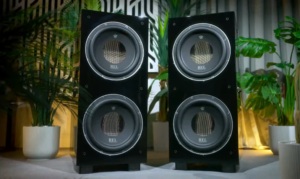
The two REL Acoustics 212BL or Black Label subwoofers. And this is the largest subwoofer in REL Acoustics’ new Series S range.
212BL:
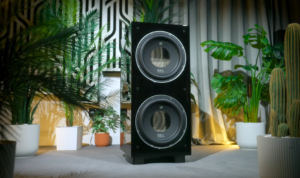
And we think there is a clue in the name for what we are dealing with here. Because these subwoofers use two 12-inch actively driven, what REL call carbon alloy woofers, that are driven by a 1,000-watt amplifier.
What REL call linear class D amplifier. So we assume a class D amplifier, but with a linear power supply, which is rare for subwoofers. With two 12-inch passive radiators, one on the rear and one underneath, that you’ll hopefully forgive us for not showing you because weighing over 60 kilograms each, we’re not man enough to pick one up, but we’re sure the bottom passive is the same as the rear, and we can show you that one, of course.
And speaking of the same, we have the expected REL amplifier plate with all of the controls and connections we expect. And that means high-level and LFE connections and controls. One thing we’re not as familiar with is REL’s wireless systems, which are a capability built into the 212 to a degree. You will need to buy an airship direct unit that includes a physically large but nicely styled signal transmitter box, which sends both high-level and LFE wirelessly to a receiver unit that connects directly to the back of the 212BLs.
And Rails says this is a zero-compression ultra-low-latency connection. And they left a unit with us just in case we needed to be creative with the subwoofer placement in our room, because wireless will make that easier. But we didn’t need to in the end, so we used our trusty Rail baseline blue high-level cables.
Instead, connected to ever solo F 10 power amplifiers running in bridged mono. Now, before we move on, let us explain something to you briefly. Now we always do our utmost level best.
Create videos with high-quality visuals that hopefully do justice to the luxury nature of the hi-fi products or goods that we’re talking to you about, but whenever something is gloss black, that is about as hard as it gets to do that because it reflects everything, so we had to be very dramatic with our use of lighting, so we don’t know if these shots do the 212 justice because we think the aesthetic design is very nice considering we are talking about a big black rectangle box at its core. But we do like how REL has added some niceties here to make these subwoofers easier on the eye, and we have the best one yet to show you.
Grills:
Now, personally, we’re not a fan of grills. Not the barbecue kind, of course. We love those. We mean, speaker and subwoofer grills. We prefer to see the drivers. We’re a commando all the way kind of guy. Well, we were. REL subwoofers always come with very nicely built grills. So if that is your thing, then we’re sure what we’re calling the stealth grill will be exactly what you want to soften the look of these subwoofers in your home. And we do like the extra details we get, such as the name logo on the top.
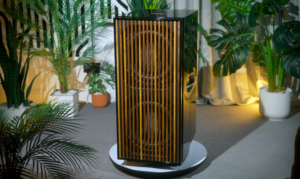
However, one of the features of the new Series S range is a wood grill option. That is an additional purchase for the 212, but we think they look great in the flesh. The finish quality on them, like the high gloss surrounds, is very high quality, as high as the subwoofers themselves, and the wood slats are all real oak wood, we believe, and they do give the 212BLs a totally different visual vibe in our room that we are a big fan of.
But look, we can imagine that for many people watching this video, already at this point, they’ve decided that this is a subwoofer just for large systems in large rooms. And we would understand that because that is exactly what we thought ourselves. And when REL asked us if we’d like to review these because they thought we would really like them, we struggled with the idea at first because we thought they would be massively overkill for our small listening room and medium-sized hi-fi system at best.
But that was us totally missing the point of what these subwoofers are all about because rails say the 212 bl can give you a close to a full line array or six pack of subwoofer experience on their own and as we’ve listened to a six pack of number 32 subwoofers only a week or so ago this was the perfect time for us to put that claim to the test somewhat at least.
Comparison Explained:
And this is also a great time for us to explain something to you that, normally, in our reviews, we like to have some kind of comparison to judge a product’s quality against. But when we’re talking about subwoofers this size and this heavy, it’s just not physically possible for us to do that in our home. So everything you’re going to hear us say about their performance is us judging them against lots and lots of different subwoofers we’ve had in this listening room in the last 20 years.
And that includes lots from RHEL themselves. We’ve had a dual number 31 set up in here before, dual T9X SE, dual S510. We’ve had RHEL classic subwoofers in here and more subwoofers from other manufacturers. And we’ve also spent a lot of time working as a system calibrator. So we’ve set up lots of subwoofers for lots of people in lots of different rooms. So we do have a ton of experience.
Dealing with subwoofers but it’s still not the same as having a comparison one here at the same time so do take all of this into account with the other thing to consider was that all of our testing was using dual 212s as a stereo pair and also for two channel music only because of course a subwoofer like this could be great for dual purpose use music and movies. But we think most people will be considering this kind of rail for what they can do for them for music as a very high priority.
Setup:

And for our listening testing, we had to think about how we were going to make these larger subwoofers work in our small room. And it made physical sense to have them positioned outside the speakers and on either side of the hi-fi racks.
And to our surprise, it was like we measured before we fitted the racks because they actually slotted into that space in inverted commas perfectly. And that is because these are actually not that large a subwoofer as you might think. And that is because of their size.
Kind of floor footprint space that they may not take up because they’re actually not as wide as a single S850 subwoofer, and that is really interesting, so all of the extra space with the 212s is really in their height and really in their depth, rather than them being kind of wide and chunky, and we actually think that makes them easier to fit or easier to accommodate in probably most rooms, but definitely in our smaller room where like floor footprint is really at a premium.
So that was great for us in a way. However, their placement obviously affected where we would position the Revival Audio AGR speakers. And the new position took a little bit of getting used to for the speaker’s sound. But overall, this setup ended up working out really great.
Sound Quality:
We will admit we was expecting to struggle with the two one twos in here in terms of like their base output and that be like overloading of the room and we like man, would we be able to even turn them on barely have them on kind of situation but that wasn’t the case at all and in fact, we ended up setting them up very similar to how we would maybe a t9x subwoofer.
In terms of the crossover and in terms of the higher level gain, that is because this new range of subwoofers, the new Siri S from REL, they are, and this is going to sound strange, they are the least like subwoofer subwoofers we’ve heard to date. Let us explain that better. We think they are the most like speakers sounding subwoofers we’ve heard to date, just with a subwoofer amount of gusto. And that is very impressive.
But it does catch you out at first, and it did here, but more so with our first experience with them when we reviewed the S850 a couple of months ago. But now we’re more familiar with this range, we can hopefully explain what they’re all about better. Because we said that the S850 was delicate in its base delivery, which it is, but we actually don’t think that was the best or the correct way to describe it to you. So let us try to do better this time.
Normally, with subwoofers, when you start to turn them up, they start to thicken the sound of music. They start to make music sound a bit thicker and a bit heavier.
Even if maybe just by a little bit with the very good ones you can always hear when you turn them up how they start to thicken the sound and that then starts to congest the music congest the sound stage and it starts to sit itself on the music and that kind of stops you being able to turn them up and that is all part of the integration and you always hear that with all subwoofers to some degree even if only by a small part and that was the kind of like the first difference we noticed with the 850 but more so with the 212BL.
Like you can have a very substantial bass sound without the bass being heavy on the music. So you can turn it up more, get more bass.
Without it kind of feels like it’s sitting on the rest of the music. So what we’re saying is normally you can hear some subwoofer-like characteristic sound that is added to the music. And sometimes this is a very pleasurable attribute. And a great example could be Rell’s Classic 98 and 99 subwoofers that add a carpet-like effect of bass.
That very much wraps around you and fattens out the sound in the whole room in a warming and pleasing kind of way. And we really like that effect, but you are still aware that a subwoofer is doing that, and that is okay. But with the 212BL, we found that with some music, we couldn’t even tell that they were playing, because there was no thickening or any sign that the subwoofer was playing bass until we turned them off and missed what was now not there.
And we found they could deliver a bass that was completely indistinguishable in its delivery from some very good speakers, the Revival Audio AGR. Well, that is, until the music calls for more it calls for more scale more drama or more impact and more punch or more scale all those fun things that subwoofers give us and then you realize you have two larger subwoofers in the system or in the room because then you get loads of that like we said a very substantial bass sound but without it feeling heavy on you or heavy in its delivery at all so we was able to get a very again big and substantial bass sound in our room that was very tight and articulate.
And controlled in the main even at very loud volumes and what more could you ask for now do bear in mind two important things our room is very acoustically treated and actually the acoustics in here are pretty exceptional for a small room of a lot of thick bass trapping being used especially by where we sit and that matters of course and also factor in we did use the parametric eq feature in the ever solo t8 music streamer to reduce hertz by a few dB because deeper bass is where the room treatment stops being so effective so some equalization has been essential for us to make the 212s work in here but we’ve only needed or wanted a small amount of adjustment here in relative terms so this is all very important to know.
Now, the fact that the 212BLs don’t have some kind of EQ system built into them, maybe could have been a bummer to us if we were listening to more vinyl, because then we wouldn’t have had the EQ feature as we did from digital.
Now that it may depend on the turntable setup, the record you listen to, but it is a potential negative for some. Others that are more digital music orientated probably won’t care because, as we say, you can get this really useful feature in a very cost-effective, high-quality music source like the Eversolo T8. Or maybe none of this will bother you. It just depends on your room, of course.
But to explain our experiences a little more, it only took us about an hour to be happy with the crossover and high-level gain settings. So, really not long at all to integrate subwoofers. We then listened for around four hours to a wide variety of music. Not everything sounded perfect.
Not every bass note was perfect, but we think that is an unrealistic expectation for any system, especially when you scale it up this big. But the majority of what we listened to sounded fantastic, which is why we were still sitting there four hours later, because we were having such a great time. Then our second listening session, we fully expected to spend the time to tweak the subwoofer’s position.
And really, we were thinking more, we’ll change the speaker’s position to try and get a better integration, tighten the bass up even more. But four hours later, we hadn’t done any of that. We just sat there and listened to a whole load of music again because, again, we were having such a great time. And something really hit us in that second listening session. And it was because we’d recently been listening to some hi-fi systems with big amplifiers, like some big Macintosh, it was.
But we spent a lot of time listening to hi-fi systems with big amplifiers like big Macintoshes or big Griffins, and the reason we think someone would have a larger subwoofer like this is similar to the reason why you have a big Amplifier in your system. You don’t have a big amplifier to listen to music louder. You have a big amplifier, so that amplifier only ever cruises regardless of what the demands of the music are, and it’s the same for a larger subwoofer like this.
We were pushing it. And we were listening to bass-heavy music. And the 212BLs were just cruising along. And you can hear that. In the sound of a big amplifier. And you can hear that in the sound of a larger subwoofer. It just delivers everything you need it to. With a real sense of ease.
And that in turn seemed to make our main speakers and amplifiers have an easier time, too. Which, of course, they’re not; they’re doing the same thing. So we know that this is just a psychoacoustic effect.
However, we could listen louder for longer, and the system seemed to sound quite noticeably smoother with a nicer tonality too, and much more dynamic. And we think most of this is just because the overall balance of sound was better in the room. But the interesting thing is that this was also true for low-volume listening as well. Because we think when you look at large speakers and large subwoofers, you can think it’s all about blasting music out really loud, which is what we do most.
Most of the time but like not everybody can do that and everybody wants that sometimes it’s about lower volume listening and having like a nice amount of bass it’s actually more important probably for lower volume listen having that right amount of bass there actually means you probably don’t need to turn the music up as loud to get like that feeling the sense of it when it’s tight and controlled and articulate too like.
Like we said, what more can you ask for? Now, we have not been looking to pop our windows listening to Bass we Love You turned up to 11. We mean, we’re not 15 anymore, and we’re sure other subwoofers will do that better if that is what you want. However, we have listened to some quite heavy drum and bass music like Chase and Status, Badadan, which sounded the best we’ve ever heard. So much scale and impact, it makes you realize what this track is all about. And we have listened to that track.
On about a half a million pound hi-fi system with just speakers and the experience was nothing like what we got here you can take a lot away from that and then we listened through all sorts of music including some harp and some other audio file demo tracks you know the shit we hate hearing at hi-fi shows and much more and all we can say is this is the most excited we’ve been about having subwoofers here in our system for years we mean for years.
And we think that also includes the time a lot of time that we spent with dual rail number 31 so one up you could look at it in the range and we think that is because of the the difference in the floor footprint being slimmer allowed us to position the 212s in a better spot in this room so we was able to achieve we’re not going to say a better result but like different type of result and then also the wood grills yes they are expensive and the price is hard to get your head around especially if you like us and you normally hate grills on speakers and subwoofers but these but these are the only grills.
VS 6 Pack:
We think, bar the number 31, that we’ve left on any speaker or subwoofer in this room in the last 20 years. And that is because they make the subwoofer look less like a giant black box in the room. They do add a touch of visual luxury, and that might help you with the WAF.
Maybe anyway. But do you get a six-pack-like experience from the 212BLs as is claimed by REL? Well, comparing to a six-pack of number 32s in a much larger room on a much more expensive hi-fi system is very unrealistic, of course, but it’s the best.
That we can do well look we can see why rel say that they say on the website that the design of the 212 bls is to give you some of that the way they’ve implemented the cabinet and rear passive radiator and you do get some of it you do get some of that sense of like impact and scale and authority of sound in the room we really like that about subwoofers anyway but you do seem to get a bit more of it a bit more of the hype kind of thing going on and that sense of like power and ease of bass.
There is some of that. But if we’re being truthful, it’s not the same experience that you get from a six pack of 32s that sounds so massive and so weighty and so authoritative. And we think some of that would be in the setup. Because, of course, a six pack comes with a lot of complexity, more cables, more individual settings to play around with. But we think it’s in that setup.
In the capability potential of that in how you could squeeze maybe more out of a set of you know a six pack of subwoofers because the 212 bl yes you get some of that but it does still sound like you’re listening to one very good or two we suppose very good subwoofers rather than a line of race six packs so it’s not the same.
But we think it gets you closer. And the reason we say that is because normally, when we go to Michael’s and listen to his six pack of 32s, we go there thinking our system sounds great. We’ve got loads of bass, loads of great bass. Normally, it’s just from speakers. And we come back and listen again after hearing the six pack. We’re like, man, we’ve got no bass at all. Where’s all the scale and everything gone? Normally, it takes us more than a week to adjust back to like real world listening. But if we had the 212 BLs here, no. We think it will be much, much, much, much less or much closer to what you will.
Negatives:
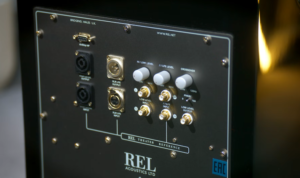
But what about negatives? Well, for us, it would be the same negative that we say for all rail subwoofers below the top two. We still only have manual controls with no remote control, which we think could be super useful on a subwoofer like the 212 because it’s taller, and the fact that the controls are at the bottom. And if you place it somewhere difficult with limited space, it might be difficult to get to. And we actually thought that was going to be the case for me. We thought we might have to lie on the floor and try to squeeze our bodies through the space.
Below the speaker stands to get to the controls but it wasn’t we could easily kind of reach across even though we’re only a short guy we could still reach across you know and adjust the control so that was all fine but look it would be easier and more luxurious to sit in your seat and you know make the adjustments with remote control said it.
And if you choose to have the wood grill added, these are expensive subwoofers, depending on how you look at it, because everything is relative. It depends on maybe what speakers you own.
You know someone dropping easily dropping 11 000 or 12 000 pounds on a new amplifier to try and get some of the sound that a set of two one twos is going to give you so it’s all relative now we do wish the wood grills were included with the 212 bl like they are with the carbon special that costs less so that is something however if you’re buying one of these or maybe two of these from a dealer.
Maybe see if you can get a deal for the wood grills to be included, because if you don’t ask, you don’t get. So summing up our time with the Relacoustics 212BL subwoofers.
Final Thoughts:
We’re really going to miss them. We thought that was going to be crazy overkill for us in this space and this room, but they’ve ended up being probably the perfect subwoofers for me. This space, this room, to match up with their revival speakers and more. They’ve ended up being about perfect, and they’re probably our favourite. They are, in fact, our favourite subwoofers we’ve had in this room to date.
So we hope this has been helpful and useful. We hope you enjoyed it.
Till then, take care. Stay healthy. Stay safe.