Realme GT 8 Pro
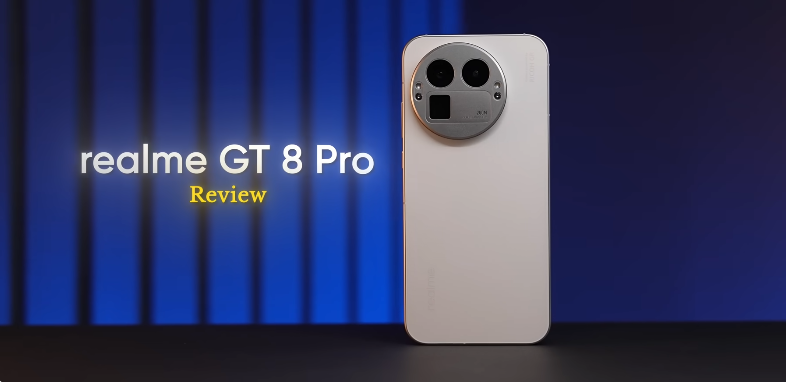
Table of Contents
Introduction:
Now this is the first realme phone in a long time that feels different. Not the kind of different, but okay, realme, we see what you’re doing there, kind of different. And the reason for that is that realme is definitely taking risks in the form of this interchangeable camera module, which you can basically change to be a circular one or a square one. But more importantly, you also have the new Ricoh collaboration, which is pretty interesting.
And yeah, it’s quite something for a realme phone, and therefore it becomes imperative for us to actually discuss what realme is trying to do with the realme GT8 Pro. So let’s unscrew everything about this phone, not just the camera module.
Design:
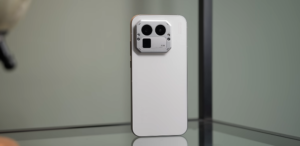
The first thing that we want to talk about on the realme GT 8 Pro has to be the interchangeable or swappable camera modules. By default, you get the circular one, but apart from that, you have a square option, you have one that looks like this, and we really like this colour by the way, or if you don’t want to use any module at all, you can just rock it completely naked, and it’s called a Mecha Robot-looking design.
We like the rocking naked look. Honestly, it does look pretty awesome. And to change this, it’s pretty simple. You get the Torx screwdriver inside the box. There are two T4 screws for each camera module, and you can just, you know, unscrew them and replace them. It’s simple. Now it might look pointless to some, and there is no added utility either, but it’s fun. It’s whimsical. We wouldn’t say it’s gimmicky. We kind of like it.
It feels like the real me is actually listening to nothing and trying to make tech fun again. All right, now for the rest of the design. On the back, you actually have fiberglass, just like you had with the OnePlus 15, especially on the white variant. But we like the OnePlus 15, which has a glass variant as well. This one doesn’t have a glass variant. You also get flat sides as well. Again, the designs across all these phones, Realme, Oppo, and OnePlus, have started to morph into one another, and they just look very similar to each other.
Now, in terms of thickness and weight, it is very similar to the OnePlus 15. So the in-hand feel also feels largely similar, and the ergonomics are largely fine too, except for the fact that now, in terms of thickness and weight, it is very similar to the OnePlus 15.
So the in-hand feel also feels largely similar, and the ergonomics are largely fine too, except for the fact that fact the white variant of the phone is kind of slippery which is not too much of a problem since you get a case inside the box and you can just slap that on we would have liked for the case to be colour coordinated and there’s one problem uh over here is that if you actually use one of the other modules like a square one or like this one you do not have a case that matches it the case only has a circular camera cut out so you’ll have to buy a case separately for that front. So the cost-cutting has happened with the glass protection and the Type-C port. But overall design-wise, we like it.
Display:
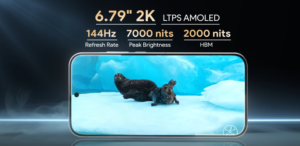
Now the Realme GT 8 Pro has a 6.79-inch BOE Q10 Plus panel. This is a 10-bit panel with 2K resolution, and it can reach a peak refresh rate of 144Hz in certain supported games. By the way, the display doesn’t have LTP or technology. It’s an LTPS panel, which means that it can refresh anywhere between 30, 60, 90, and 120. But we rarely ever saw it go down to 30, by the way. And the panel can also get really, really bright. You can reach a peak brightness of 7000 nits at a 1% APL, and the HBM brightness can also go up to 2000 nits, which means that when you take it outdoors, it’s plenty bright.
HDR video playback is supported on both YouTube and Netflix. On Netflix, you do get support for Dolby Vision as well. Now, the HDR tuning and the gradation have been done exceptionally well. We really like it. In fact, even within the settings of the display, you do get the Pro Color mode, which means that you can get closer to neutral colors as well. In fact, the red skin problem that we noticed in the OnePlus 15’s HDR video playback is not a problem with the Realme GT 8 Pro.
The quality of the panel itself and the color accuracy are pretty good. And we’re sure that the bezel nerds out there might have noticed that the bezels on the Realme GT 8 Pro’s display are not the slimmest in the market right now, at least among the current crop of flagships. But honestly, if you ask me, we don’t really care too much about the bezel size. It’s pretty slim, and you know, it doesn’t really bother in daily usage.
As for the haptic feedback, you get the same motor as the one that you get inside the OnePlus 15. So it’s good, but not the best. You also get an ultrasonic in-display fingerprint scanner, and the stereo speakers do sound loud and clear. In fact, take a listen to it right next to the OnePlus 15. So overall, if you look at the display and multimedia experience, we think that the realme GT 8 Pro does a bang-up job.
Performance:
Alright, now it’s time to talk about the performance of the realme GT 8 Pro, and let’s start with the benchmarks. Now, in Antutu, the phone scored around 3.97 million, and in Geekbench 6, we got about 3,684 in single-core and 10,964 in multi-core scores. Now, these are strong numbers, and they’re only a touch behind the OnePlus 15, which is our leader in our charts at the moment.
Now we also ran a bunch of GPU benchmarks in Steel Nomad Lite; the phone hit 22.64 average FPS. In Solar Bay, it returned around 51.85 average FPS, and it peaked to about 67 FPS, and all of these are solid GPU numbers.
Now let’s talk about the stability aspect of the performance on the realme GT 8 Pro, because things are interesting here, because with the CPU throttle test, where we engage 40 threads for 30 minutes, we got about 63% CPU stability, which is in the ballpark range of most flagship phones. It’s not bad, we would say.
Now the storage performance was pretty good too. Apps load fast. Now, in the GPU stability test, things got interesting because it does throttle really hard. Realme throttles really hard to keep the temperatures in check because in OnePlus, we got, you know, 47 degrees as the peak temperature, whereas we got a 71.6% GPU stability. But with the Realme GT 8 Pro, we got 43 degrees, which is not as high as OnePlus, but the stability is almost half.
Now, this could be a problem for gamers who want to game for a really long time because realme, in the interest of keeping the phone cool, is throttling performance, and that could mean that frame rates could drop.
And that is also evident from our regular gaming tests because in Genshin Impact, we got about 59.9 FPS, and the temperature went up to 40 degrees, which means that to keep it at 40 degrees, Realme had to drop the frame rates a little bit. And in Wuthering Waves, we got about 59.2 FPS at roughly 41 degrees Celsius.
Now, one thing to note is that you do get a bunch of gaming features like game frame interpolation, with which you can run Genshin Impact at 120 FPS as well, but it uses a separate display chip, so it doesn’t run without touch delay input delays, which is not a problem with the OnePlus 15.
But native level 144 FPS is possible on both COD and BGMI, which is good. Now, overall, the Snapdragon 880 Gen 5 inside the Realme GT 8 Pro has been tuned for short bursts of performance, but if you want sustained gaming performance, we feel like the OnePlus 15 does a better job.
Battery:
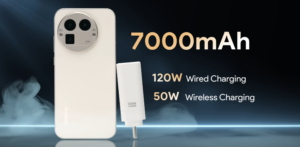
Pretty good on the realme GT8 Pro. You get a 7000 mAh silicon carbon battery. It’s a split cell battery, and you can get up to 9 hours of screen on time or slightly more than that with the phone. And you also get a 120-watt charger inside the box, and that takes about 37 minutes for a full charge, which is fantastic. And you also get 50-watt wireless charging for your convenience. Of course, you’ll have to buy the charger separately.
Now, what we like about the Realme GT 8 Pro is that, unlike previous Realme GT phones, it does have a focus on cameras this year, including a very interesting addition to the hardware. So the primary is a 50 megapixel camera, and it’s the same 1.1.56 inch sensor. And the ultrawide is also a 50 megapixel ultrawide angle camera. The selfie is a 32 megapixel selfie camera, but with no autofocus.
Camera:
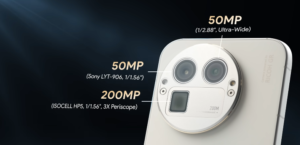
Now, the telephoto or the periscope is one where Realme has used a 200 megapixel Samsung HP5 sensor. And that’s an interesting move for sure, but let’s take a look at how it performs in real life, including what that Ricoh branding brings to the table. The primary camera photos in daylight especially look sharp and clean.
Now, just like the OnePlus 15 and the Oppo Find X9 Pro with the Realme GT 8 Pro and its primary camera, you can actually shoot 26 megapixel shots now in the high-res mode, which means that you do get amount of details in daylight whether you’re shooting in 12 mp or 26 mp but one of the things that we noticed while you know checking the samples is that the 26 megapixel shots do have some aberrations in them especially when you’re shooting hdr shots and there is multi-stacking involved there is a little bit of bloom that you will notice and some chromatic aberration as well also the colour processing is very contrast heavy this year and therefore the colours tend to look deeper than normal.
Not necessarily a problem, it’s a kind of look that some people might prefer and some people might not. Then there’s the Ricoh GR mode. This is a special mode. You get fixed focal lengths like 28mm, 35mm, 40mm, and 50mm. You can choose manual or auto focus, which is nice.
To have control in your hands. You also get a few film-style colour modes like positive film, negative film, mono, high contrast, black and white, and standard. It’s the high contrast black and white film filter that is a trademark Ricoh filter. It’s quite a look.
It’s a very stark look not everybody will like it or appreciate it or find it useful but if you try to frame the right shot you can get some incredible shots in fact the photos taken in this mode have a special watermark and they’re also saved in a special place in the gallery as well all right now coming back to the regular mode shots the skin tones are not close to neutral that’s one thing that realme could have done better also again the contrast is a little too high portrait mode mode on the other hand, has a decent edge cutout and bokeh drop off, plus since you get 200 megapixel 3x portraits, you do get very good quality in terms of details.
In fact, what we like about the portraits in particular is that in low light, you do get really good-looking portraits and a good bokeh drop off like the ones that you are seeing right now on your screen. Now talking about low light with the primary camera, the smaller sensor does you know face a setback because the low light shots do not have that much light intake, and could have been better, if you ask me. Ultrawide is decent in daylight once again, but it doesn’t have the depth or the crispness of the main shooter, which was to be expected despite being a 50MP camera. And in low light, the ultrawide softens noticeably and loses shadow detail faster. Now let’s talk about the Zoom performance.
At 2x, it’s alright. At 3x, it’s alrightthe X you do get very sharp you know photos especially with that 200 megapixel camera we’re talking about the daylight shots in fact even at 6x and up to 12x you do get really good shots with the realme GT 8 pro replete with a lot of details but you go anywhere beyond 2030 X and you know the AI creeps in and sometimes photos do end up looking slightly over processed it’s Still one of the best zoom cameras that Realme has ever fitted on one of their phones.
Even at night at 3x, we would say that the 200 megapixel camera does a very good job of capturing light, but beyond that, it starts struggling even at 6x or 12x. Now talking about selfies, since the selfie camera doesn’t have autofocus, we weren’t really happy with the kind of selfies we got with the Realme GT 8 Pro. It does have a little bit of that skin-smoothing effect that you can see when you look at it in close-up, and that gets exaggerated when you shoot in low light as well. Video is one area where Realme GT 8 Pro has definitely leveled up because now you can shoot 4K 120fps videos using the primary and the telephoto camera.
And of course, with the selfie and the ultra-wide-angle camera, you can shoot 4K 60fps videos. And of course, you can also shoot Dolby Vision 4K 60fps videos using all the cameras in the stack. But 4K 120fps Dolby Vision videos are possible using the primary and the telephoto. But more importantly, you can also shoot log videos at 4K 120fps. In fact, with the Realme GT 8 Pro, you can also shoot 8K 30fps videos, which is a capability that the OnePlus 15 doesn’t offer.
Now, for the most part, when you’re recording videos with the phone in daylight, you do get very good quality. And even the Dolby Vision videos that are recorded do look very good, too. But in low light, it does take a dip in quality, especially with the primary, the ultrawide, and the selfie. The telephoto, on the other hand, does a fairly decent job in low-light videos.
See, overall, we would say that the Realme GT 8 Pro has the best camera experience that we’ve had on a Realme GT lineup of phones. It’s fun, it’s versatile, and that 200 megapixel camera, you know, telephoto camera is a good addition. But we would say that the tuning could have been slightly better. Maybe a few updates can fix that.
Software:
The software on the Realme GT 8 Pro is easily one of the best things about the phone, by the way, which is very nice, right? Because what you get is Realme UI 7 based on Android 16, and the company is also promising 4 plus 5 years of updates. But let’s take a look at what’s new and different. So, of course, inspired by iOS, you get a light glass design now. So it adds a subtle transparency and depth across the interface. It looks nice. You also get upgraded ice cube icons, a cleaner Misty glass control center, and a new breathing dock.
That feels kind of modern and polished. We like it. You also get a bunch of customization options very similar to what we saw with Oxygen OS 16 and Color OS 16. So basically, you get full-screen AOD backgrounds, AI depth of field effects, new widgets, new lock screen layouts, custom fingerprint animations, and Flux themes 2.0.
And scalable icons and scalable folders as well. Of course, you also get Oplus Connect with Realme GT 8 Pro and the Realme UI 7, which means that you can actually connect to your iPhone and Mac using the phone itself. Plus, there are a bunch of AI features too. For example, there’s AI Notify Brief, AI Framing Master, and AI Gaming Coach, which all could be considered as quality of life improvements depending on how you use them.
And of course, you also get mind space for that you actually have to swipe up with three fingers to take a screenshot and then send it to mind space because you do not have that special button. Regardless, it’s there the features are there. So overall, the realme UI 7 is a great experience.
Conclusion:
You know what, the realme GT 8 Pro has to be one of the nicest realme phones that we’ve tested in a long time. It’s a very good flagship in that you get a really good design, a whimsical design, we would say. You also get a very good display experience. The battery life is stellar. The performance tuning is not the best, but still, you get the best performance in terms of Snapdragon 8 Elite, Gen 5, NVIDIA 5X Ultra RAM type, and UFS 4.1 storage.
And the camera has some personality this year. It’s not the best, yes, it could still be better, but Not the best, but still, you get the best performance in terms of Snapdragon 8 Elite, Gen 5, NVIDIA 5X Ultra RAM type, and UFS 4.1 storage. And the camera has some personality this year. It’s not the best, yes, it could still be better, but we like it. It’s interesting.
However, the pricing has jumped up quite a bit for the realme GT series. And what we’re wondering in our head is, will anybody pay that kind of money for a realme phone? Your guess is as good as mine, honestly. But if you had that kind of money, would you actually pick the realme GT 8 Pro, the OnePlus 15, or the upcoming iQOO 15?
So those are our thoughts on the realme GT8 Pro for now. We’ll see you guys in the next one. Until then, keep tracking and stay safe.