
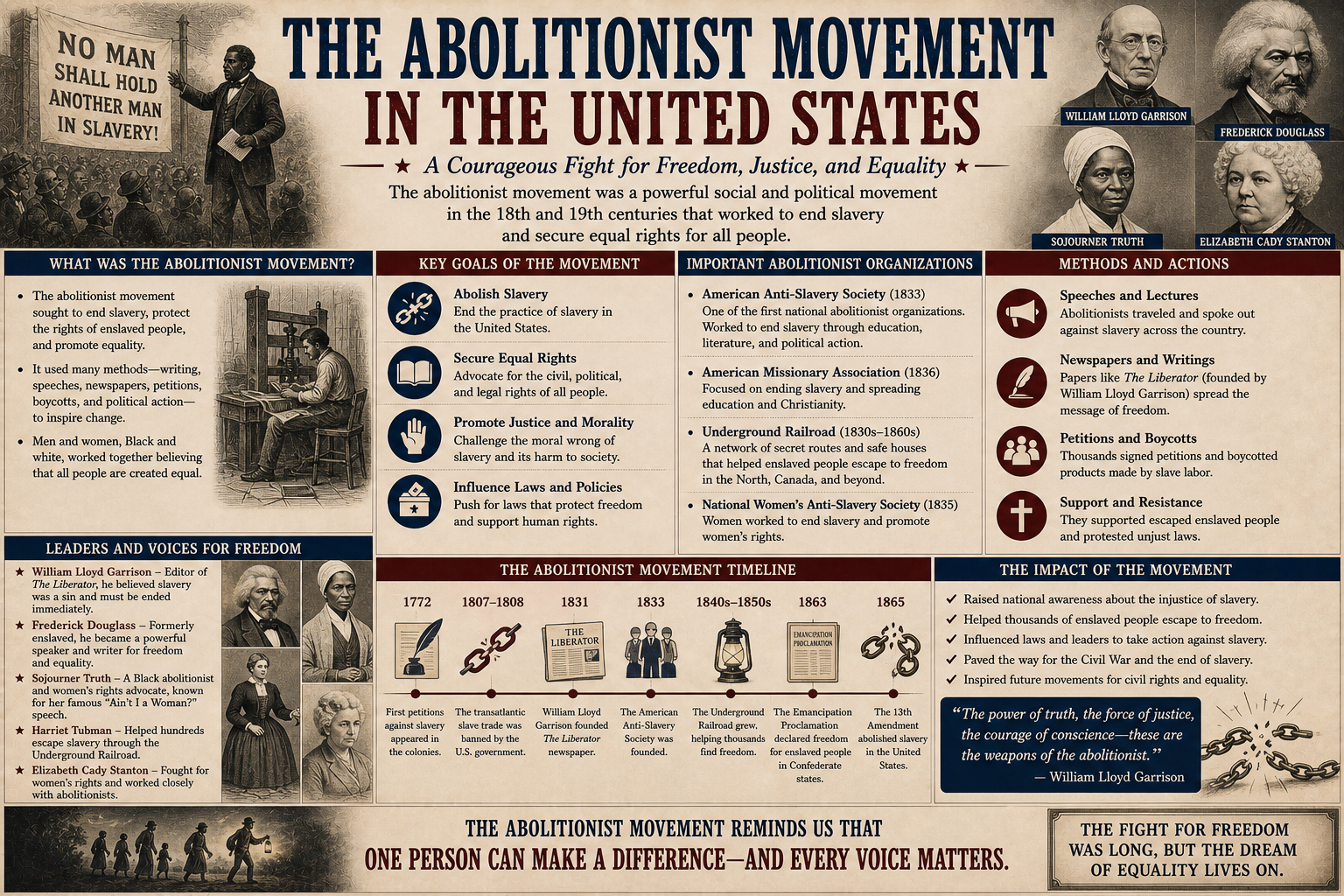
The abolitionist movement was one of the most important reform movements in nineteenth-century American history. Abolitionists were people who wanted to end slavery in the United States. They came from different backgrounds and used different methods, including newspapers, speeches, books, petitions, political campaigns, religious activism, and direct assistance to people escaping slavery.
The movement did not end slavery by itself, but it helped change public opinion and made slavery one of the country’s most important political and moral issues. By the time the Civil War began in 1861, abolitionists had played a major role in challenging the institution and exposing its human cost.
What Did Abolitionists Believe?
Abolitionists generally believed that slavery was morally wrong and should be ended.
This position was more radical than simply opposing the expansion of slavery into new territories. Some politicians, including many early Republicans, wanted to prevent slavery from spreading without necessarily demanding its immediate abolition everywhere.
Abolitionists went further.
They argued that enslaved people should be free and that slavery itself was an injustice that could not be accepted.
Many abolitionists based their arguments on religious beliefs. They believed that all people were created by God and therefore could not rightfully be owned by another person.
Others opposed slavery because they believed it violated basic principles of human rights and American ideals of liberty.
Early Opposition to Slavery
Opposition to slavery existed in America long before the organized abolitionist movement of the nineteenth century.
Some religious groups, particularly Quakers, had criticized slavery for decades.
Free Black communities also played an important role in opposing slavery.
Black Americans wrote petitions, published newspapers, organized meetings, established schools, and helped freedom seekers.
Their activism was essential because they brought firsthand knowledge of slavery and racial discrimination into the public debate.
William Lloyd Garrison
One of the most famous white abolitionists was William Lloyd Garrison.
In 1831, Garrison founded The Liberator, an antislavery newspaper published in Boston.
Garrison used the newspaper to demand the immediate abolition of slavery.
He was often outspoken and uncompromising.
Garrison believed slavery was so fundamentally wrong that Americans should not simply wait for gradual political change.
He wanted the institution destroyed.
The Liberator became an important voice for the abolitionist movement and remained in publication until slavery was abolished after the Civil War.
Frederick Douglass
Frederick Douglass became one of the movement’s most powerful voices.
Born into slavery in Maryland, Douglass escaped in 1838.
After gaining his freedom, he became a writer and public speaker.
His firsthand experience gave his arguments extraordinary power.
In 1845, he published Narrative of the Life of Frederick Douglass, an American Slave.
The book described his experiences under slavery and helped readers understand the cruelty of the system.
Douglass later founded his own newspaper, The North Star, and became an important political activist.
He also supported women’s rights and other reform movements.
Harriet Tubman and Direct Action
Harriet Tubman represented another side of the struggle against slavery.
After escaping slavery herself, Tubman repeatedly returned to the South to help other enslaved people escape.
She became one of the best-known figures associated with the Underground Railroad.
Unlike abolitionists who primarily used speeches and newspapers, Tubman took direct action.
Her work was extremely dangerous.
She risked capture, imprisonment, and death every time she returned to slaveholding territory.
Her efforts demonstrated that resistance to slavery could take many forms.
The Underground Railroad
The Underground Railroad was a loose network of people who helped enslaved people escape toward free states and Canada.
It was not an actual railroad.
The term described a system of secret routes, safe houses, churches, farms, and individuals who provided assistance.
Free Black Americans played an especially important role.
People provided food, clothing, transportation, shelter, information, and other forms of support.
The network became increasingly important after Congress passed the Fugitive Slave Act of 1850.
The Fugitive Slave Act of 1850
The Fugitive Slave Act was designed to help slaveholders recover enslaved people who had escaped.
It required federal authorities to assist in the process and imposed penalties on people who helped freedom seekers.
The law created anger in many Northern communities.
Some people who had previously paid little attention to slavery became more involved in opposition after seeing federal authorities attempt to return escaped people to slavery.
Abolitionists strongly opposed the law.
They argued that the federal government was forcing citizens to participate in an unjust system.
Abolitionist Newspapers and Books
Print media was one of the movement’s most powerful tools.
Abolitionists published newspapers, pamphlets, books, and speeches.
These publications described the realities of slavery and challenged arguments used by its defenders.
Newspapers such as The Liberator and The North Star gave abolitionists a way to reach readers across the country.
Formerly enslaved people also published narratives describing their experiences.
These firsthand accounts became important sources of information about slavery.
They helped challenge claims that enslaved people were happy with their condition.
Women in the Abolitionist Movement
Women played an important role in abolitionism.
Women organized antislavery societies, raised money, circulated petitions, wrote articles, and attended public meetings.
Figures such as Lucretia Mott and the Grimké sisters became prominent reformers.
Angelina and Sarah Grimké were born into a wealthy slaveholding family in South Carolina but eventually became outspoken opponents of slavery.
Their activism also connected abolitionism with the emerging women’s rights movement.
Women discovered that campaigning against slavery gave them opportunities to speak publicly and participate in political activism, despite restrictions placed on women at the time.
Religious Opposition to Slavery
Religion was another important part of abolitionism.
Many evangelical Christians argued that slavery contradicted Christian teachings.
They believed that every human being had moral value and should not be treated as property.
Religious abolitionists organized meetings, distributed literature, and encouraged people to oppose slavery.
However, American Christianity was deeply divided over slavery.
Some religious leaders defended slavery or argued that the Bible permitted it.
This disagreement contributed to divisions within major American churches during the decades before the Civil War.
Political Abolitionism
Not all abolitionists agreed about politics.
Some, including Garrison, became skeptical of traditional political institutions and believed the Constitution protected slavery too strongly.
Others believed political action was necessary.
The Liberty Party was formed in the 1840s to promote abolition through electoral politics.
Later, many antislavery activists supported the Free Soil movement and eventually the Republican Party.
These groups did not always demand immediate abolition, but they opposed the expansion of slavery into western territories.
John Brown
John Brown took a much more militant approach.
Brown was a radical abolitionist who believed slavery could not be destroyed through words alone.
He participated in the violence of Bleeding Kansas and later organized the raid on the federal arsenal at Harpers Ferry, Virginia, in 1859.
Brown hoped to seize weapons and encourage an uprising among enslaved people.
The raid failed.
Brown was captured, tried, and executed.
His actions divided public opinion.
Many Southerners saw him as a dangerous terrorist who wanted to destroy their society.
Some Northerners, while not supporting his violence, admired his willingness to sacrifice himself for the cause of ending slavery.
His execution made him a powerful symbol within parts of the abolitionist movement.
Opposition to Abolitionists
Abolitionists faced serious opposition.
They were sometimes attacked by angry crowds.
Their newspapers were destroyed.
Some were threatened or physically assaulted.
In Congress, Representative Preston Brooks famously attacked Senator Charles Sumner with a cane after Sumner delivered an antislavery speech.
Abolitionists were also criticized by people who believed that attacking slavery would destroy national unity.
Southern leaders strongly opposed the movement because they viewed abolitionism as a threat to slavery and Southern society.
Abolitionism and the Coming of the Civil War
The abolitionist movement did not directly cause the Civil War.
The war had many causes, particularly the long-running conflict over slavery, its expansion, political power, and the relationship between the states and the federal government.
However, abolitionists helped make slavery a major national issue.
Their speeches, newspapers, books, and activism forced Americans to confront the human consequences of slavery.
As the movement became more influential, Southern leaders became increasingly concerned about antislavery politics in the North.
The election of Abraham Lincoln in 1860 intensified those fears.
Lincoln opposed the expansion of slavery, although his position was different from that of immediate abolitionists.
Southern states began seceding after his election.
Abolition During the Civil War
When the Civil War began, abolitionists continued pushing the federal government toward emancipation.
Frederick Douglass was particularly active.
He encouraged African American men to join the Union Army and argued that military service could help secure both freedom and citizenship.
In 1863, President Lincoln issued the Emancipation Proclamation.
It declared enslaved people in areas under rebellion to be free, subject to its terms.
The proclamation did not immediately end slavery throughout the country, but it transformed the purpose and meaning of the war.
Eventually, the Thirteenth Amendment abolished slavery throughout the United States in 1865.
The Legacy of the Abolitionist Movement
The abolitionist movement left a lasting impact on American history.
Abolitionists helped change the way many Americans thought about slavery.
They gave enslaved and formerly enslaved people platforms to tell their own stories.
They challenged laws that protected slavery.
They organized communities and created networks of resistance.
They also helped connect the struggle against slavery with broader questions about citizenship, equality, women’s rights, and human freedom.
The movement was not united in every belief or strategy.
Some abolitionists wanted immediate political action.
Others rejected traditional politics.
Some supported nonviolence, while others believed violence could be justified against slavery.
Despite these differences, they shared a fundamental belief that slavery should not continue.
Final Thoughts
The abolitionist movement was a major force in the struggle against slavery in the United States.
It included famous figures such as Frederick Douglass, Harriet Tubman, William Lloyd Garrison, and John Brown, but it also depended on thousands of lesser-known people who organized meetings, published newspapers, sheltered freedom seekers, raised money, and challenged slavery in their communities.
Abolitionists faced intense opposition and sometimes great personal danger.
Their efforts did not end slavery on their own, but they helped make slavery impossible to ignore.
By exposing its violence and challenging its moral and political foundations, abolitionists contributed to the growing national crisis over slavery.
The Civil War eventually brought the destruction of slavery, and the Thirteenth Amendment made abolition permanent in the Constitution.
The history of abolitionism therefore reminds us that major social change often develops through the combined efforts of many people.
Some use their voices, others use their writing, some organize communities, and others take direct action.
Together, these efforts helped transform the debate over slavery and contributed to one of the most important changes in American history: the legal end of slavery in the United States.
Leave a Reply