
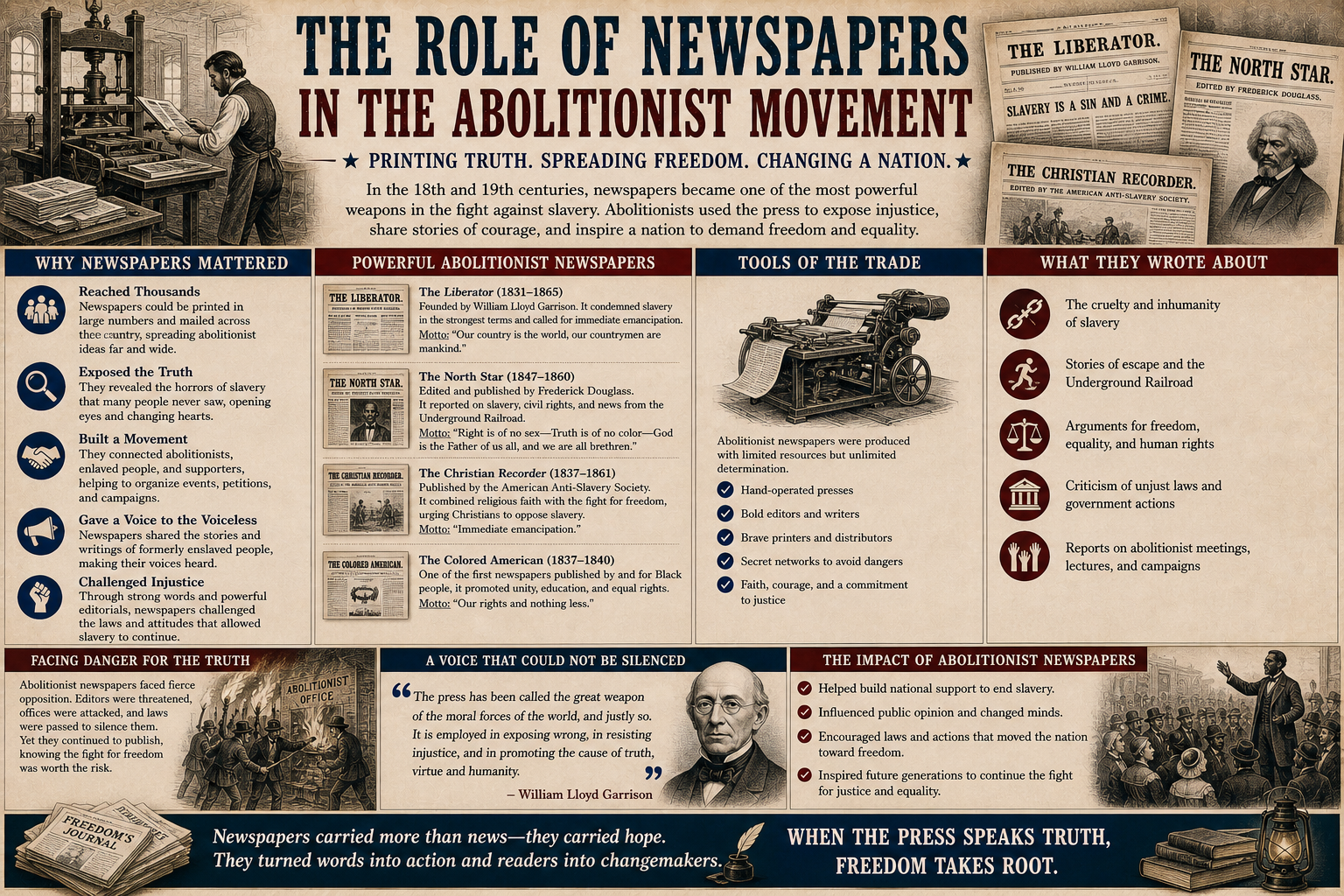
Before television, radio, and the internet, newspapers were among the most powerful ways to spread information in the United States. During the nineteenth century, newspapers played an important role in shaping public opinion and influencing political debates.
This was especially true during the abolitionist movement, the campaign to end slavery in the United States.
Abolitionist newspapers gave activists a way to speak directly to the public. They published stories about slavery, criticized laws that protected slaveholders, shared the experiences of formerly enslaved people, and encouraged readers to support the fight against slavery.
Newspapers did not end slavery by themselves, but they helped turn slavery into a national moral and political issue.
The Growth of Newspapers in the 1800s
Newspapers became increasingly common in the United States during the nineteenth century.
Printing technology improved, transportation became faster, and literacy increased. Newspapers could therefore reach larger audiences than ever before.
Different newspapers represented different political, religious, and social viewpoints.
Some supported slavery or defended Southern interests.
Others opposed slavery.
This created an intense battle over public opinion.
For abolitionists, newspapers were particularly valuable because they could communicate their ideas to people who might never attend an abolitionist meeting or hear an antislavery speaker.
William Lloyd Garrison and The Liberator
One of the most important abolitionist newspapers was The Liberator, founded by William Lloyd Garrison in Boston in 1831.
Garrison used the newspaper to demand the immediate abolition of slavery.
His approach was considered radical at the time.
Rather than supporting gradual emancipation, Garrison argued that slavery should end immediately.
Through The Liberator, he criticized slaveholders, politicians, religious leaders, and institutions that supported or tolerated slavery.
The newspaper became one of the best-known voices of the abolitionist movement.
Although its circulation was relatively small compared with some mainstream newspapers, its influence was much larger than its readership numbers might suggest.
Its articles were discussed, reprinted, and debated throughout the country.
Giving Abolitionists a Public Voice
Newspapers gave abolitionists something they desperately needed: a regular platform.
An abolitionist could give a speech to a crowd, but a newspaper could continue communicating after the meeting ended.
Readers could receive arguments and information directly in their homes.
Newspapers also allowed activists to respond to events quickly.
When Congress passed controversial legislation, when violence occurred, or when an escaped enslaved person told their story, abolitionist editors could publish their reactions.
This helped create a continuing national conversation about slavery.
Sharing the Stories of Enslaved People
One of the most powerful uses of abolitionist newspapers was sharing firsthand accounts of slavery.
Abolitionists wanted readers to understand that slavery was not simply a political or economic system.
It affected real human beings.
Newspapers published accounts describing forced labor, family separation, physical punishment, and attempts to escape.
Stories from formerly enslaved people were especially powerful because they challenged claims that enslaved people were satisfied with their condition.
These personal stories helped put a human face on the slavery debate.
Frederick Douglass and The North Star
Frederick Douglass became one of the most important Black newspaper publishers of the nineteenth century.
In 1847, he founded The North Star in Rochester, New York.
The newspaper was named after the North Star, which had long been associated with freedom and guidance for people escaping slavery.
Douglass used the paper to discuss slavery, racial discrimination, education, politics, and human rights.
As a formerly enslaved person, Douglass brought a perspective that was extremely important to the abolitionist movement.
He did not simply write about slavery from a distance.
He had experienced it himself.
His writing challenged racist arguments and demonstrated the intellectual abilities of African Americans.
Newspapers and the Underground Railroad
Newspapers also helped create awareness of the Underground Railroad.
The Underground Railroad was a loose network of people who helped enslaved people escape toward free states and Canada.
Because the work was dangerous, participants had to be careful about revealing specific information.
Abolitionist newspapers could discuss the broader issue of escape without necessarily publishing details that would expose individual freedom seekers.
They also reported cases involving escaped enslaved people and criticized efforts to capture and return them.
This helped build opposition to the laws that supported slaveholders’ claims.
The Fugitive Slave Act of 1850
The Fugitive Slave Act of 1850 became a major subject for abolitionist newspapers.
The law strengthened the federal government’s role in helping slaveholders recover escaped enslaved people.
It also punished people who assisted freedom seekers.
Abolitionist newspapers strongly criticized the law.
They argued that it forced Northern communities to participate in slavery by requiring them to help return people to bondage.
Newspapers reported on individual cases in which alleged fugitives were captured.
These stories often generated anger among Northern readers.
As a result, the Fugitive Slave Act became an important issue in the growing sectional conflict.
Reaching People Outside the Abolitionist Movement
Abolitionist newspapers were not only read by committed abolitionists.
Copies could be passed from one person to another.
Articles could be reprinted in other newspapers.
Speeches and editorials could circulate beyond the original publication.
This meant that an idea printed in Boston or Rochester could eventually be read in communities hundreds of miles away.
The printed word therefore helped abolitionists reach people who might otherwise never encounter their arguments.
Newspapers as Political Weapons
Newspapers were also important because they could influence political debates.
Abolitionist editors criticized politicians who supported slavery and praised politicians who opposed its expansion.
They discussed elections, legislation, court decisions, and political speeches.
As the country became more divided over slavery, newspapers helped voters understand where political candidates stood.
The rise of the Republican Party in the 1850s also created a new political environment.
Although Republicans were not identical to abolitionists, many Republican newspapers opposed the expansion of slavery into western territories.
The press therefore helped make slavery one of the central political issues of the era.
Reporting Events That Increased Tensions
Several major events were widely discussed in newspapers.
The violence of Bleeding Kansas attracted national attention.
The 1857 Dred Scott decision generated intense debate.
John Brown’s raid on Harpers Ferry in 1859 became a major national story.
The election of Abraham Lincoln in 1860 produced even more newspaper coverage.
Each event contributed to the growing disagreement between North and South.
Newspapers did not simply report these events.
They often interpreted them according to their political beliefs.
A Northern abolitionist newspaper might describe an event very differently from a Southern newspaper defending slavery.
This helped create competing versions of reality among different sections of the country.
The Dangers Faced by Abolitionist Publishers
Publishing antislavery material was not always safe.
Abolitionist newspapers faced threats, harassment, and destruction.
Garrison’s office was attacked by an angry mob in Boston in 1835.
Other abolitionist publications also faced opposition.
Publishers could be threatened because their work challenged powerful political and economic interests.
The danger demonstrated how controversial abolitionism had become.
Despite these risks, abolitionist editors continued publishing.
Black Newspapers and African American Leadership
Black newspapers were particularly important because they provided African Americans with a platform to speak for themselves.
Black editors discussed slavery, racism, education, voting rights, and community development.
They challenged the idea that African Americans were incapable of participating in intellectual and political life.
Newspapers such as The North Star helped establish African American journalism as an important part of the struggle for freedom and equality.
These publications did not simply depend on white abolitionists to tell Black people’s stories.
They allowed African American writers and activists to control their own message.
The Limitations of Abolitionist Newspapers
Although newspapers were powerful, they had limitations.
Not everyone could read.
Many newspapers had relatively small circulations.
People who strongly supported slavery often refused to read or believe abolitionist publications.
Southern communities could also restrict the distribution of antislavery literature.
In some places, abolitionist mail was intercepted or destroyed.
Therefore, newspapers alone could not change the entire country.
They were one part of a much larger abolitionist movement that included speeches, books, churches, petitions, political campaigns, and direct resistance to slavery.
Newspapers and the Coming of the Civil War
By the 1850s, newspapers had become deeply involved in the national argument over slavery.
They reported political debates, court decisions, violent confrontations, and stories of resistance.
This helped Americans understand how serious the conflict had become.
At the same time, newspapers could also increase division.
Because publications often presented events from strongly partisan perspectives, Northern and Southern readers sometimes received very different interpretations of the same event.
This contributed to the growing sectional divide.
The Role of Newspapers During the Civil War
When the Civil War began in 1861, newspapers became even more important.
They reported battles, political developments, military victories, and defeats.
Abolitionist publications continued pushing the Union government toward emancipation.
Frederick Douglass, in particular, continued using his writing and speeches to pressure the government to make freedom a central objective of the war.
The Emancipation Proclamation of 1863 became a major subject of public discussion.
Eventually, the Thirteenth Amendment abolished slavery throughout the United States in 1865.
The Lasting Impact
The abolitionist press left an important legacy.
It demonstrated how journalism could challenge powerful institutions and influence public opinion.
Abolitionist newspapers helped expose the realities of slavery, amplify the voices of formerly enslaved people, and encourage political activism.
They also helped develop African American journalism and created a tradition of using the press to fight racial injustice.
Their influence extended beyond the abolition of slavery.
The same tradition of activist journalism continued during later struggles for civil rights and equality.
Final Thoughts
Newspapers played a crucial role in the abolitionist movement.
Publications such as The Liberator and The North Star gave abolitionists platforms from which they could challenge slavery and communicate with readers across the United States.
They published firsthand accounts, criticized pro-slavery laws, reported important political events, and encouraged people to question the morality and legality of slavery.
Frederick Douglass demonstrated how powerful the press could be when people who had experienced slavery told their own stories.
Abolitionist newspapers faced threats, censorship, and violence, but many continued publishing despite the risks.
They did not end slavery by themselves.
The abolition of slavery resulted from a much larger struggle involving enslaved people’s resistance, abolitionist activism, political conflict, the Civil War, emancipation, and constitutional change.
However, newspapers helped shape the public debate that surrounded these events.
They turned private experiences into public conversations and gave the antislavery movement a powerful way to reach people.
In an age before television, radio, or the internet, the printed newspaper was one of the most effective tools for spreading ideas.
For abolitionists, it became a powerful instrument for exposing injustice, challenging slavery, and arguing for a different future for the United States.
Leave a Reply