
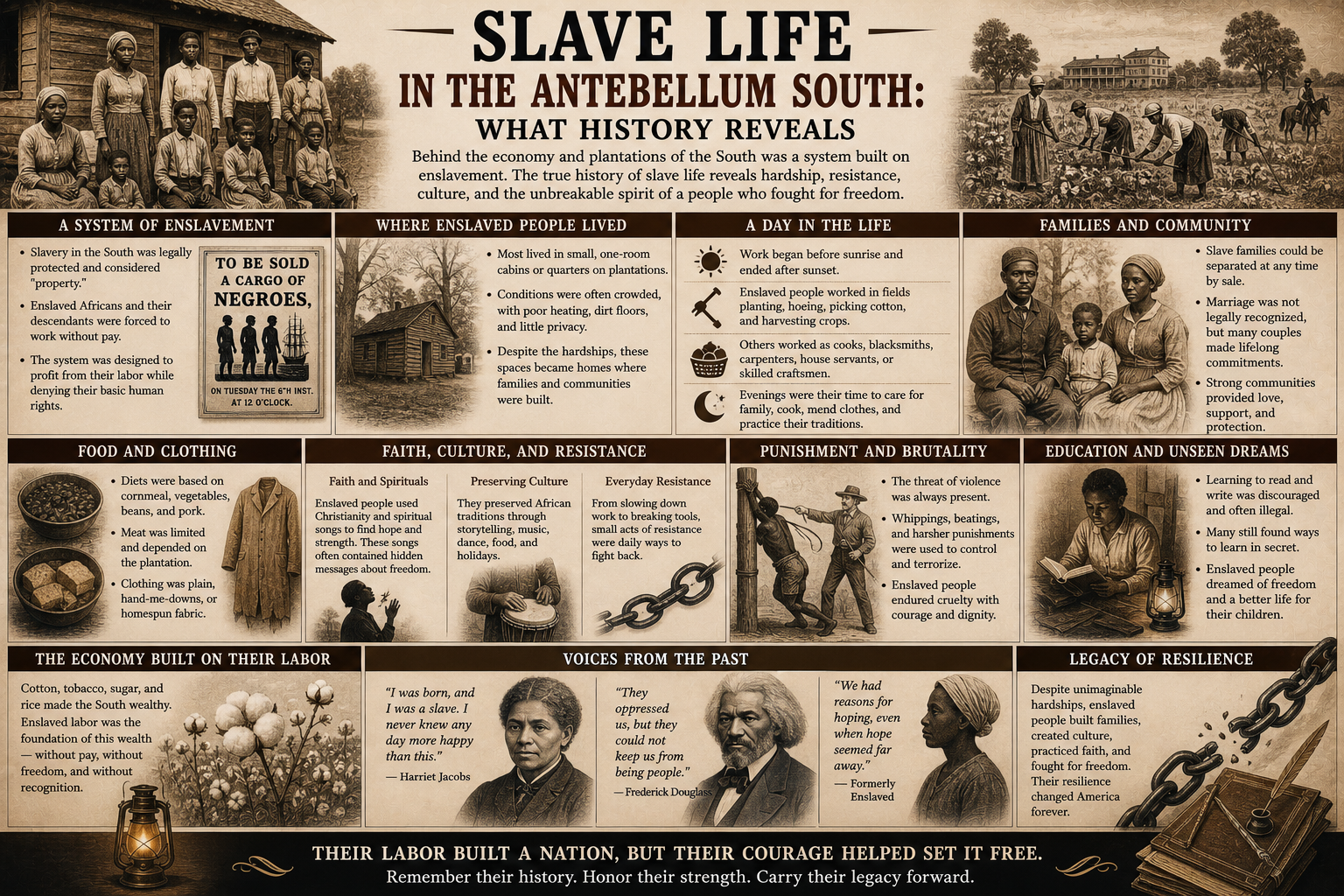
The history of slavery in the American South is an essential part of understanding the United States before the Civil War. For generations, millions of African Americans were held in slavery and forced to work without freedom or control over their own lives.
The word “antebellum” simply means “before the war.” In American history, the antebellum South generally refers to the Southern states during the decades before the Civil War, particularly the period from the early 1800s to 1861.
Life under slavery was different from person to person and from plantation to plantation, but one fact remained constant: enslaved people were legally treated as property and were denied basic freedoms. At the same time, enslaved people built families, communities, religious traditions, and forms of resistance despite the restrictions placed upon them.
Looking at their daily lives helps us understand slavery not simply as an economic system, but as a human experience.
Slavery as a System
Slavery was deeply connected to the Southern economy.
By the nineteenth century, cotton had become one of the region’s most important cash crops. The invention of the cotton gin had made processing cotton much faster, contributing to the expansion of cotton production.
As cotton farming expanded, so did the demand for enslaved labor.
Enslaved people worked on plantations, small farms, in cities, workshops, mines, households, and many other workplaces.
They performed agricultural labor, domestic work, skilled trades, construction, transportation, and other forms of work.
Although popular images of slavery often focus on large plantations, many enslaved people lived and worked on smaller farms.
Forced Labor
Work was one of the defining features of enslaved life.
On plantations, enslaved workers often began working early in the morning and continued until evening.
Agricultural labor could be physically exhausting.
Workers planted, cultivated, and harvested crops under difficult conditions.
During harvest seasons, working hours could become particularly long.
Enslaved people had little control over their work schedules.
They could not simply leave a job or negotiate employment in the way free workers could.
Enslavers controlled where enslaved people worked and could punish them for failing to meet expectations.
Physical Punishment
Physical punishment was an important tool used to maintain control over enslaved people.
Enslavers and overseers could use whipping, confinement, deprivation, and other forms of punishment.
The severity varied, but the threat of violence was always present.
Punishment was not only intended to hurt an individual.
It also served as a warning to others.
The possibility of being punished or sold created fear and helped enforce the system.
Family Life
Family was extremely important to enslaved people.
However, slavery made family life extremely difficult.
Enslaved people could be sold at almost any time.
Parents could be separated from children.
Husbands and wives could be sold to different owners.
Brothers and sisters could also be separated.
This constant threat created enormous emotional suffering.
Despite these conditions, enslaved people worked hard to maintain family relationships.
They cared for children, supported relatives, and created extended family networks.
Family became an important source of emotional strength.
Marriage Under Slavery
Enslaved people formed marriages and long-term relationships despite the fact that the law generally did not give enslaved marriages the same legal protection as marriages between free people.
Couples built families and communities together.
However, they lived with the possibility that an enslaver could sell one partner.
Some couples were separated by forced sales and had little or no ability to reunite.
The survival of family relationships under these circumstances demonstrates the determination of enslaved people to create meaningful lives despite the system controlling them.
Housing and Living Conditions
Housing conditions varied.
Many enslaved families lived in small cabins or other simple structures provided by enslavers.
These homes were often crowded and lacked basic comforts.
Food quality and quantity also varied depending on the location and the enslaver.
Some enslaved people were given basic food rations, while others grew vegetables, raised small animals, hunted, or fished to supplement what they received.
These differences should not hide the larger reality: enslaved people had very limited control over the resources available to them.
Clothing
Enslaved people were generally provided with basic clothing, although the amount and quality varied.
Clothing was often simple and designed primarily for work.
Some enslaved people made or repaired their own clothing.
Women frequently played important roles in sewing and maintaining garments for their families.
Clothing was another area where enslaved people used their own skills and creativity to make difficult conditions more manageable.
Religion and Spiritual Life
Religion became an important source of strength for many enslaved people.
Christianity was widely practiced among enslaved African Americans, although their religious traditions often differed from those promoted by white slaveholders.
Enslaved people sometimes gathered for worship in secret or semi-private meetings.
Songs, prayers, and biblical stories provided ways to express hope and community.
Stories about freedom in the Bible, especially the story of the Israelites escaping bondage, had particular meaning.
Religious gatherings could also provide opportunities for enslaved people to meet with others outside their immediate households.
Education and Literacy
Enslaved people were often denied access to formal education.
In many Southern states, laws restricted or prohibited teaching enslaved people to read and write.
Slaveholders feared that literacy could encourage resistance or make it easier for enslaved people to communicate.
Despite these restrictions, some enslaved people secretly learned to read and write.
They sometimes learned from sympathetic white people, other enslaved people, or through self-education.
Frederick Douglass famously learned to read while enslaved in Baltimore.
Education became a form of resistance because it allowed enslaved people to access information and ideas about freedom.
Resistance to Slavery
Enslaved people resisted slavery in many ways.
Resistance did not always involve running away or violence.
Some people deliberately slowed their work.
Others damaged tools, secretly learned to read, pretended to be ill, resisted orders, or secretly preserved cultural traditions.
Some escaped temporarily or permanently.
Others participated in organized resistance.
These actions demonstrated that enslaved people were not passive.
They continually looked for ways to protect themselves, their families, and their independence.
Escape and the Underground Railroad
Some enslaved people attempted to escape to free states or Canada.
The Underground Railroad helped many freedom seekers move through networks of trusted people and safe locations.
Harriet Tubman became one of the most famous conductors associated with the Underground Railroad.
After escaping slavery herself, she repeatedly returned to the South to help others reach freedom.
Escape was extremely dangerous.
People could be captured and returned to slavery, while those who helped them could face serious punishment.
The Fugitive Slave Act of 1850 increased these dangers by strengthening federal efforts to return escaped enslaved people.
Skilled Workers and Urban Slavery
Not all enslaved people worked in agriculture.
Many lived in towns and cities.
They worked as carpenters, blacksmiths, cooks, seamstresses, drivers, construction workers, domestic servants, and craftsmen.
Some enslaved workers were highly skilled.
In certain situations, enslaved people were allowed to hire themselves out and keep part of their earnings, although the arrangement still existed within a system in which they were legally enslaved.
Urban slavery could therefore look different from plantation slavery, but enslaved people still lacked fundamental freedom.
The Domestic Slave Trade
One of the most painful aspects of slavery was the internal slave trade.
As cotton production expanded into the Deep South, enslaved people were transported from older slave states to places such as Alabama, Mississippi, Louisiana, and Texas.
Families were often separated during these sales.
People could be sold at auctions or through private transactions.
The domestic slave trade created enormous fear because an enslaved person could be separated from loved ones with little warning.
This constant threat affected nearly every aspect of family and community life.
The Psychological Impact of Slavery
Slavery affected more than physical conditions.
It also created psychological pressure.
Enslaved people lived under a system in which another person could legally claim control over their labor, movement, family relationships, and future.
The fear of sale or punishment could never be completely removed.
Yet enslaved people also found ways to maintain dignity and identity.
Family relationships, religion, music, storytelling, food traditions, crafts, and community relationships helped preserve cultural connections.
These traditions became important parts of African American culture.
The Importance of Firsthand Accounts
Much of what historians know about enslaved life comes from firsthand accounts.
Formerly enslaved people such as Frederick Douglass, Harriet Jacobs, and many others described their experiences in autobiographies and interviews.
These accounts provide valuable evidence about daily life, family separation, work, punishment, resistance, and the search for freedom.
The Federal Writers’ Project interviews conducted during the 1930s also recorded memories from many formerly enslaved people.
Historians compare these sources with plantation records, newspapers, court documents, letters, advertisements, and other evidence to develop a fuller understanding of slavery.
Slavery and the Coming of the Civil War
By the 1850s, slavery had become the central issue dividing American politics.
Southern leaders increasingly defended slavery as essential to their economy and society.
Many Northern Americans opposed its expansion into western territories.
Events such as the Fugitive Slave Act, Bleeding Kansas, the Dred Scott decision, and John Brown’s raid increased tensions.
The election of Abraham Lincoln in 1860 was followed by the secession of Southern states.
The political crisis eventually became the Civil War.
The End of Slavery
The Civil War transformed the situation.
President Abraham Lincoln issued the Emancipation Proclamation in 1863, declaring enslaved people in areas under rebellion to be free, subject to its terms.
Thousands of African Americans also joined the Union military and contributed to the fight against the Confederacy.
In 1865, the Thirteenth Amendment abolished slavery throughout the United States.
After generations of enslavement, millions of African Americans were legally free.
Freedom, however, did not immediately create equality.
Formerly enslaved people faced enormous challenges during Reconstruction and beyond.
Final Thoughts
Life for enslaved people in the antebellum South cannot be reduced to a single experience.
Conditions varied depending on location, occupation, enslaver, and many other circumstances.
But slavery itself imposed a fundamental lack of freedom.
Enslaved people could be forced to work, physically punished, denied education, separated from family members, and sold against their will.
At the same time, they created families, maintained communities, practiced religion, developed skills, preserved traditions, and resisted slavery in countless ways.
Their lives reveal both the cruelty of the institution and the remarkable determination of people living under it.
Studying slave life is important because it puts the history of the Civil War into human terms.
The conflict was not simply about political parties, states, or constitutional arguments.
At its center was a system that controlled the lives of millions of people.
Understanding their experiences helps explain why slavery became such a powerful source of conflict and why its abolition became one of the most significant consequences of the Civil War.
The history of enslaved people is therefore not only a history of suffering.
It is also a history of family, courage, resistance, survival, and the continuing pursuit of freedom.
Leave a Reply