
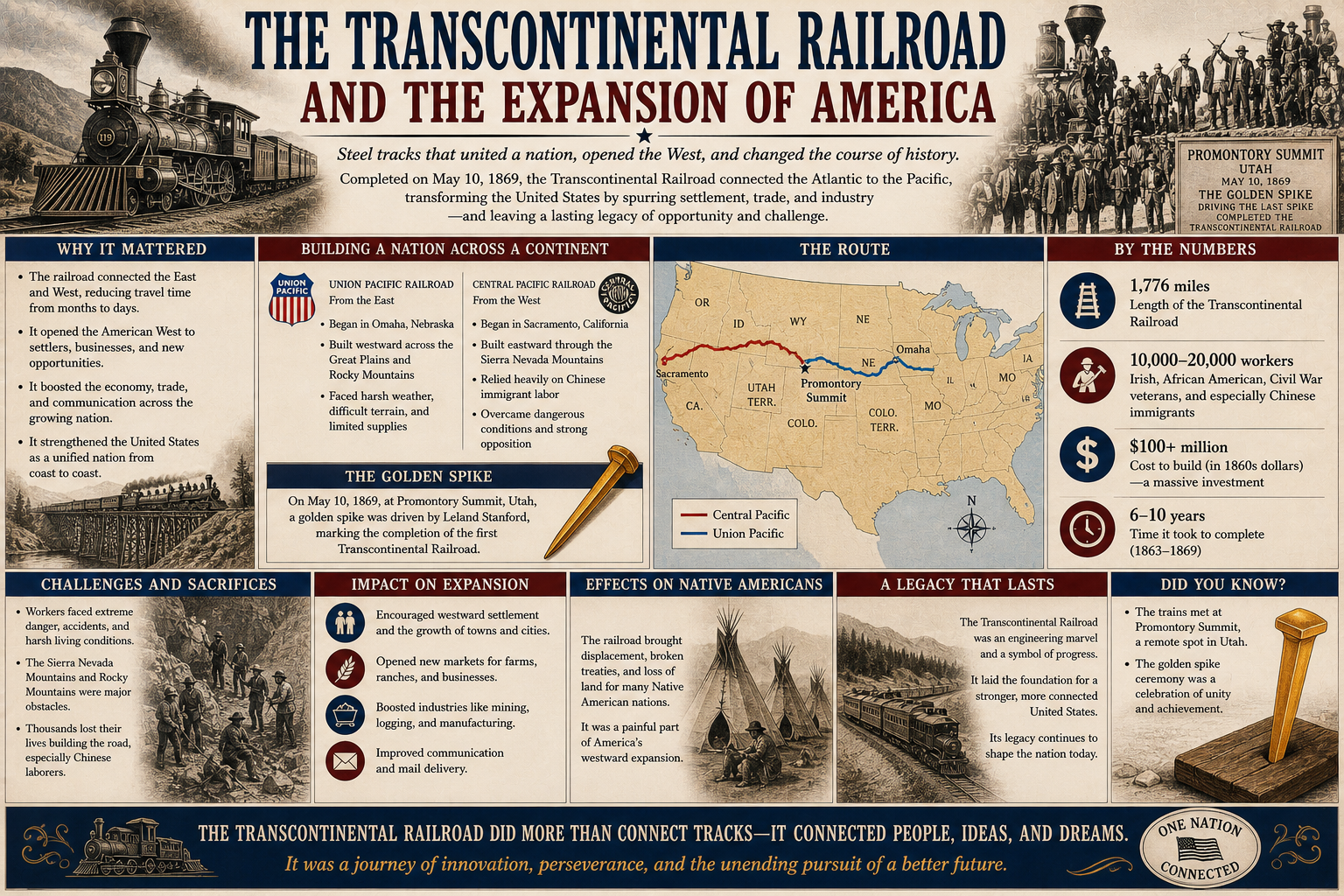
The Transcontinental Railroad was one of the most important transportation projects in American history. Completed in 1869, it connected the eastern United States with the Pacific Coast and dramatically changed the way people, goods, and information moved across the country.
Before the railroad was completed, traveling from the East Coast to California could take weeks or even months. People had to travel by wagon, ship, stagecoach, or a combination of different methods. The railroad made the journey much faster and helped connect distant regions of the growing nation.
However, the story of the Transcontinental Railroad is more complicated than a simple story of progress. Its construction depended heavily on the labor of Chinese immigrants and other workers, while the expansion of railroads contributed to the displacement of Native American communities and the transformation of the American West.
What Was the Transcontinental Railroad?
The Transcontinental Railroad was a railway system that connected the existing railroad networks of the eastern United States with the Pacific Coast.
Construction was led primarily by two companies.
The Central Pacific Railroad built eastward from Sacramento, California.
The Union Pacific Railroad built westward from Omaha, Nebraska.
The two railroads eventually met at Promontory Summit in Utah Territory.
On May 10, 1869, officials and workers celebrated the completion of the connection.
The event became a major symbol of American expansion and technological achievement.
Why Was a Transcontinental Railroad Needed?
The United States was expanding rapidly during the nineteenth century.
After the Louisiana Purchase, the acquisition of additional western territories, and the incorporation of California and other western lands, the country stretched across a huge area.
California became especially important after the Gold Rush began in 1848.
Thousands of people traveled west in search of gold and new opportunities.
However, reaching the West remained difficult.
A journey from the eastern states to California could involve crossing mountains, deserts, rivers, and vast areas of unsettled land.
A faster transportation system could make trade and migration much easier.
The railroad offered a possible solution.
Government Support
The federal government played an important role in making the railroad possible.
During the Civil War, Congress passed the Pacific Railway Act of 1862.
The legislation authorized the construction of a transcontinental railroad and provided federal support to the companies involved.
The government offered loans and large amounts of land along proposed railroad routes.
The land grants gave railroad companies valuable property that could later be sold or developed.
Federal support reflected the belief that transportation infrastructure could strengthen the country’s economy and help connect distant regions.
The Union Pacific Railroad
The Union Pacific began construction westward from Omaha.
Its workers faced difficult conditions as they crossed the Great Plains and approached the Rocky Mountains.
Much of the work had to be done by hand.
Workers cleared land, built bridges, laid track, dug through difficult terrain, and constructed tunnels.
The work was physically demanding and sometimes dangerous.
Despite the challenges, construction continued steadily toward the western frontier.
The Central Pacific Railroad
The Central Pacific began construction eastward from Sacramento.
Its greatest early challenge was the Sierra Nevada mountain range.
Building a railroad through the mountains required enormous amounts of labor.
Workers had to cut through rock, construct bridges, and create tunnels.
The Central Pacific eventually became heavily dependent on Chinese immigrant labor.
Chinese Railroad Workers
Chinese immigrants played a crucial role in building the Transcontinental Railroad.
Thousands of Chinese workers were recruited to work for the Central Pacific.
Many came from southern China and were willing to take difficult jobs because economic opportunities in the United States could be attractive compared with conditions they had experienced at home.
They performed some of the most dangerous work on the project.
Workers used explosives to blast tunnels through mountains.
They handled heavy materials and worked in difficult weather.
Accidents and deaths occurred during construction.
Despite their enormous contribution, Chinese workers faced discrimination and were generally paid less than many white workers.
Their role was essential to the completion of the railroad.
Irish and Other Workers
Chinese immigrants were not the only people who built the railroad.
Irish immigrants and other workers played major roles, particularly on the Union Pacific.
Civil War veterans, immigrants, and other laborers also participated.
The railroad was therefore built by a diverse workforce.
However, working conditions were difficult for almost everyone.
Long hours, dangerous equipment, harsh weather, and difficult terrain made railroad construction physically demanding.
Meeting at Promontory Summit
The two railroad companies eventually approached one another.
On May 10, 1869, the Central Pacific and Union Pacific tracks were connected at Promontory Summit in Utah Territory.
A ceremonial golden spike was driven to mark the occasion.
The completion of the railroad became a national celebration.
For the first time, a continuous railroad connection linked the nation’s eastern and western railroad networks.
The symbolic meaning was enormous.
The United States had created a faster transportation connection across the continent.
Travel Became Much Faster
Before the railroad, a cross-country journey could take many weeks or months.
After the railroad was completed, the trip could be made in roughly a week, depending on the route and circumstances.
This transformed travel.
People could move west more easily.
Businesses could transport goods over long distances.
Mail and information could also travel much faster.
The country became more economically connected.
Growth of Western Towns
The railroad contributed to the growth of towns and cities across the West.
Railroad companies established stations and promoted settlement near their routes.
Communities developed around transportation hubs.
Some small settlements became important commercial centers.
Railroads made it easier to transport agricultural products, livestock, timber, and minerals to larger markets.
This helped stimulate economic development throughout the West.
The Railroad and Western Migration
The railroad encouraged migration into western territories.
People looking for farmland, jobs, business opportunities, or a new life could travel west more easily.
Government land policies also encouraged settlement.
The Homestead Act of 1862 offered public land to settlers who met certain requirements.
Together, land policies and railroad development contributed to rapid settlement of the West.
The American population continued moving farther west during the late nineteenth century.
Impact on Native American Communities
The expansion of railroads had devastating consequences for many Native American nations.
Railroad construction crossed lands that Native communities had inhabited and used for generations.
The arrival of settlers, soldiers, hunters, and businesses disrupted traditional ways of life.
Railroads also made it easier for large numbers of settlers to enter the Great Plains and other western regions.
The destruction of buffalo herds was particularly damaging to many Plains Indian societies whose economies and cultures were closely connected to the animal.
As settlement expanded, conflicts between Native nations and the U.S. government intensified.
Military campaigns, forced relocation, reservation policies, and the loss of traditional lands followed.
Therefore, the railroad’s role in American expansion came at a tremendous cost for many Native communities.
The Railroad and the Buffalo
The railroad also contributed to the rapid decline of the American bison.
Buffalo herds had once numbered in the millions.
Railroads made it easier for commercial hunters to reach the Great Plains and transport buffalo hides and other products.
Some railroad companies also encouraged buffalo hunting because large herds could interfere with railroad operations.
The destruction of buffalo weakened an important economic and cultural resource for many Native American communities.
By the late nineteenth century, buffalo populations had fallen dramatically.
Economic Growth
The railroad helped transform the American economy.
Manufactured goods could move west.
Western agricultural products and raw materials could move east.
Factories could reach larger markets.
Farmers could sell crops and livestock to distant customers.
Mining communities could transport minerals to processing centers.
The railroad therefore helped create a more integrated national economy.
The Railroad and Industrialization
The Transcontinental Railroad was part of a larger period of American industrial growth.
Railroads created demand for steel, coal, timber, machinery, and other materials.
They also created jobs in construction, maintenance, transportation, and related industries.
As railroad networks expanded, businesses increasingly operated on a national scale.
The railroad helped connect local economies to a much larger marketplace.
This contributed to the industrial transformation of the United States during the late nineteenth century.
Railroad Companies Become Powerful
Railroad companies eventually became some of the largest and most powerful businesses in America.
Their influence extended beyond transportation.
Railroad executives could influence land development, local economies, and politics.
The enormous government land grants and financial assistance given to railroad companies later became controversial.
Critics accused some railroad companies of corruption and unfair business practices.
These concerns contributed to the rise of movements calling for greater regulation of large corporations.
Effects on Immigration
The railroad also had an important connection to immigration.
Workers from different countries helped build and operate railroads.
Chinese immigrants were particularly important during the construction of the Central Pacific.
However, Chinese immigrants faced increasing discrimination.
The hostility eventually contributed to the passage of the Chinese Exclusion Act of 1882, which severely restricted Chinese immigration.
This demonstrates one of the contradictions of western expansion.
Chinese workers were essential to building the railroad, yet Chinese immigrants later faced laws designed to exclude them.
Communication Changed Too
Railroad expansion also helped improve communication.
Telegraph lines often followed railroad routes.
This meant information could travel quickly alongside trains.
Businesses could coordinate activities across long distances.
Government officials could communicate more efficiently.
Newspapers could receive information faster.
The combination of railroads and telegraph technology made the United States feel increasingly connected.
The Long-Term Legacy
The Transcontinental Railroad permanently changed the geography and economy of the United States.
It helped connect the Atlantic and Pacific regions.
It encouraged migration and settlement.
It supported trade and industrial growth.
It helped develop western towns and cities.
At the same time, it contributed to the displacement of Native American communities and accelerated environmental changes across the West.
Its history therefore contains both achievement and serious human costs.
Final Thoughts
The Transcontinental Railroad was much more than a transportation project.
Completed in 1869, it helped transform the United States into a more connected national economy.
The railroad reduced travel times, encouraged migration, expanded trade, and helped western communities grow.
Thousands of workers built it under difficult and dangerous conditions. Chinese immigrants played a particularly important role in constructing the Central Pacific line through the Sierra Nevada.
But the railroad also had consequences that cannot be ignored.
Its expansion encouraged settlers to move onto Native American lands, contributed to the destruction of buffalo herds, and accelerated conflicts between the U.S. government and Native nations.
The railroad also became a symbol of the opportunities and contradictions of nineteenth-century American expansion.
It represented technological progress and economic opportunity, but that progress was not experienced equally by everyone.
Today, the Transcontinental Railroad remains an important part of American history because it helped reshape how people lived, worked, traveled, and traded across the country.
Its completion marked a major step in connecting the United States from coast to coast—and helped define the rapid expansion of America in the decades after the Civil War.
Leave a Reply