
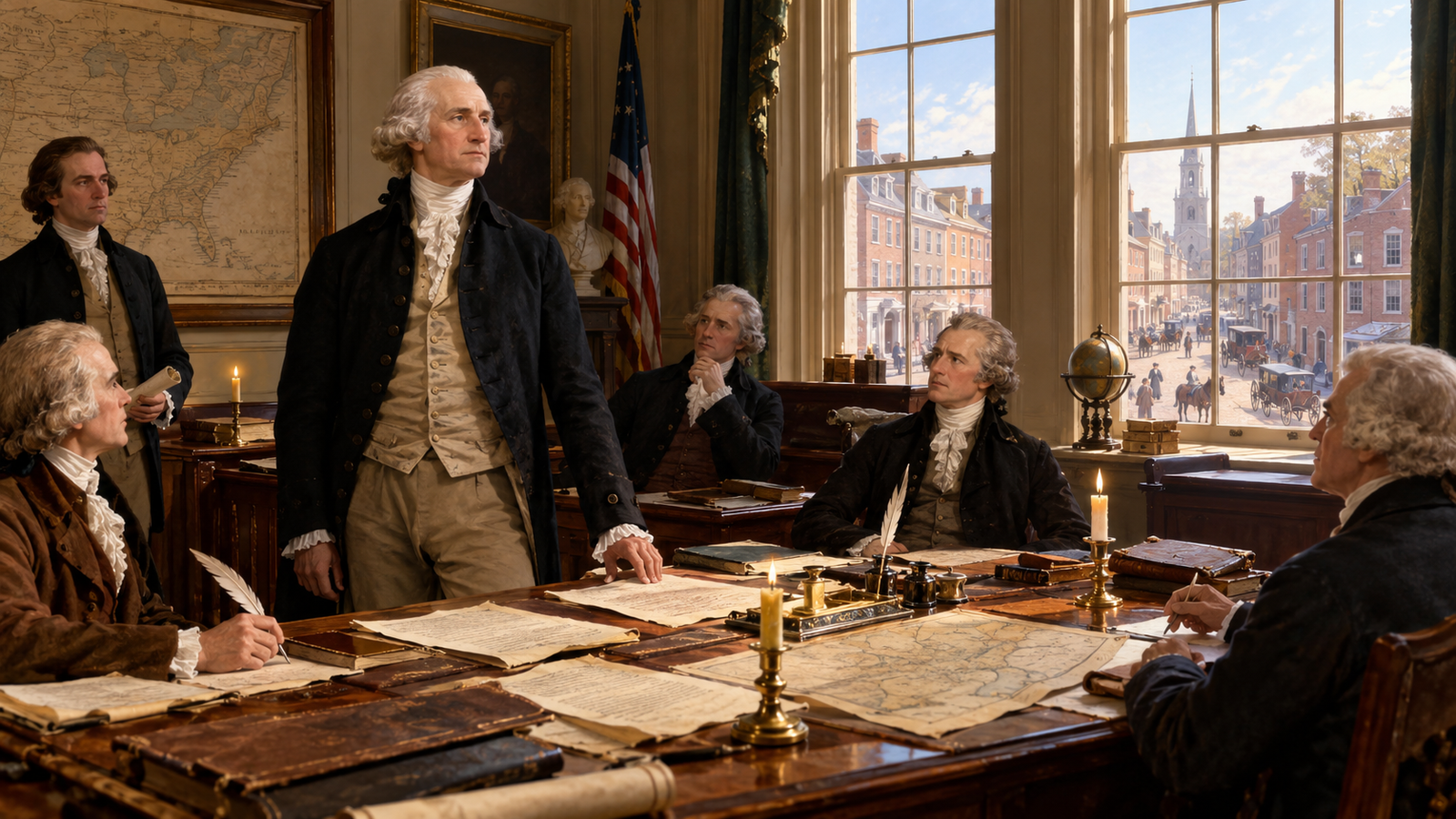
When the United States became independent from Britain, winning the Revolutionary War was only the beginning. The new country had to build a functioning government, establish financial stability, create relationships with foreign nations, and determine how the Constitution would work in practice.
In 1789, George Washington became the first president of the United States. His administration established many traditions and institutions that influenced the country’s government for generations.
However, the early United States faced serious disagreements. Americans differed over the proper size and power of the federal government, economic policy, relations with European countries, and the future of the young republic.
The country’s early leaders therefore had to make decisions without having an established American presidential tradition to follow. Many of the choices made during this period became important precedents for future presidents and governments.
George Washington Becomes the First President
The first presidential election was held in 1788–1789 under the new Constitution.
George Washington was unanimously elected president.
Washington was already one of the most respected figures in the country. He had commanded the Continental Army during the Revolutionary War and had later presided over the Constitutional Convention.
His reputation made him a natural choice to lead the new government.
Washington took the presidential oath of office on April 30, 1789, in New York City.
At the time, the federal government was still being organized. Washington had to create an administration, work with Congress, establish relationships with the courts, and determine how the powers of the presidency should actually be used.
Establishing the Federal Government
The Constitution created the basic structure of the federal government, but many practical details still had to be worked out.
Congress created executive departments to help the president manage national affairs.
The first major departments included the Department of State, Department of the Treasury, and Department of War.
The government also established a federal judiciary.
The Judiciary Act of 1789 created the structure of the federal court system and helped establish the Supreme Court and lower federal courts.
These early decisions helped transform the Constitution from a written document into a functioning government.
The First Cabinet
Washington needed trusted advisers to help him manage the new executive branch.
Two of his most important advisers were Thomas Jefferson and Alexander Hamilton.
Jefferson became secretary of state.
Hamilton became secretary of the treasury.
Henry Knox served as secretary of war, while Edmund Randolph became attorney general.
Washington’s advisers did not always agree.
In fact, disagreements between Hamilton and Jefferson became some of the most important political debates of the early republic.
Alexander Hamilton’s Financial Program
Alexander Hamilton believed the United States needed a strong financial system.
The new nation had significant debts from the Revolutionary War.
Hamilton proposed that the federal government should assume certain state debts and establish a stronger national credit system.
He also supported the creation of a national bank.
The Bank of the United States was established in 1791.
Hamilton believed that a stronger financial system would encourage investment, improve government credit, and help develop the American economy.
His policies were controversial.
Some Americans believed that the federal government did not have constitutional authority to establish a national bank.
Others feared that Hamilton’s economic plans favored wealthy merchants and investors.
The Debate Over Federal Power
Hamilton and Jefferson represented different political ideas.
Hamilton generally supported a stronger national government.
Jefferson preferred a system in which states retained significant authority and believed that agriculture should remain central to the nation’s economy.
Their disagreements reflected a larger debate that would shape American politics.
How powerful should the federal government be?
How should the Constitution be interpreted?
Should the United States focus primarily on agriculture or encourage manufacturing and financial development?
These questions divided the country’s political leaders.
The Birth of Political Parties
The Constitution did not originally establish political parties.
However, disagreements among national leaders eventually led to the development of organized political groups.
Hamilton and his supporters became associated with the Federalist Party.
Jefferson and James Madison helped organize the political movement that became the Democratic-Republican Party.
The emergence of political parties was controversial.
Some leaders, including Washington, worried that political divisions could damage national unity.
Nevertheless, political parties quickly became an important part of American democracy.
The Whiskey Rebellion
One of the first major challenges to the authority of the new federal government was the Whiskey Rebellion.
In 1791, Congress placed an excise tax on distilled spirits.
Farmers in western Pennsylvania were particularly unhappy with the tax because some used distilled spirits as an important part of their local economy.
Protests became increasingly serious, and violence eventually occurred.
Washington responded by calling upon state militias to help enforce federal law.
Thousands of troops were assembled, although the confrontation ended without a major battle.
The event demonstrated that the new federal government was prepared to enforce its laws.
It also showed that many Americans remained suspicious of centralized government power.
Relations With Britain and France
The early United States faced a difficult international situation.
Britain and France were major European powers, and both had interests in North America.
The French Revolution, which began in 1789, created additional complications.
France was involved in war with Britain and expected the United States to honor its earlier alliance with France.
Washington, however, wanted the United States to remain neutral.
In 1793, he issued a neutrality proclamation.
His administration attempted to keep the United States out of the European conflict.
Jay’s Treaty
Relations between the United States and Britain remained tense.
British forces continued to occupy several forts in territory that the Treaty of Paris had recognized as part of the United States.
British restrictions also affected American trade.
In 1794, Washington sent John Jay to negotiate with Britain.
The resulting agreement became known as Jay’s Treaty.
The treaty helped reduce the immediate risk of war between the United States and Britain.
However, many Americans criticized it because they believed it made too many concessions to Britain.
The controversy demonstrated how foreign policy could divide Americans at home.
The Treaty With Spain
The United States also had important relations with Spain.
Spain controlled Florida and large areas west of the Mississippi River.
American settlers and merchants wanted greater access to the Mississippi River and the port of New Orleans.
In 1795, the United States and Spain reached an agreement known as Pinckney’s Treaty.
The treaty established the boundary between the United States and Spanish Florida and gave Americans navigation rights on the Mississippi River.
This was an important development for western farmers and merchants.
Washington’s Farewell Address
Washington decided not to seek a third presidential term.
Before leaving office in 1797, he issued his famous Farewell Address.
He warned Americans about the dangers of excessive political divisions and permanent foreign alliances.
Washington believed national unity was essential to the survival of the republic.
His decision to voluntarily leave office after two terms also became an important presidential tradition, although the Constitution did not originally impose a two-term limit.
John Adams Becomes President
In 1797, John Adams became the second president of the United States.
Adams had been an important Patriot during the American Revolution and had served as Washington’s vice president.
His presidency was difficult from the beginning.
The United States faced growing tensions with revolutionary France.
The XYZ Affair
In 1797, American diplomats were sent to France to negotiate an end to diplomatic tensions.
French representatives demanded payments before negotiations could proceed.
When news of the incident reached the United States, Americans became angry.
The event became known as the XYZ Affair.
Public opinion turned strongly against France.
The United States and France eventually entered an undeclared naval conflict known as the Quasi-War.
Although the conflict did not become a full-scale war, it created major political divisions in the United States.
The Alien and Sedition Acts
During the tensions with France, the Federalist-controlled Congress passed several controversial laws in 1798.
These laws became known collectively as the Alien and Sedition Acts.
They increased federal authority over immigrants and made certain forms of criticism against the federal government punishable.
The laws were strongly criticized by Jefferson and Madison.
Opponents argued that the measures threatened freedom of speech and political opposition.
The controversy contributed to growing political divisions between Federalists and Democratic-Republicans.
The Election of 1800
The presidential election of 1800 was one of the most important elections in early American history.
Thomas Jefferson and John Adams were political rivals.
The election was extremely competitive and exposed the deep divisions between Federalists and Democratic-Republicans.
Jefferson ultimately won the presidency after a complicated electoral process.
The peaceful transfer of power from one political party to another was historically significant.
It demonstrated that political disagreements could be resolved through elections rather than through violence or military force.
The Louisiana Purchase
One of the most important developments of the early republic occurred during Jefferson’s presidency.
In 1803, the United States purchased the Louisiana Territory from France.
The agreement became known as the Louisiana Purchase.
The territory covered a huge area west of the Mississippi River.
The purchase approximately doubled the size of the United States.
Jefferson had previously favored a limited interpretation of federal power, but the purchase raised constitutional questions because the Constitution did not explicitly describe a presidential power to acquire such a large territory.
Nevertheless, Jefferson supported the agreement because he believed the opportunity was extremely important to the country’s future.
The Lewis and Clark Expedition
After the Louisiana Purchase, Jefferson supported an expedition to explore the newly acquired territory.
Meriwether Lewis and William Clark led the expedition from 1804 to 1806.
The expedition traveled across much of the western territory and reached the Pacific Ocean.
Lewis and Clark gathered information about geography, plants, animals, and Indigenous nations.
They were assisted by Indigenous people along their journey, including Sacagawea, who traveled with the expedition and played an important role in communication and navigation.
The expedition increased American knowledge of the western part of the continent.
However, the expansion that followed would have profound consequences for Indigenous nations whose lands were increasingly claimed and settled by the United States.
The Growth of the Young Republic
During the early 1800s, the population of the United States continued to grow.
People moved westward into new territories.
New towns and farms developed.
Trade expanded, and new transportation systems gradually connected different regions.
The country was still relatively young, but its territory and population were increasing.
This growth created new opportunities while also producing conflicts over land, slavery, Indigenous sovereignty, and the balance of power between different regions.
The Importance of the Early Presidents
The administrations of Washington, Adams, and Jefferson helped establish important traditions.
Washington demonstrated that a president could voluntarily leave office.
His administration established precedents for presidential leadership and federal authority.
Adams faced the challenges of foreign conflict and political opposition.
Jefferson oversaw the Louisiana Purchase and a major expansion of American territory.
Their presidencies helped establish patterns that future American leaders would continue to debate and develop.
Challenges That Remained
Despite the creation of the Constitution and the establishment of the federal government, many problems remained unresolved.
Slavery continued to expand.
Indigenous nations faced increasing pressure as American settlers moved westward.
Political parties became increasingly hostile toward one another.
The proper balance between state and federal power remained controversial.
Relations with European powers continued to create difficulties.
The United States was also still developing its economy and transportation networks.
The country’s future was therefore far from certain.
The Beginning of a Larger American Story
The early years of the United States established many of the institutions that still define the country.
The presidency, Congress, federal courts, political parties, national financial institutions, and diplomatic policies all developed during this period.
The country was learning how to operate under its new Constitution while dealing with disagreements that had no easy solutions.
The early republic also revealed an important reality about American history: the ideals of liberty and representative government existed alongside slavery, unequal political rights, and the displacement of Indigenous peoples.
The United States continued to grow, and new territories were gradually added to the nation. As Americans moved farther west and the country developed economically, debates over slavery and territorial expansion became increasingly important.
Leave a Reply