
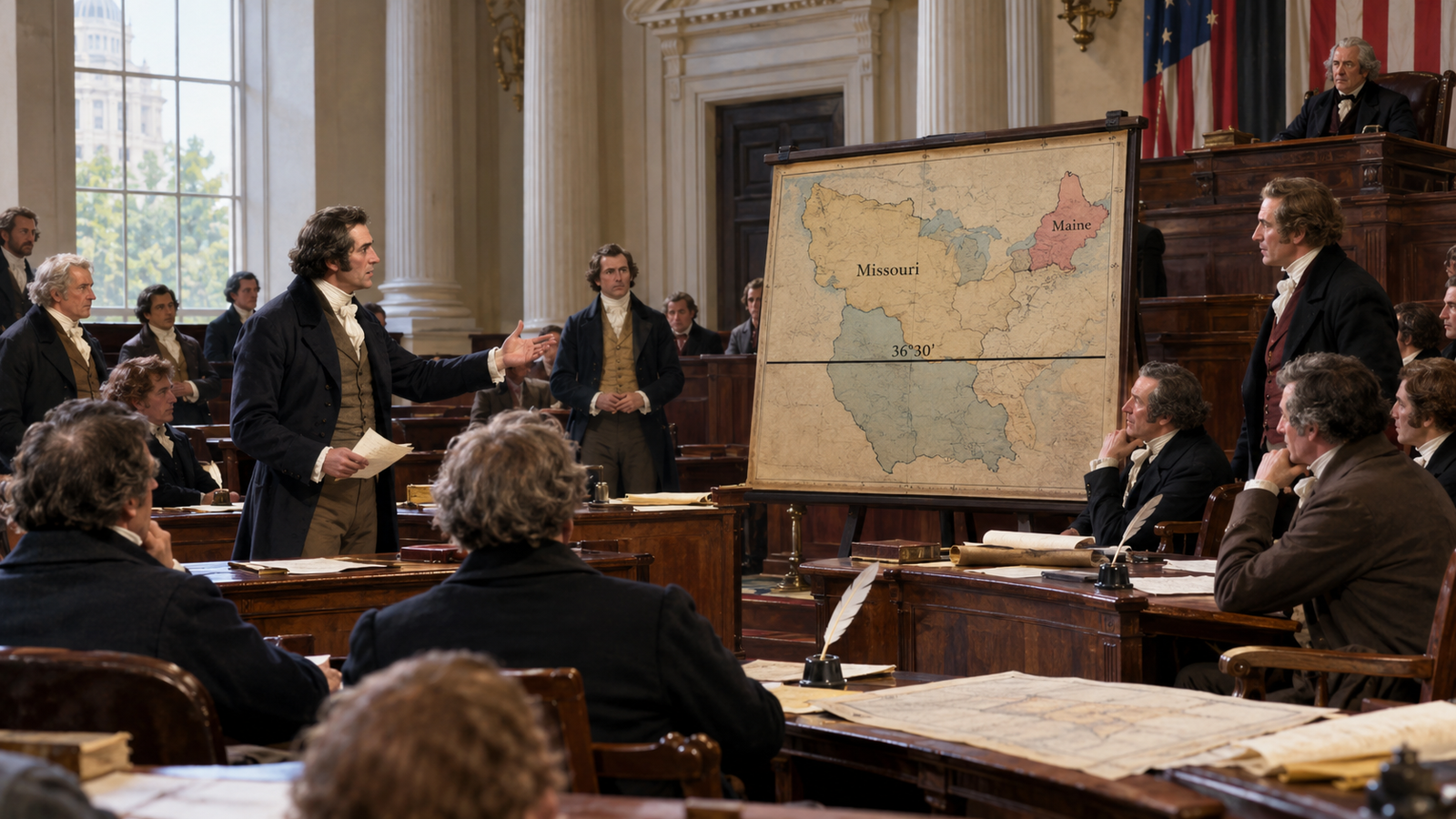
The Missouri Compromise of 1820 was one of the most important political agreements in the early history of the United States. It attempted to reduce growing tensions between the states where slavery was legal and those where slavery was restricted or prohibited.
The issue became especially serious as the United States continued expanding westward. Whenever a new territory applied to become a state, Americans had to consider whether slavery would be permitted there. This was not simply a question about individual states. The balance between free and slave states could affect political power in Congress and influence the future direction of the entire country.
The Missouri Compromise temporarily reduced the conflict, but it did not solve the underlying disagreement over slavery. Instead, it became one of several compromises that delayed a much larger national crisis.
Why Was the Missouri Compromise Necessary?
By the beginning of the nineteenth century, slavery had become deeply connected to the economy and political system of the United States.
Slavery was legal in many Southern states, where enslaved labor was used extensively, particularly in agriculture.
In many Northern states, slavery had been abolished or was being gradually eliminated.
This created an important political difference between the two regions.
The United States Senate was especially important because each state had two senators regardless of its population.
If the number of free states and slave states remained relatively balanced, neither side could easily dominate the Senate on issues directly connected to slavery.
As the country acquired new territories, maintaining that balance became increasingly difficult.
The Louisiana Purchase Created a New Problem
The Louisiana Purchase of 1803 dramatically expanded the United States.
The enormous territory purchased from France included land that would eventually become parts or all of numerous present-day states.
As settlers moved into these territories, questions arose about how the new territories would be governed.
One of the biggest questions was whether slavery would be allowed.
This became especially important when Missouri applied to become a state.
Missouri Wants to Become a State
Missouri had been part of the Louisiana Territory.
By 1819, its population had grown enough for residents to seek statehood.
Missouri’s leaders wanted the territory to enter the Union as a slave state.
This created a political problem.
At that time, the United States had an equal number of free and slave states.
Adding Missouri as a slave state could upset the balance in the Senate.
The issue quickly became the subject of a major national debate.
The Tallmadge Amendment
In 1819, Representative James Tallmadge Jr. of New York proposed restrictions on slavery in Missouri.
His proposal would have prevented additional enslaved people from being brought into Missouri and would have provided for the eventual freedom of enslaved children born there.
Southern representatives strongly opposed the proposal.
They argued that Congress did not have the right to impose such restrictions on a territory seeking statehood.
Northern politicians who opposed the expansion of slavery, meanwhile, saw the debate as an opportunity to limit slavery’s growth into new territories.
The disagreement became intense.
Why the Debate Was So Serious
The Missouri question was about more than one state.
It raised a much larger issue:
Would slavery continue expanding as the United States expanded?
Southern leaders feared that if Congress began prohibiting slavery in new territories, the political power of slaveholding states would eventually decline.
Many Northern politicians feared that allowing slavery to spread across western territories would strengthen the institution and make it harder to restrict in the future.
The debate therefore reflected growing differences between different sections of the country.
The Role of Henry Clay
One of the most important figures in finding a solution was Henry Clay, a politician from Kentucky.
Clay became known as the “Great Compromiser” because of his role in several major political agreements.
He helped support a solution that would allow Missouri to enter the Union while maintaining the balance between free and slave states.
The compromise involved several parts.
Maine Becomes a Free State
At the same time that Missouri was seeking statehood, the northern territory of Maine was seeking admission to the Union.
Maine had previously been part of Massachusetts.
Congress admitted Maine as a free state.
Missouri could then enter as a slave state.
This preserved the balance in the Senate.
The arrangement was politically important because neither side gained an immediate advantage from Missouri’s admission.
The 36°30′ Line
The compromise also created a geographic boundary for slavery in much of the Louisiana Territory.
The 36°30′ parallel was established as a line across the Louisiana Purchase.
North of this line, slavery would generally be prohibited in the territories created from the Louisiana Purchase, except for Missouri.
South of the line, slavery could be permitted.
The arrangement did not apply to every existing state or territory in the same way, but it established an important principle for the organization of western territories.
This line became one of the most recognizable features of the Missouri Compromise.
Missouri’s Statehood
After the compromise was reached, Missouri entered the Union as a slave state.
Maine entered as a free state.
The immediate political crisis was therefore reduced.
Congress had found a way to preserve the balance between free and slave states while establishing rules for slavery in much of the remaining Louisiana Territory.
For the moment, the country avoided a major political breakdown.
But the disagreement had revealed how difficult the slavery issue was becoming.
The Compromise Did Not End the Slavery Debate
The Missouri Compromise did not solve the fundamental disagreement over slavery.
Instead, it temporarily postponed the conflict.
Americans continued debating whether slavery should expand into new territories.
The issue became more difficult as the country continued acquiring land and admitting new states.
Each new territory created another political question.
Would it become a free state?
Would it become a slave state?
Would Congress create another compromise?
These questions would eventually become central to American politics.
Why Slavery Was Such a Difficult Issue
Slavery affected the economy, politics, society, and law of the United States.
In the South, many plantation owners depended heavily on enslaved labor.
The system was also supported by laws and institutions that denied enslaved people basic freedoms and treated them as property.
Enslaved people themselves resisted slavery in many ways, including escaping, organizing, maintaining family and cultural traditions, and resisting the system imposed upon them.
In the North, opposition to slavery grew among many people, although attitudes toward abolition, racial equality, and Black Americans varied widely.
The disagreement was therefore not simply a disagreement between two political parties.
It involved deeply different views about the future of the country.
The Missouri Crisis and Sectionalism
The Missouri debate increased what historians call sectionalism.
Sectionalism means strong loyalty to a particular region of a country, sometimes at the expense of national unity.
Northern and Southern politicians increasingly viewed political issues through the interests of their regions.
A politician might support a policy because it benefited the North or the South rather than because it benefited the country as a whole.
The Missouri debate demonstrated how quickly sectional tensions could become national political crises.
The Importance of Congress
The Missouri Compromise also demonstrated the important role of Congress in dealing with major national disagreements.
The House of Representatives and Senate had to negotiate a solution that enough politicians from different regions could accept.
This required compromise.
The agreement showed that political leaders could still find temporary solutions to extremely difficult problems.
However, it also demonstrated the limitations of compromise.
If the underlying issue remains unresolved, another crisis can eventually emerge.
The Compromise and Westward Expansion
The United States continued expanding after 1820.
As settlers moved farther west, the question of slavery followed them.
The Missouri Compromise became an important reference point whenever politicians discussed new territories.
The basic question was whether Congress had the authority to restrict slavery in territories.
That question would return repeatedly in later decades.
The country’s rapid expansion therefore made the slavery debate increasingly difficult to contain.
The Annexation of Texas
One later development that complicated the situation was the annexation of Texas.
Texas had become an independent republic after breaking away from Mexico.
In 1845, the United States annexed Texas.
Because slavery was legal in Texas, its annexation increased concerns about the balance between free and slave states.
The United States then became involved in a war with Mexico.
The resulting territorial expansion created an even larger debate about whether slavery would be allowed in the newly acquired western territories.
The Missouri Compromise’s attempt to create a geographic solution was no longer enough to settle every new question.
The Mexican-American War
The Mexican-American War ended in 1848 with Mexico transferring a large amount of territory to the United States.
The newly acquired lands included areas that would later become parts of California, Nevada, Utah, Arizona, New Mexico, Colorado, and other states.
Once again, Americans faced the question of slavery’s expansion.
Would slavery be permitted in the new territories?
The political arguments became increasingly bitter.
The Missouri Compromise remained important, but new circumstances were making its rules harder to apply.
The Compromise of 1850
The crisis eventually contributed to another major political agreement: the Compromise of 1850.
This compromise addressed several issues connected to the territories acquired from Mexico.
California entered the Union as a free state.
Other territories were allowed to determine the status of slavery through a policy known as popular sovereignty.
The agreement also included a stronger federal Fugitive Slave Act, which required authorities to assist in the return of escaped enslaved people.
The Compromise of 1850 temporarily reduced tensions but also generated strong opposition, especially in the North.
The Kansas-Nebraska Act
The Missouri Compromise faced a major challenge in 1854.
Congress passed the Kansas-Nebraska Act, which created the territories of Kansas and Nebraska and allowed settlers to decide the slavery question through popular sovereignty.
This effectively overturned the restriction established by the Missouri Compromise’s 36°30′ line in those territories.
The decision produced intense political conflict.
Pro-slavery and anti-slavery settlers moved into Kansas, hoping to influence the territory’s future.
Violence and political disorder followed.
The events became known as Bleeding Kansas.
The Missouri Compromise, once viewed as an important solution, had effectively been dismantled.
The Supreme Court and the Slavery Debate
The slavery question eventually reached the Supreme Court.
In the Dred Scott v. Sandford decision of 1857, the Court ruled that African Americans could not be citizens of the United States and that Congress lacked authority to prohibit slavery in federal territories.
The decision was highly controversial.
It further increased tensions between supporters and opponents of slavery.
The ruling also weakened the idea that Congress could use territorial restrictions like those established by the Missouri Compromise to limit slavery.
From Compromise to Civil War
By the late 1850s, political compromise was becoming increasingly difficult.
The country had experienced repeated disputes over slavery.
The Missouri Compromise had delayed one crisis, but later conflicts over western territories made the issue more difficult to contain.
The election of Abraham Lincoln in 1860 further increased Southern fears about the future of slavery.
Although Lincoln opposed the expansion of slavery into the territories, his election was viewed by many Southern leaders as a serious threat.
Several Southern states eventually seceded from the Union.
The American Civil War began in 1861.
The Missouri Compromise did not cause the Civil War by itself. However, it was one of several major events that demonstrated how deeply divided the country had become over slavery and its expansion.
Why the Missouri Compromise Matters
The Missouri Compromise is important because it shows how American political leaders attempted to manage one of the nation’s most difficult problems.
In 1820, compromise was still possible.
Congress created a temporary balance between free and slave states and established a geographic restriction on slavery in much of the Louisiana Territory.
For several decades, the agreement helped maintain political stability.
But the compromise could not resolve the moral, economic, legal, and political questions surrounding slavery.
As the United States continued expanding, those questions became harder to avoid.
The Missouri Compromise therefore represents both the power and the limitations of political compromise.
It demonstrated that lawmakers could temporarily prevent a national crisis, but it also showed that some conflicts become more difficult when they are postponed rather than permanently resolved.
The debates surrounding Missouri would become part of a much larger struggle over slavery, freedom, federal power, and the future of the United States.
Leave a Reply