
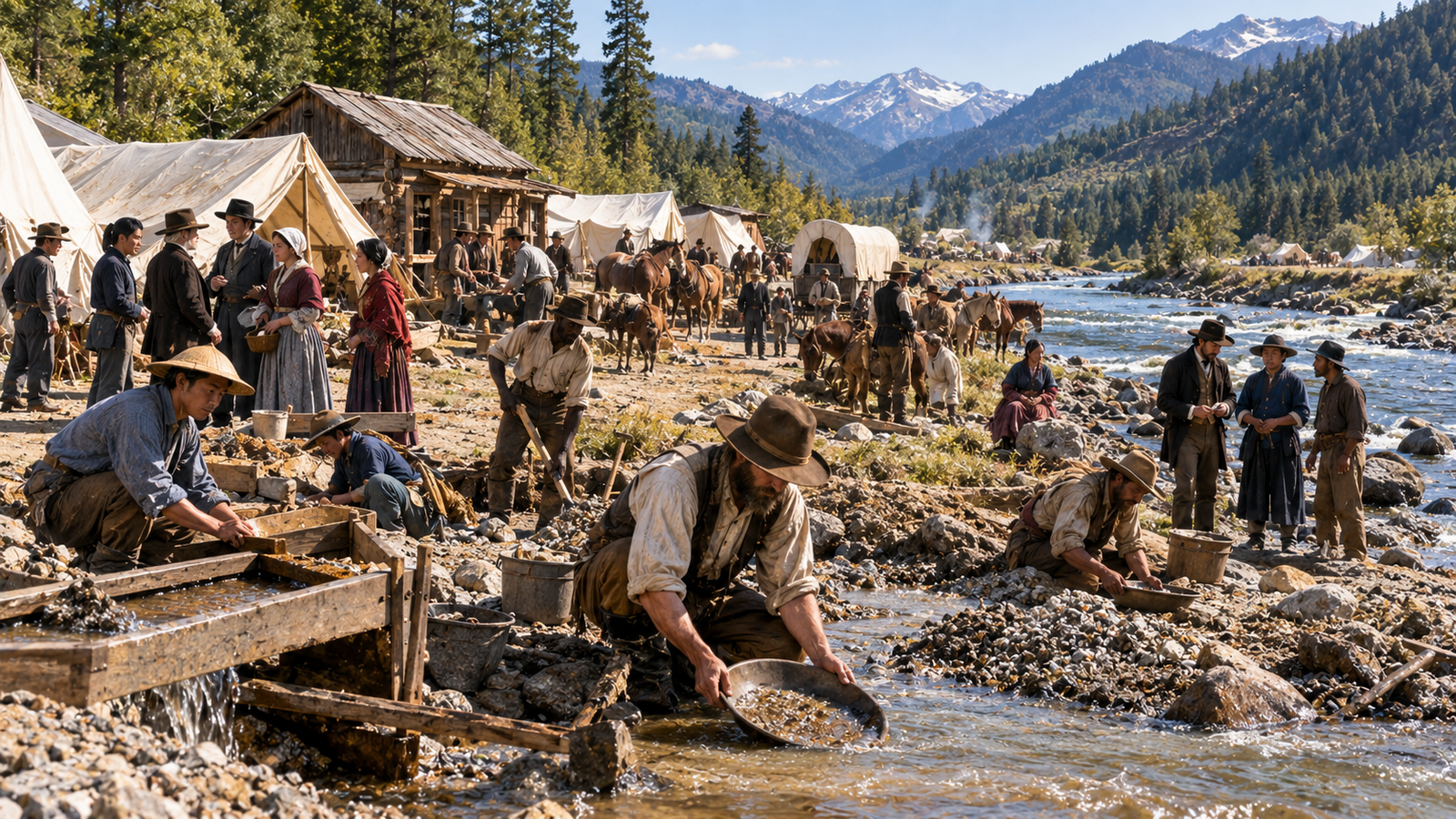
The California Gold Rush was one of the most important events in nineteenth-century American history. What began with the discovery of gold in January 1848 quickly became a massive migration that transformed California, changed the American economy, and accelerated the settlement of the western United States.
Thousands of people traveled enormous distances hoping to find gold and build a better future. They came from different parts of the United States and from countries around the world. California’s population grew rapidly, new towns appeared almost overnight, and San Francisco developed into an important commercial center.
But the Gold Rush was about much more than people searching for wealth. It also brought serious challenges. Native American communities suffered enormous disruption, competition for land and resources increased, and the rapid growth of California created difficult political questions. The Gold Rush also helped California become a state in 1850.
The Discovery of Gold in California
The story began on January 24, 1848, when James W. Marshall discovered gold while working at a sawmill being built for John Sutter near Coloma, along the South Fork of the American River.
Marshall noticed shining pieces of metal in the water and suspected that they were gold.
At first, Sutter and Marshall hoped to keep the discovery quiet. They understood that a large rush of people could interfere with their businesses and plans.
However, news eventually spread throughout California.
The discovery happened at an important moment in American history. The Mexican-American War was coming to an end, and the Treaty of Guadalupe Hidalgo, signed in February 1848, transferred California and other large territories from Mexico to the United States.
California was therefore becoming part of a rapidly expanding United States at almost exactly the moment gold was discovered.
Why Did the Gold Rush Become So Large?
The discovery of gold alone did not immediately bring hundreds of thousands of people to California.
The news had to travel.
In 1848, communication across the United States was much slower than it is today. There were no modern telephones, internet services, or rapid transportation networks connecting California with the eastern United States.
The news eventually traveled by ship and overland routes. President James K. Polk officially confirmed the discovery in his message to Congress in December 1848. This confirmation helped convince many people that the reports of California’s gold were real.
By 1849, thousands of people were heading toward California.
These migrants became known as the Forty-Niners, because many began their journeys in 1849.
The Gold Rush had begun.
How People Traveled to California
Getting to California was not easy.
People traveling from the eastern United States had several choices.
Some traveled overland by wagon along trails that crossed the Great Plains, deserts, and mountains.
Others traveled by sea.
One route took ships around Cape Horn, the southern tip of South America. This journey could take months and covered thousands of miles.
Another option involved traveling by ship to Panama, crossing the Isthmus of Panama, and then taking another ship north to California.
Neither journey was simple.
Travelers faced difficult weather, unfamiliar terrain, disease, shortages of food and water, and other dangers. The California National Historic Trail became one of the major routes used by people traveling west.
Despite the difficulties, thousands continued making the journey.
The possibility of finding valuable gold was powerful enough to convince many people to leave their homes, jobs, and families behind.
Life in the Gold Fields
When people arrived in California, many traveled into the Sierra Nevada and other areas where gold had been discovered.
Mining communities developed around rivers and streams.
Some miners searched for gold in riverbeds using simple tools. Others eventually used more complicated methods as easily accessible deposits became harder to find.
Early mining could be physically demanding. Miners spent long hours searching through dirt, gravel, and water.
Many people arrived expecting to become rich quickly.
For some, gold was found relatively easily.
For many others, however, the reality was very different.
The gold fields became crowded, and competition increased. Supplies were often expensive because transporting goods to remote mining areas was difficult.
A person could spend considerable money on food, clothing, tools, and transportation without finding enough gold to make a fortune.
The Growth of San Francisco
One of the biggest winners of the Gold Rush was San Francisco.
Before the Gold Rush, San Francisco was a relatively small settlement.
The sudden arrival of thousands of people transformed it.
Ships arrived carrying passengers, supplies, and equipment. Businesses opened to serve the growing population.
Stores, hotels, restaurants, workshops, banks, newspapers, and transportation services became increasingly important.
San Francisco became the major commercial center for the Gold Rush.
The city continued to grow even after many people realized that becoming rich through mining was not easy.
The Gold Rush therefore helped establish San Francisco as one of the most important cities on the Pacific Coast.
People Came From Around the World
The California Gold Rush was an international event.
People came not only from different parts of the United States but also from Latin America, Europe, China, Hawaii, and other regions.
The Library of Congress notes that miners and workers came from places including Mexico, Chile, Hawaii, and China.
This created a remarkably diverse population in California.
People brought different languages, traditions, religions, foods, and business practices.
The diversity created new cultural connections, but it also produced discrimination and conflict.
Chinese immigrants, in particular, became an important part of California’s mining and business communities, while also facing prejudice and discriminatory laws.
Women and Families During the Gold Rush
The popular image of the Gold Rush often focuses on male miners searching for gold.
However, women also played important roles in California’s transformation.
Some women traveled west with their families. Others operated businesses, restaurants, boarding houses, farms, laundries, and other services.
As communities developed, California became more than a temporary mining destination.
People began building permanent homes and businesses.
The growing population created schools, churches, newspapers, stores, farms, and government institutions.
The Gold Rush was therefore gradually transforming California from a sparsely populated region into a developing American state.
The Impact on Native American Peoples
The Gold Rush had devastating consequences for many Native American communities.
Indigenous peoples had lived throughout California for thousands of years before the arrival of large numbers of American settlers and miners.
The sudden population explosion created intense competition for land, water, food, and other resources.
Mining and settlement disrupted traditional ways of life.
Native communities also faced violence, forced displacement, disease, and severe population loss.
The National Park Service notes that the rapid arrival of emigrants placed enormous pressure on Native peoples and their resources.
This is an important part of the Gold Rush story because the event brought opportunity and wealth to some people while causing tremendous suffering and disruption for others.
California’s Rapid Population Growth
The population of California changed dramatically during the Gold Rush.
California State Parks reports that the non-Indigenous population was approximately 14,000 when gold was discovered. By the end of 1849, it had grown to around 100,000, and by 1852 it had reached approximately 250,000.
This extraordinary growth created a huge demand for government services.
California needed roads, courts, schools, law enforcement, businesses, and political institutions.
The rapid growth also encouraged people to think about California’s future as a permanent part of the United States.
California Becomes a State
Before the Gold Rush, California had only a small non-Indigenous population compared with its enormous size.
After the Gold Rush began, the situation changed quickly.
California sought admission to the United States.
The question of whether California would enter as a free or slave state became part of the larger national debate over slavery.
Eventually, the Compromise of 1850 allowed California to enter the Union as a free state.
California officially became the 31st state on September 9, 1850.
The Gold Rush had therefore helped accelerate California’s transition from a recently acquired territory into an American state.
The Gold Rush Was Not Just About Gold
Although gold attracted people to California, many migrants eventually discovered that there were other ways to make money.
Businesses supplying miners could be profitable.
Merchants sold food, clothing, tools, transportation, and other necessities.
Farmers produced food for growing communities.
Builders constructed homes and businesses.
People also found opportunities in transportation, banking, shipping, and trade.
In some cases, the people selling supplies to miners made more reliable profits than the miners themselves.
This helped create a broader California economy.
The Changing Mining Industry
During the earliest years of the Gold Rush, miners could sometimes find gold close to the surface.
As these deposits became harder to reach, mining became more complicated.
Companies began using larger equipment and more organized methods.
Mining increasingly required significant investment.
This changed the nature of the Gold Rush.
The image of an individual miner searching for gold with simple equipment became less representative of the developing mining industry.
California’s gold production remained important, but the economy was becoming increasingly diverse.
The Gold Rush and the American West
The Gold Rush also encouraged further American migration westward.
Thousands of people who traveled to California settled there permanently.
Others moved through the region and continued exploring or settling other parts of the West.
The Gold Rush encouraged the development of roads, trails, ports, shipping networks, and communication systems.
It also strengthened the economic importance of the Pacific Coast.
The California National Historic Trail became an important migration route, and hundreds of thousands of emigrants traveled toward California and its farmland and gold fields during the 1840s and 1850s.
The Gold Rush and the Growth of California
By the 1850s, California was no longer simply a place where people went to search for gold.
It had become a permanent and rapidly developing part of the United States.
Agriculture expanded.
Cattle ranching grew.
San Francisco developed into a major commercial center.
New communities appeared throughout the state.
The population continued increasing even as the most famous period of the Gold Rush began to decline.
The Library of Congress notes that California’s population continued to grow rapidly after the Gold Rush, reaching about 308,000 people in the 1860 census.
What Happened When the Gold Rush Ended?
The Gold Rush did not suddenly stop on one particular day.
Instead, the easiest-to-reach gold deposits gradually became harder to find.
Some miners left California.
Others stayed and found new occupations.
Mining continued, but California’s economy became less dependent on individual prospectors.
Agriculture, trade, manufacturing, transportation, and other industries became increasingly important.
California’s transformation continued long after the first wave of Forty-Niners had disappeared.
The Long-Term Legacy of the Gold Rush
The California Gold Rush permanently changed the United States.
It helped transform California into one of the country’s most important states.
It encouraged massive migration to the West and strengthened connections between the eastern United States and the Pacific Coast.
It helped San Francisco become a major American city.
It also contributed to the development of transportation, agriculture, commerce, and communication across the West.
At the same time, the Gold Rush had serious and lasting consequences for Native American communities and other groups who faced discrimination and displacement.
The discovery of gold therefore created both opportunity and hardship.
The Gold Rush remains one of the clearest examples of how a single discovery can completely transform a region. What began with James Marshall noticing gold near a sawmill in January 1848 eventually brought hundreds of thousands of people to California, helped the territory become a state, and changed the economic and political future of the American West.
Leave a Reply