
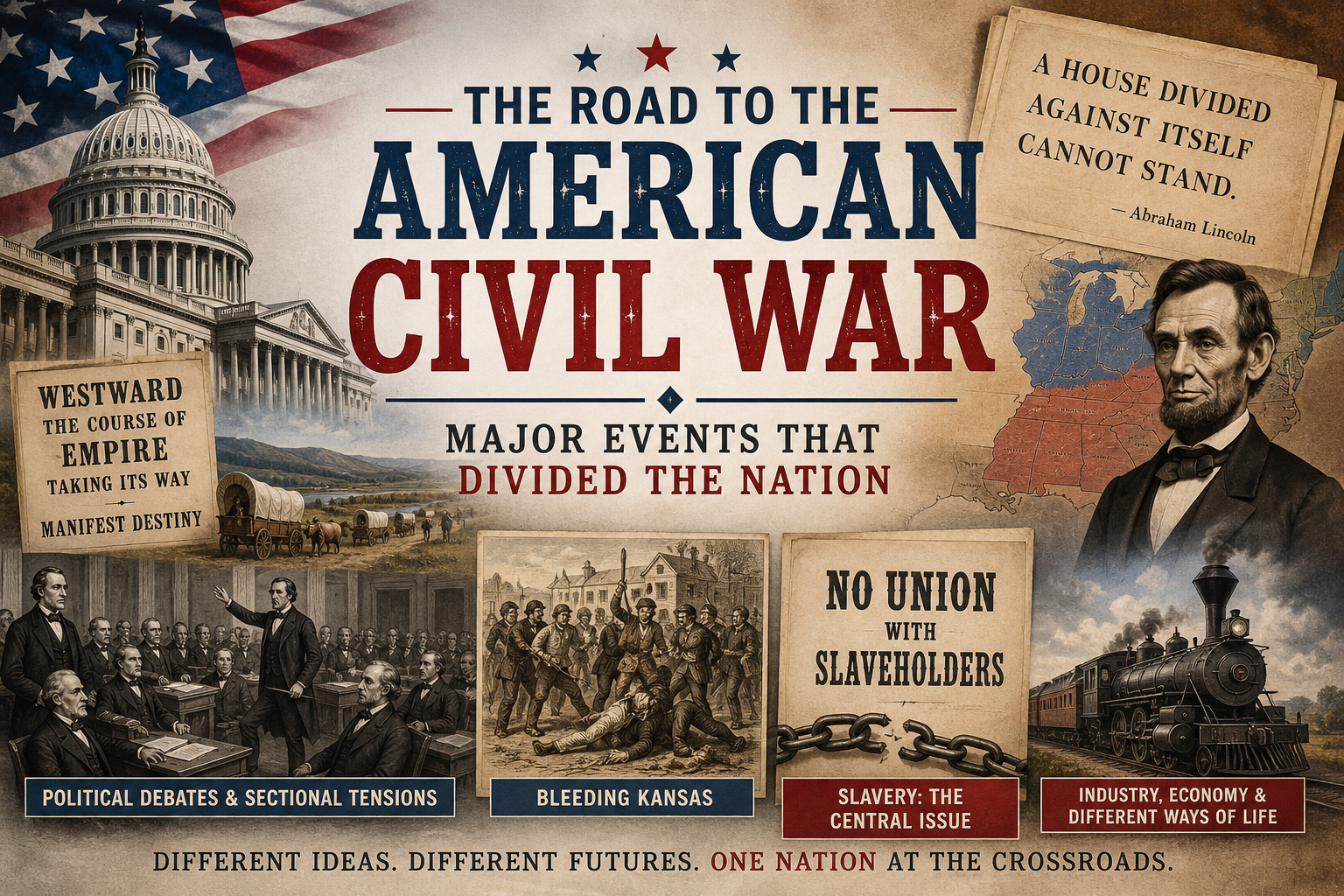
The American Civil War did not begin suddenly in 1861. For decades before the first shots were fired, the United States was becoming increasingly divided over slavery, political power, economics, and the future of the country.
The conflict eventually became a war between the Union, made up of the United States government and the states that remained in the Union, and the Confederacy, formed by eleven Southern states that seceded.
Understanding the American Civil War means looking at the events that gradually increased tensions between the North and South.
From disagreements over slavery to political crises and the election of Abraham Lincoln, several major events pushed the country toward war.
Slavery and the Growing Divide
At the center of the conflict was slavery.
By the 1800s, slavery had become deeply connected to the economy and social structure of the Southern states. Large plantations depended heavily on enslaved labor, particularly for crops such as cotton.
In much of the North, slavery was less economically important and increasingly opposed by abolitionists and other antislavery activists.
The disagreement was not simply about whether slavery should exist. Americans also argued about whether slavery should be allowed to expand into new territories and states.
As the United States expanded westward, this question became increasingly difficult to avoid.
The Missouri Compromise of 1820
One of the earliest major political attempts to manage the growing conflict was the Missouri Compromise.
Missouri wanted to enter the Union as a slave state, while Maine entered as a free state. Congress also established a geographic boundary for slavery in much of the Louisiana Purchase territory.
The compromise temporarily reduced tensions, but it did not solve the underlying disagreement.
Instead, it demonstrated how deeply the issue of slavery had become connected to the balance of political power between free and slave states.
The Compromise of 1850
The United States gained additional territory following the Mexican-American War, creating another major question: Would slavery be permitted in the new territories?
Congress responded with the Compromise of 1850.
California entered the Union as a free state, while other measures addressed slavery in the territories.
The compromise also included a stronger Fugitive Slave Act, requiring authorities in free states to assist in the return of escaped enslaved people.
The law generated intense opposition in the North and increased tensions between supporters and opponents of slavery.
Rather than ending the debate, the compromise helped expose how difficult it was becoming for the country to find a political solution.
The Kansas-Nebraska Act of 1854
Another major turning point came with the Kansas-Nebraska Act.
The legislation allowed settlers in the Kansas and Nebraska territories to decide whether slavery would be permitted through a concept known as popular sovereignty.
This effectively overturned the slavery restrictions established by the Missouri Compromise.
The result was violence in Kansas.
Pro-slavery and antislavery settlers competed for political control, and armed conflict broke out.
The violence became known as Bleeding Kansas.
Events in Kansas showed that political disagreements over slavery could turn into physical violence.
The Rise of the Republican Party
The Kansas-Nebraska Act also contributed to the rise of the Republican Party.
Founded in the 1850s, the Republican Party opposed the expansion of slavery into the western territories.
The party attracted former Whigs, antislavery Democrats, Free Soilers, and other opponents of slavery’s expansion.
As the Republicans became stronger in Northern states, many Southern political leaders became increasingly concerned about losing their influence in the federal government.
The growing political divide made compromise more difficult.
The Dred Scott Decision
In 1857, the Supreme Court issued its decision in Dred Scott v. Sandford.
Dred Scott, an enslaved man who had lived in free territory, argued that this should have made him free.
The Supreme Court ruled against Scott and declared that African Americans could not be citizens of the United States in the constitutional sense recognized by the Court.
The decision also held that Congress did not have the authority to prohibit slavery in federal territories.
The ruling angered many antislavery Americans and strengthened fears in the North that slavery could expand across the country.
The Lincoln-Douglas Debates
The political conflict became even more visible during the 1858 Illinois Senate campaign between Abraham Lincoln and Stephen A. Douglas.
Lincoln argued that slavery should not expand into the territories, while Douglas supported popular sovereignty.
Their debates attracted national attention.
Lincoln did not call for immediate abolition of slavery in states where it already existed, but he strongly opposed its expansion.
The debates helped establish him as a major Republican political figure.
John Brown’s Raid
In October 1859, abolitionist John Brown led a raid on the federal arsenal at Harpers Ferry, Virginia.
Brown hoped to seize weapons and encourage enslaved people to join a rebellion against slavery.
The raid failed.
Brown was captured, tried, and executed.
Many white Southerners saw the raid as evidence that abolitionists were willing to use violence to destroy slavery.
Although Brown had acted independently, the event increased fear and distrust between Northern and Southern communities.
The Election of Abraham Lincoln in 1860
The presidential election of 1860 became one of the final major political triggers.
Abraham Lincoln won the presidency after campaigning on the Republican position against the expansion of slavery into the territories.
He did not win the majority of the national popular vote, and he received virtually no electoral support from the Deep South.
Southern leaders feared that Lincoln’s election represented a long-term threat to slavery and their political power.
South Carolina became the first state to secede from the Union in December 1860.
Other Southern states followed.
Secession and the Confederacy
Between December 1860 and June 1861, eleven Southern states eventually seceded.
They formed the Confederate States of America, with Jefferson Davis serving as president.
The seceding states argued that they were exercising a right to leave the Union and protecting their interests.
However, slavery was central to the secession crisis.
Declarations and statements from several seceding states explicitly identified the protection of slavery as a major reason for leaving the Union.
The United States government rejected secession and maintained that the Union was permanent.
The country was now moving rapidly toward armed conflict.
The Attack on Fort Sumter
The final major step toward full-scale war came at Fort Sumter in Charleston Harbor, South Carolina.
Confederate forces attacked the Union-held fort on April 12, 1861.
Union troops surrendered on April 13.
President Lincoln then called for troops to suppress the rebellion.
The attack encouraged additional Southern states to leave the Union.
By the summer of 1861, the United States was engaged in a full-scale civil war.
Why Compromise Failed
For decades, American politicians had attempted to resolve disagreements through compromises.
The Missouri Compromise, Compromise of 1850, and other political arrangements temporarily reduced tensions.
But each solution eventually faced new challenges.
The expansion of the United States created new territories where the question of slavery had to be answered again.
At the same time, political parties became increasingly divided along sectional lines.
Violence in Kansas, the Dred Scott decision, John Brown’s raid, and Lincoln’s election all demonstrated how difficult it had become to find common ground.
By 1860, trust between many Northern and Southern leaders had deteriorated significantly.
The Deeper Causes of the Conflict
Although slavery was the central issue, the Civil War also involved broader disagreements about federal authority, states’ rights, political power, and economic differences.
The Northern and Southern economies had developed in different directions.
The North had a growing industrial and commercial economy, while the South remained heavily dependent on plantation agriculture and enslaved labor.
These differences contributed to disagreements over tariffs, federal policies, western expansion, and political representation.
However, debates about states’ rights cannot be separated from slavery.
The major constitutional and political disputes of the period repeatedly centered on whether slavery would be protected, expanded, or restricted.
Final Thoughts
The American Civil War was the result of decades of growing tension rather than one isolated event.
The expansion of slavery, political compromises, the Kansas-Nebraska Act, Bleeding Kansas, the rise of the Republican Party, the Dred Scott decision, John Brown’s raid, and Abraham Lincoln’s election all contributed to the worsening crisis.
By the time South Carolina seceded in December 1860, the political relationship between many Northern and Southern leaders had already broken down.
The attack on Fort Sumter in April 1861 transformed the political crisis into open warfare.
The Civil War would ultimately cost hundreds of thousands of American lives and lead to the abolition of slavery through the Thirteenth Amendment.
Understanding the road to the war is important because it shows how political disagreements can become increasingly difficult to resolve when societies are divided over fundamental questions of rights, power, and human freedom.
Leave a Reply