
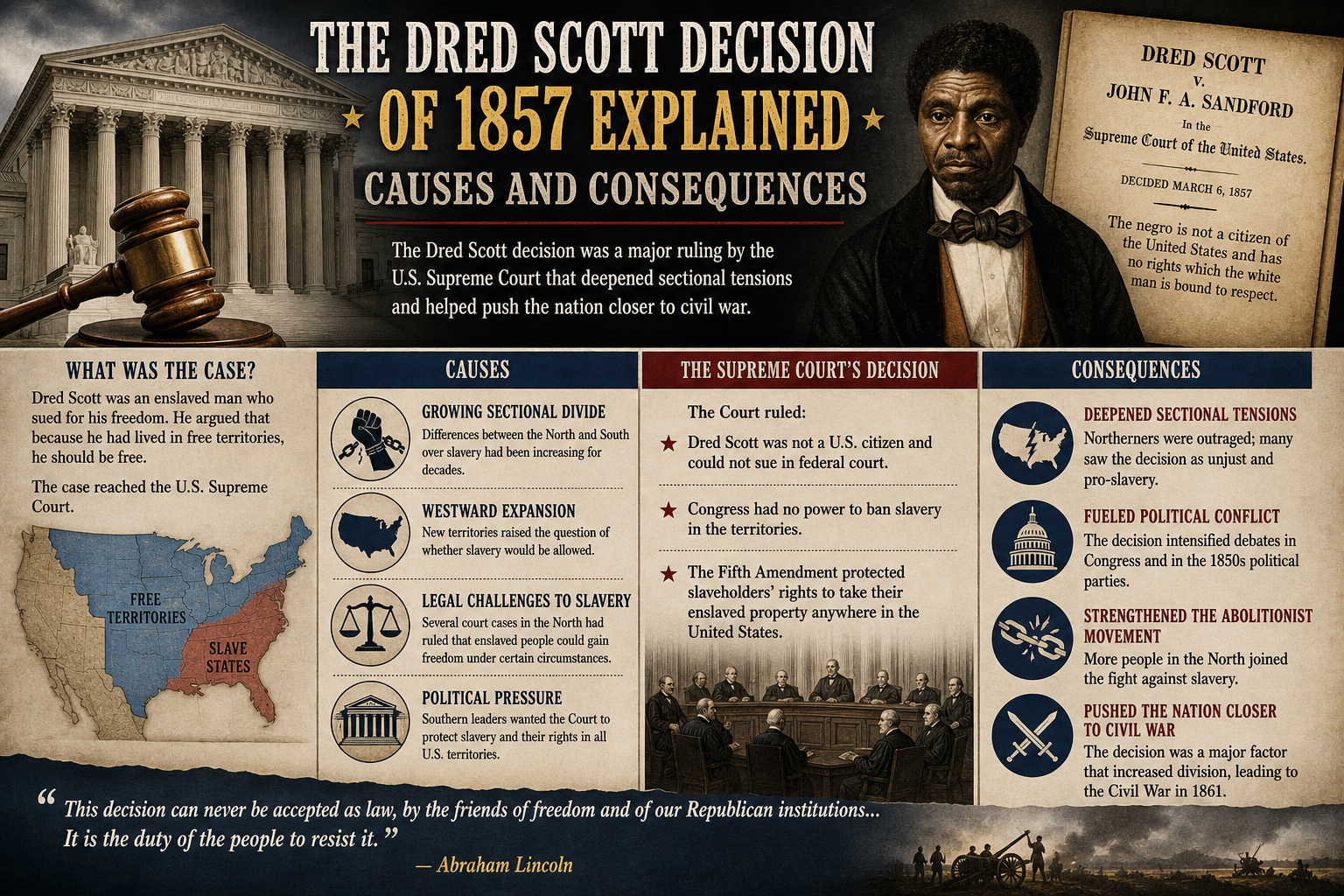
The Dred Scott decision of 1857 was one of the most controversial and consequential Supreme Court rulings in American history. The case involved an enslaved man named Dred Scott who argued that he should be free because he had lived with his enslaver in free territory and a free state.
Instead of resolving the growing national argument over slavery, the Supreme Court’s decision made the conflict even more intense.
The ruling addressed questions about citizenship, slavery, and the power of Congress to regulate slavery in U.S. territories. Its consequences were felt throughout the country and contributed to the political tensions that eventually led to the American Civil War.
To understand why the decision mattered so much, it is important to look at Dred Scott’s story, the legal arguments behind the case, and the reaction that followed the ruling.
Who Was Dred Scott?
Dred Scott was an enslaved African American man who was born in Virginia around 1799.
He was later taken to Missouri, where he was enslaved by Peter Blow and eventually acquired by U.S. Army surgeon Dr. John Emerson.
Because Emerson served in the U.S. Army, he was assigned to different locations.
During the 1830s, Emerson took Scott to Illinois and later to Fort Snelling in what was then the Wisconsin Territory.
At the time, laws and federal regulations restricted slavery in these areas.
Scott eventually returned to Missouri.
After Emerson’s death, Scott was controlled by Emerson’s widow, Irene Emerson.
Scott attempted to negotiate for his freedom, but when that effort failed, he took his case to court.
Why Did Scott Believe He Should Be Free?
Scott’s legal argument was based largely on the principle that living in free territory could make an enslaved person free.
There was an established legal idea in some Northern states known as “once free, always free.”
Under this principle, if an enslaved person was taken by their enslaver into a place where slavery was prohibited, the person’s status could change.
Scott had lived in both Illinois and the Wisconsin Territory.
His lawyers therefore argued that his residence in free areas meant he was legally free.
In 1846, Scott filed a lawsuit in Missouri seeking his freedom.
His first case ended in a mistrial, but he eventually won at the trial level.
However, the Missouri Supreme Court later reversed that decision.
Scott’s legal battle continued.
The Case Reaches the Federal Courts
Scott’s case eventually moved into the federal court system.
The legal dispute became more complicated because Scott’s lawyers argued that he was a citizen entitled to sue in federal court.
The case eventually reached the United States Supreme Court.
The justices were asked to address several major constitutional questions.
Could an African American be a U.S. citizen?
Could an enslaved person become free by living in a free territory?
Could Congress prohibit slavery in federal territories?
These questions were politically explosive because the country was already deeply divided over slavery.
The Supreme Court’s Decision
On March 6, 1857, the Supreme Court issued its decision.
Chief Justice Roger B. Taney wrote the majority opinion.
The Court ruled against Dred Scott.
More importantly, the ruling addressed broader constitutional questions.
The Court concluded that people of African descent whose ancestors had been brought to the United States as enslaved people were not considered U.S. citizens under the Constitution, according to the Court’s interpretation.
Because Scott was not considered a citizen under that interpretation, the Court held that he could not bring the federal lawsuit in the way he had attempted.
But the Court went further.
It also ruled that Congress did not have the constitutional authority to prohibit slavery in federal territories.
This part of the decision was particularly significant because it challenged the constitutional basis of restrictions on slavery in territories.
The Missouri Compromise Was Undermined
One major consequence of the decision involved the Missouri Compromise of 1820.
The Missouri Compromise had restricted slavery in much of the territory north of a particular geographic line.
The Supreme Court’s reasoning in Dred Scott effectively declared that Congress could not prohibit slaveholders from taking enslaved people into federal territories.
This meant that an important federal restriction on slavery’s expansion could not stand under the Court’s interpretation.
The decision therefore affected not only Dred Scott but the future of slavery throughout the western territories.
Why Was the Decision So Controversial?
The ruling was controversial for several reasons.
First, the Court denied citizenship to a large class of African Americans.
Second, the Court ruled that Congress lacked authority to prohibit slavery in federal territories.
Third, many Northerners believed the decision went beyond the immediate legal question and effectively protected the expansion of slavery.
The decision therefore became a major political issue.
Many Republicans strongly opposed the ruling.
They argued that slavery should not be allowed to spread into the territories.
Northern Reaction
The reaction in the North was overwhelmingly negative among antislavery Americans.
Republicans used the decision as evidence that the federal government was becoming increasingly supportive of slaveholding interests.
The ruling also increased public attention to the Republican Party’s position against the expansion of slavery.
Abraham Lincoln, who was becoming an increasingly important Republican political figure, criticized the decision.
In speeches and debates, Lincoln argued that the American political system should not accept slavery as a permanent institution throughout the nation’s territories.
The decision helped make the expansion of slavery an even more important political issue.
Southern Reaction
Many white Southerners welcomed the decision.
They viewed it as confirmation that enslaved people were property protected by the Constitution and that Congress could not simply prevent slaveholders from taking that property into federal territories.
Southern supporters of slavery argued that the decision strengthened their constitutional rights.
However, the ruling did not end political disagreements within the South.
Some Southern politicians and activists wanted stronger federal protections for slavery, while others had different views about how slavery should expand.
The Decision and the Republican Party
The Dred Scott ruling gave Republicans an important political issue.
The Republican Party had emerged in the 1850s largely around opposition to the expansion of slavery into western territories.
The Supreme Court’s decision appeared to make that position more difficult to achieve through congressional legislation.
Republicans responded by arguing that the decision should not prevent the political branches of government from opposing slavery’s expansion.
This contributed to the growing divide between Republicans and Democrats.
The Lincoln-Douglas Debates
The Dred Scott decision became especially important during the 1858 Illinois Senate campaign between Abraham Lincoln and Stephen A. Douglas.
During their famous debates, Lincoln criticized the decision and questioned how the country could prevent slavery from spreading if the Supreme Court’s reasoning were accepted.
Douglas defended the principle of popular sovereignty but faced difficult questions about whether territories could effectively exclude slavery after the Dred Scott decision.
The debates attracted national attention and helped establish Lincoln as a leading figure in the national debate over slavery.
Did the Decision Cause the Civil War?
The Dred Scott decision did not directly cause the Civil War.
The conflict had much deeper roots, particularly the institution of slavery, disagreements over its expansion, sectional political divisions, and disputes over federal authority.
However, the decision contributed significantly to the growing crisis.
It made political compromise more difficult because it appeared to eliminate one possible way of restricting slavery’s expansion.
Instead of settling the slavery question, the ruling intensified the disagreement.
Dred Scott’s Freedom
Interestingly, Dred Scott did eventually become free.
After the Supreme Court decision, Scott and his family were returned to the control of the Blow family, who had been connected to his early life.
In May 1857, Scott was formally freed by Taylor Blow.
Scott did not live long afterward.
He died in St. Louis in September 1858, roughly a year and a half after the Supreme Court decision.
Although Scott himself did not live to see the Civil War or the abolition of slavery, his case became one of the most famous legal battles in American history.
The Long-Term Consequences
The Dred Scott decision had consequences that extended far beyond the individual case.
It intensified Northern opposition to the expansion of slavery.
It strengthened the political position of Republicans who argued against slavery’s expansion.
It increased Southern confidence in constitutional protections for slaveholders.
It also damaged public confidence in the Supreme Court among many Northerners.
Most importantly, the decision demonstrated how difficult it had become to resolve the slavery question through the courts or political compromise.
The issue eventually had to be confronted through the Civil War and constitutional amendments.
After the war, the Thirteenth Amendment abolished slavery throughout the United States.
The Fourteenth Amendment later established birthright citizenship and equal protection under the law, directly rejecting key aspects of the Dred Scott decision.
Final Thoughts
The Dred Scott decision of 1857 was a turning point in the history of the United States.
Dred Scott had hoped that his residence in free territory would provide a legal path to freedom. Instead, the Supreme Court ruled against him and made broader decisions about citizenship and Congress’s authority over slavery in the territories.
The ruling intensified the national debate over slavery and made political compromise increasingly difficult.
Rather than ending the argument, it helped push the country closer to the crisis of secession and civil war.
The case is still remembered because it demonstrates how a single Supreme Court decision can have consequences far beyond the people directly involved.
Dred Scott’s struggle became part of the larger American conflict over slavery, citizenship, constitutional rights, and the meaning of freedom.
Although the Supreme Court’s decision was eventually overturned by constitutional changes, its place in American history remains significant because it helped reveal just how deeply divided the nation had become before the Civil War.
Leave a Reply