
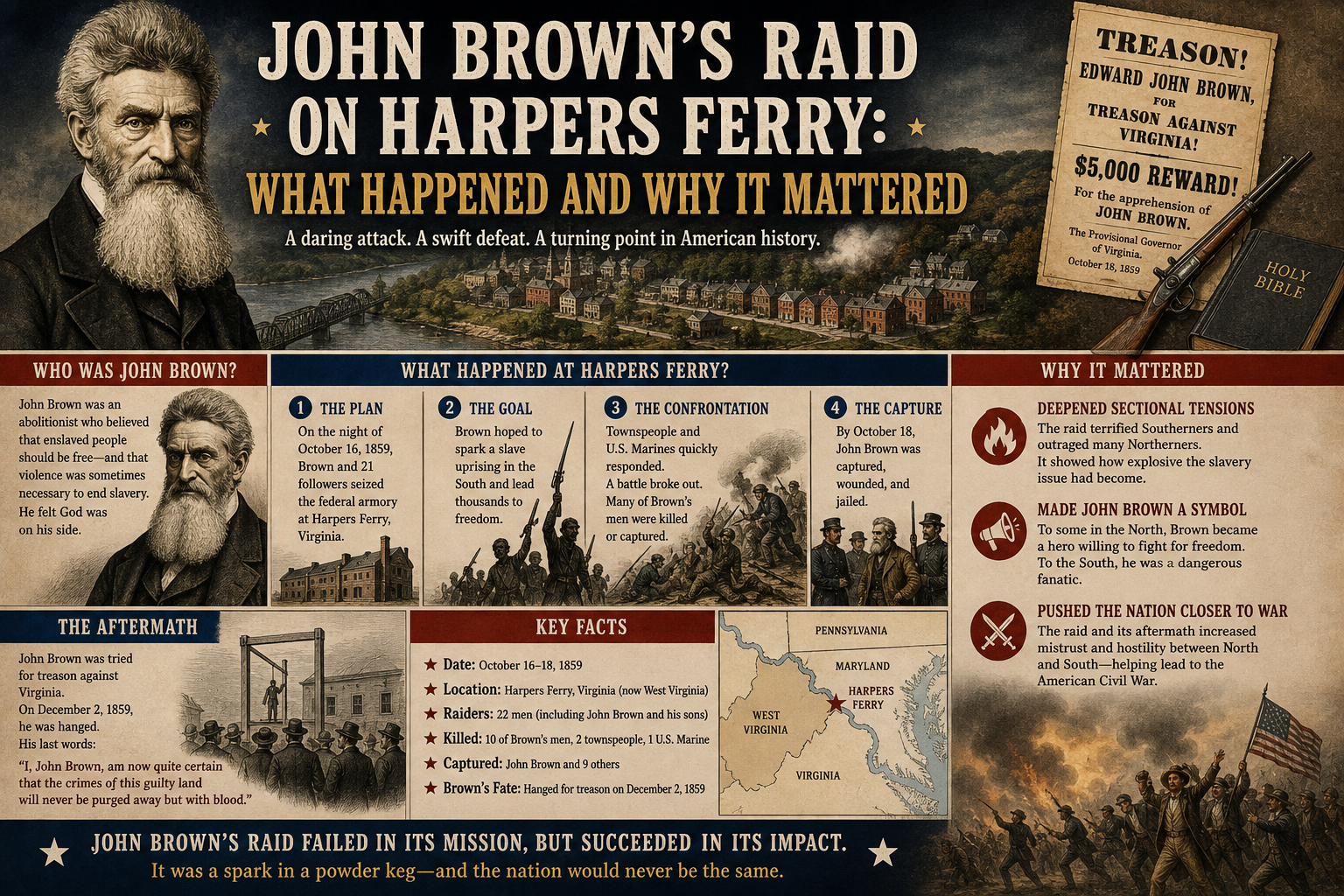
On October 16, 1859, a small group of armed men led by the abolitionist John Brown attacked the federal arsenal at Harpers Ferry, Virginia. Brown hoped to seize weapons, free enslaved people, and begin a much larger uprising against slavery.
The plan failed within two days.
Brown and several of his followers were captured, while others were killed. Brown was later tried and executed.
Although the raid was unsuccessful as a military operation, it had a major impact on American politics. It increased fear in the South, strengthened antislavery feelings in parts of the North, and became one of the important events that pushed the United States closer to the Civil War.
Who Was John Brown?
John Brown was a white abolitionist who believed slavery was a profound moral evil.
Born in Connecticut in 1800, Brown grew up in a deeply religious family. As he became an adult, his opposition to slavery became increasingly strong.
Unlike many antislavery activists who focused primarily on speeches, petitions, newspapers, and political action, Brown believed that violence could be justified to destroy slavery.
His beliefs became more extreme during the violent struggle over slavery in Kansas during the 1850s.
Brown and Bleeding Kansas
In the 1850s, Kansas became a battleground over whether slavery would be permitted in the territory.
The Kansas-Nebraska Act of 1854 allowed settlers to decide the issue through popular sovereignty.
Pro-slavery and antislavery settlers moved into Kansas, and political disagreements soon turned violent.
John Brown and several of his sons became involved in the conflict.
In 1856, Brown and his followers killed five pro-slavery settlers in the Pottawatomie killings.
The violence helped establish Brown as a militant opponent of slavery.
For Brown, Kansas reinforced the belief that armed resistance could be used against slavery.
Brown’s Plan
After Kansas, Brown developed a much larger plan.
He wanted to create an armed group that would enter the South, seize weapons, and encourage enslaved people to escape and join a rebellion.
Brown believed that the mountains of western Virginia and surrounding areas could provide a base for his movement.
His ultimate goal was not simply to capture an arsenal.
He hoped to create a community of escaped enslaved people who could resist slaveholders and gradually undermine slavery.
Brown understood that the plan was dangerous.
He also knew that he did not have a large army.
Nevertheless, he believed that a small, determined group could start a much larger movement.
Why Harpers Ferry?
Harpers Ferry was strategically important.
The town was located at the meeting point of the Potomac and Shenandoah Rivers in Virginia.
It also contained a federal arsenal and armory where weapons were manufactured and stored.
Brown believed that capturing the federal weapons would give his group the supplies needed to arm additional supporters.
Harpers Ferry was also relatively close to areas where enslaved people lived in large numbers.
For Brown, it appeared to be an ideal location to begin his planned uprising.
The Raid Begins
On the night of October 16, 1859, Brown and approximately 18 followers entered Harpers Ferry.
His group included both white and Black men.
They quickly seized control of important locations, including the federal arsenal and armory.
Brown’s men also captured several prominent local residents and took hostages.
At first, Brown apparently expected enslaved people in the surrounding area to join his movement.
But the large-scale uprising he imagined did not happen.
Most local enslaved people did not join the raid.
The raiders were also unable to secure enough control over the town.
The Raid Falls Apart
News of the attack spread quickly.
Local residents organized against Brown’s men, and militia units began arriving.
The raiders became trapped inside the federal armory’s engine house.
Their position became increasingly difficult to defend.
The federal government eventually sent U.S. Marines under the command of Lieutenant Colonel Robert E. Lee to end the uprising.
Among the Marines was a young officer named J. E. B. Stuart, who would later become a famous Confederate cavalry commander during the Civil War.
On October 18, the Marines stormed the engine house.
Several of Brown’s followers were killed.
Brown was captured alive.
The raid was over.
Brown’s Trial
John Brown was taken to nearby Charles Town, Virginia, where he was put on trial.
He was charged with several crimes, including murder, inciting a slave insurrection, and treason against the Commonwealth of Virginia.
Brown’s trial attracted national attention.
He did not present himself as an ordinary criminal.
Instead, he used the courtroom to explain his opposition to slavery.
His statements were reported widely by newspapers.
Brown was found guilty and sentenced to death.
He was hanged on December 2, 1859.
Northern Reaction
Many Northerners did not support Brown’s use of violence.
Even people who opposed slavery could distinguish between opposing the institution and supporting an armed uprising.
However, Brown’s courage and willingness to sacrifice himself attracted sympathy among some abolitionists.
After his execution, he became a martyr to parts of the antislavery movement.
The famous phrase “John Brown’s body” later became associated with the Union during the Civil War.
Brown’s execution therefore did not end the controversy surrounding him.
Instead, it turned him into a powerful symbol.
Southern Reaction
The reaction in the South was very different.
Many white Southerners were horrified by the raid.
They believed Brown’s attack demonstrated that abolitionists were willing to use violence to destroy slavery.
The fact that Brown had attacked a federal facility made the event particularly alarming.
Southern newspapers and political leaders emphasized the threat of armed antislavery movements.
Fear spread that similar attacks could happen elsewhere.
Some Southerners also became increasingly suspicious of Northern political movements, particularly the growing Republican Party.
Why the Raid Mattered Politically
The raid intensified the already serious political division between North and South.
For many Southerners, Brown’s attack appeared to confirm their belief that their society was under threat.
For some Northerners, Brown’s willingness to die for the cause of abolition made the brutality of slavery more difficult to ignore.
The raid therefore deepened distrust on both sides.
Instead of bringing Americans together, it reinforced opposing interpretations of slavery and resistance.
The Connection to Abraham Lincoln
The raid also became part of the political debate surrounding the 1860 presidential election.
Abraham Lincoln opposed slavery’s expansion but did not support John Brown’s raid.
Lincoln and other Republicans wanted to distance their political movement from Brown’s violence.
However, Southern politicians sometimes portrayed Republicans as part of a broader antislavery threat.
This contributed to fears that a Republican victory could eventually threaten slavery.
Was John Brown a Terrorist or a Freedom Fighter?
John Brown remains a controversial historical figure because his actions involved deliberate violence.
He killed people in Kansas and led an armed attack intended to trigger a rebellion.
From one perspective, his actions were violent and illegal.
From another perspective, Brown believed he was fighting an unjust system and helping enslaved people achieve freedom.
Historians continue to debate how Brown should be understood.
What is less controversial is that his actions had a major political impact.
His raid forced Americans to confront the possibility that the slavery conflict could become violent on a much larger scale.
The Raid and the Coming Civil War
The Harpers Ferry raid did not cause the Civil War by itself.
The country had already been divided for decades over slavery, territorial expansion, political power, and federal authority.
However, the raid added another layer of fear and distrust.
The South became increasingly concerned about slave uprisings and Northern abolitionism.
The North became increasingly divided between those who condemned Brown’s violence and those who admired his opposition to slavery.
Less than a year after Brown’s execution, Abraham Lincoln was elected president.
Southern states then began seceding from the Union.
In April 1861, the Civil War began.
The Legacy of John Brown
John Brown’s raid failed in its immediate objective.
He did not create the large-scale uprising he had imagined.
The arsenal was not successfully used to arm a widespread rebellion, and Brown’s followers were defeated quickly.
Yet his actions had consequences far beyond the battlefield.
His trial attracted national attention.
His execution made him a martyr to some abolitionists.
His raid frightened many white Southerners and strengthened their belief that slavery needed stronger protection.
The event also demonstrated how easily the slavery controversy could turn into armed conflict.
Final Thoughts
John Brown’s raid on Harpers Ferry was one of the most dramatic events in the years leading up to the American Civil War.
Brown believed that armed action could help destroy slavery. On October 16, 1859, he and his followers captured the federal arsenal at Harpers Ferry, hoping to obtain weapons and encourage enslaved people to join a broader uprising.
The plan failed.
Federal Marines captured Brown, and he was later executed.
But the raid mattered because of what happened afterward.
It increased Southern fears of abolitionist violence, strengthened Brown’s status as a martyr among some antislavery Americans, and further damaged the already fragile relationship between the North and South.
The United States was already moving toward crisis, but Harpers Ferry showed that the conflict over slavery was no longer only a political argument.
It could become a matter of armed violence.
Just over a year later, the nation would enter the Civil War.
Leave a Reply