
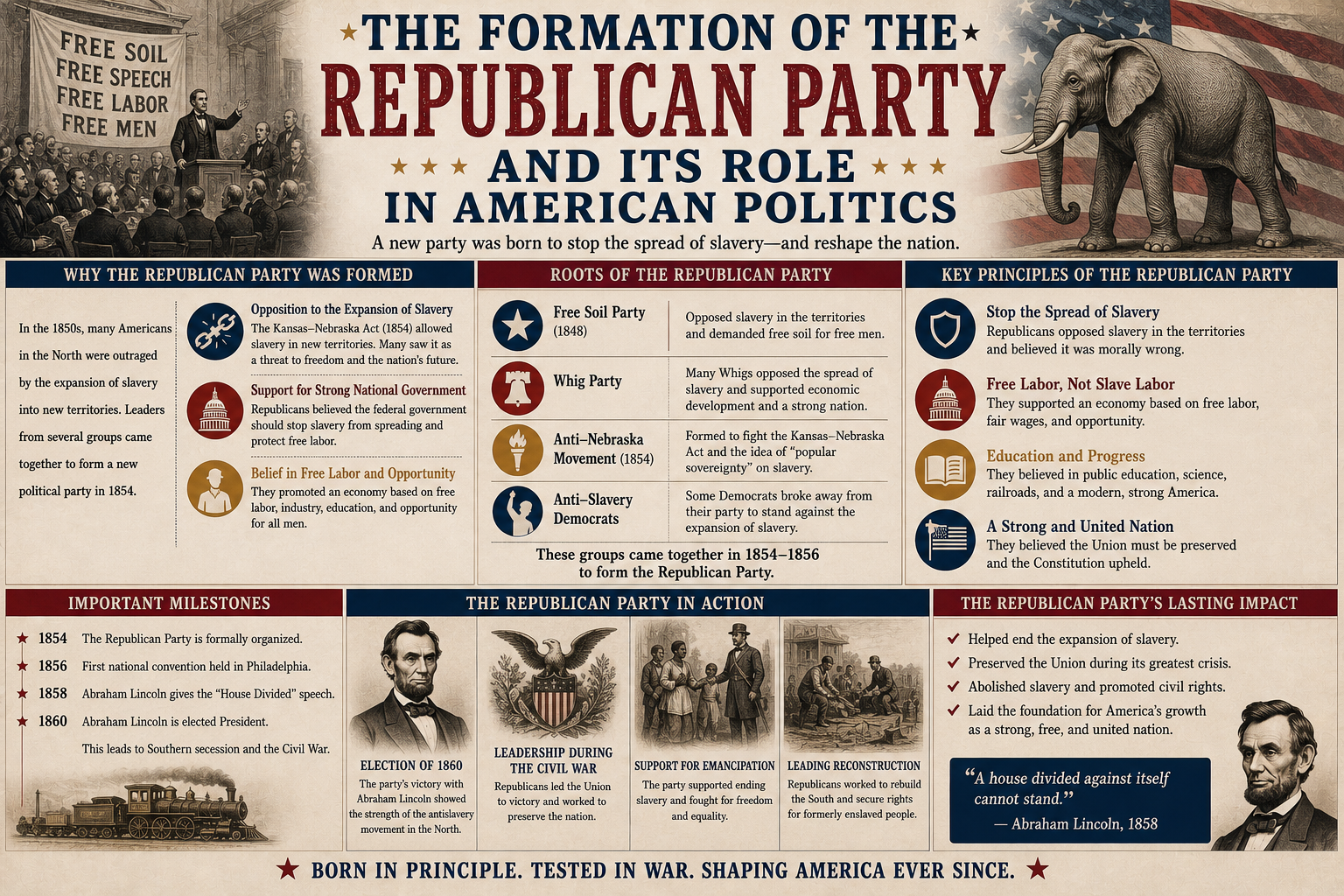
The Republican Party is one of the two major political parties in the United States today, but its origins are closely connected to one of the most important conflicts in American history: the debate over slavery.
The party was formed in the 1850s during a period of intense political change. Its emergence reflected growing opposition in the North to the expansion of slavery into western territories.
Within only a few years, the Republican Party became a powerful political force. Abraham Lincoln’s election as its first successful presidential candidate in 1860 helped trigger the secession crisis and eventually the American Civil War.
Understanding how the Republican Party was created helps explain the political environment that existed before the war.
America Before the Republican Party
During the early and middle nineteenth century, American politics was dominated by the Democratic Party and the Whig Party.
The Democrats were a major national political organization with supporters in both the North and South.
The Whig Party also attracted voters from different regions and focused on issues such as economic development, federal policy, and congressional power.
However, slavery increasingly placed pressure on the existing political system.
As the United States expanded westward, Americans repeatedly argued over whether slavery should be permitted in new territories.
These disagreements became especially serious after the United States acquired large areas of land following the Mexican-American War.
The question was simple but politically explosive:
Would slavery be allowed to expand?
The Kansas-Nebraska Act
A major turning point came in 1854 with the Kansas-Nebraska Act.
The legislation was strongly associated with Senator Stephen A. Douglas of Illinois.
It organized the Kansas and Nebraska territories and allowed settlers to determine whether slavery would be permitted through popular sovereignty.
The law effectively overturned the restrictions on slavery established by the Missouri Compromise in much of the affected territory.
Many Northerners were outraged.
They believed the federal government had opened the possibility of slavery expanding into areas where it had previously been restricted.
The controversy helped destroy the Whig Party and created an opportunity for a new political movement.
The Birth of the Republican Party
The Republican Party emerged in 1854.
Its supporters came from several different political backgrounds.
Former Whigs, antislavery Democrats, Free Soilers, abolitionists, and other opponents of slavery’s expansion began working together.
They did not necessarily agree on every issue.
What united many of them was opposition to the expansion of slavery into the western territories.
The new party therefore represented a political coalition rather than a completely uniform movement.
Its supporters believed that slavery should not be allowed to spread into new federal territories.
“Free Soil, Free Labor, Free Men”
One important Republican idea was the concept of free labor.
Republicans argued that western territories should provide opportunities for free workers, farmers, and businesses rather than being dominated by large slaveholding plantations.
They believed that slavery’s expansion could threaten the economic opportunities of free white laborers.
This did not mean that every Republican held the same views about racial equality.
Many early Republicans opposed slavery’s expansion while holding racial attitudes that were common among white Americans of the period.
This distinction is important when understanding the party’s origins.
The Republican coalition was united primarily around opposition to the expansion of slavery, not complete agreement about racial equality.
The Party Gains Support
The Republican Party grew rapidly in the North.
It attracted voters who were concerned about slavery’s expansion and believed the Democratic Party had become too sympathetic to Southern slaveholding interests.
The party performed strongly in the 1854 congressional elections and continued building support.
By the mid-1850s, Republicans had become a major political force in Northern states.
Their growth alarmed many Southern politicians.
They feared that a Republican-controlled federal government could eventually restrict slavery and threaten the Southern economic system.
The Election of 1856
The Republican Party participated in its first presidential election in 1856.
Its candidate was John C. Frémont.
The campaign focused heavily on opposition to the expansion of slavery.
Frémont did not win the presidency.
James Buchanan, the Democratic candidate, won the election.
However, the Republican Party performed strongly in the North.
The result demonstrated that the new party had quickly become a serious national political force.
The Dred Scott Decision
The Republican Party’s position became even more important after the Supreme Court’s Dred Scott decision in 1857.
The Court ruled against Dred Scott and declared, among other things, that Congress could not prohibit slavery in federal territories.
Republicans strongly opposed the decision.
They argued that the federal government should have the authority to prevent slavery from expanding into the territories.
The ruling therefore became another major political issue.
Republicans increasingly portrayed themselves as defenders of the principle that slavery should not spread westward.
Abraham Lincoln’s Rise
One of the most important figures in the growth of the Republican Party was Abraham Lincoln.
Lincoln had previously been associated with the Whig Party.
After the Whig Party collapsed, he became a Republican.
He gained national attention through his debates with Stephen Douglas during the 1858 Illinois Senate campaign.
Lincoln argued that the United States could not permanently remain divided between freedom and slavery without facing a serious crisis.
He strongly opposed the expansion of slavery but did not initially advocate immediate abolition in states where slavery already existed.
His political position helped him appeal to many Northern Republicans.
The Lincoln-Douglas Debates
The 1858 debates between Lincoln and Douglas became nationally famous.
Douglas defended popular sovereignty.
Lincoln argued that slavery should not be allowed to expand into the western territories.
The debates focused heavily on the future of slavery and the meaning of the Dred Scott decision.
Although Lincoln lost the Senate election to Douglas, the debates made him nationally known.
They helped establish him as one of the leading voices within the Republican Party.
The Election of 1860
The Republican Party nominated Abraham Lincoln for president in 1860.
Lincoln faced three major opponents:
- Stephen Douglas, representing the Northern Democrats
- John C. Breckinridge, representing the Southern Democrats
- John Bell, representing the Constitutional Union Party
The Democratic Party had split over slavery.
This division helped Lincoln.
On November 6, 1860, Lincoln won the presidency.
He received about 40 percent of the popular vote but won a majority of electoral votes.
His victory was largely based on support from Northern states.
He received no electoral votes from the Deep South.
Southern Reaction
Lincoln’s victory produced an immediate political crisis.
Many Southern leaders believed the Republican Party represented a direct threat to slavery.
They were particularly concerned that the party’s opposition to slavery’s expansion would eventually weaken slavery itself.
South Carolina became the first state to secede from the Union in December 1860.
Several other Southern states followed.
By February 1861, the Confederate States of America had been formed.
The Republican Party and the Civil War
Once the Civil War began, Republicans played a major role in supporting the Union war effort.
Lincoln’s administration worked to preserve the Union and eventually made emancipation an important part of the war.
In 1863, Lincoln issued the Emancipation Proclamation, declaring enslaved people in areas under rebellion to be free, subject to its terms.
The Republican-controlled Congress also passed important legislation during the war.
The party increasingly became associated with the preservation of the Union and the destruction of slavery.
Reconstruction and the Republican Party
After the Civil War, Republicans played a major role in Reconstruction.
Radical and moderate Republicans disagreed about how the former Confederate states should be reorganized and how formerly enslaved people should be protected.
Congress passed major legislation supporting civil and political rights for African Americans.
The Thirteenth Amendment abolished slavery.
The Fourteenth Amendment established citizenship and equal protection principles.
The Fifteenth Amendment prohibited denying voting rights based on race, color, or previous condition of servitude.
Republicans strongly supported these constitutional changes.
The Republican Party After the Civil War
The party’s role continued to change after Reconstruction.
Republicans became associated with economic development, industrialization, business interests, and a stronger federal government.
Over time, the party’s political positions changed significantly.
The Republican Party of the nineteenth century was not identical to the Republican Party of the twentieth or twenty-first centuries.
Political parties evolve as society changes.
However, its origins remain important because the party’s creation was directly connected to the slavery crisis that preceded the Civil War.
Why the Republican Party Mattered
The creation of the Republican Party changed American politics because it broke the old two-party balance.
The Whig Party collapsed, and Republicans replaced it as the main opposition to the Democrats in the North.
More importantly, Republicans made opposition to the expansion of slavery a central national political issue.
Their success demonstrated that a political movement based largely in the North could win control of the federal government.
This development frightened many Southern leaders and contributed to the secession crisis.
Final Thoughts
The Republican Party was created in the 1850s during one of the most divided periods in American history.
Its emergence was closely connected to opposition to the expansion of slavery into western territories.
The Kansas-Nebraska Act helped bring together former Whigs, antislavery Democrats, Free Soilers, and other opponents of slavery’s expansion.
The party grew rapidly and became a major force in Northern politics.
Abraham Lincoln’s rise gave the Republicans their most important national leader.
When Lincoln won the presidential election of 1860, Southern leaders interpreted the result as a serious threat to slavery and their political future.
The election was followed by secession, the creation of the Confederacy, and eventually the Civil War.
During and after the war, Republicans played a major role in preserving the Union, abolishing slavery, and passing constitutional amendments that transformed the legal status of African Americans.
The Republican Party’s early history therefore cannot be separated from the larger story of slavery, sectional conflict, the Civil War, and Reconstruction.
Its formation marked a major turning point in American politics and demonstrated how deeply the slavery question had transformed the nation’s political system by the 1850s.
Leave a Reply