
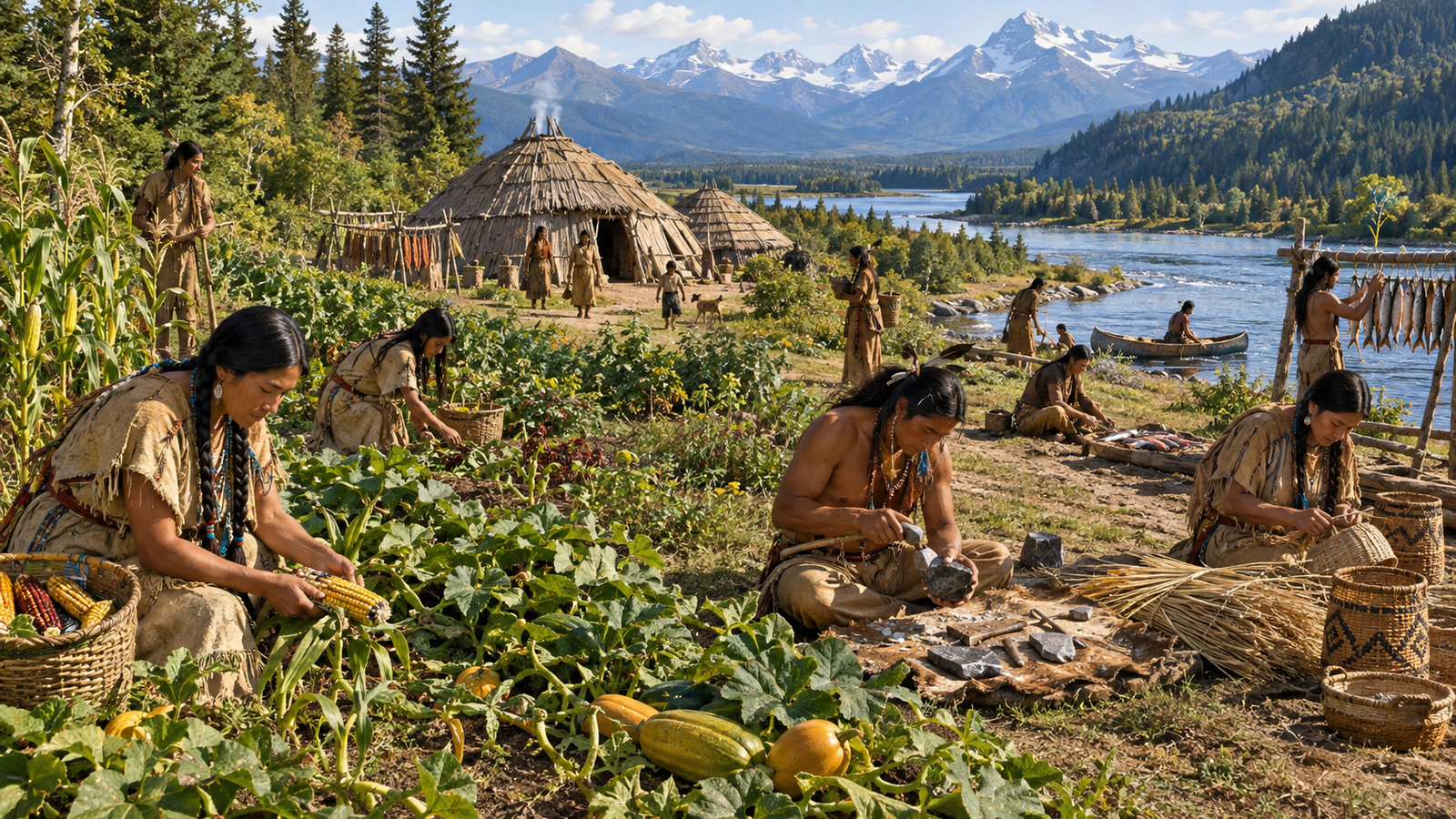
Long before European explorers arrived in North America, the continent was home to hundreds of Indigenous nations and communities with their own languages, traditions, governments, economies, belief systems, and ways of life. These societies were not one single group. They were incredibly diverse and developed in response to the different environments in which people lived, from the Arctic regions to the forests of the East and the deserts of the Southwest.
The history of Indigenous peoples in North America stretches back thousands of years. Over generations, communities developed sophisticated ways of hunting, farming, fishing, trading, building homes, managing natural resources, and organizing political life. Their history is an important part of understanding the history of what later became the United States.
The First Peoples of North America
Indigenous peoples have lived in North America for thousands of years. Archaeological evidence shows that ancient communities occupied different parts of the continent and adapted to a wide variety of environments.
Scientists continue to study exactly how and when the first people arrived in the Americas. Evidence indicates that migrations occurred during the distant past, when groups of people moved into the Americas from northeast Asia. Over thousands of years, their descendants spread across the continent and developed many distinct cultures.
These early communities gradually learned how to use the resources available in their surroundings. Some groups depended heavily on hunting large and small animals, while others relied on fishing, gathering plants, or eventually agriculture. In many regions, people combined several of these activities rather than depending on only one source of food.
The Development of Different Indigenous Cultures
As Indigenous populations grew and communities became established in different regions, cultures developed in different ways. Geography played an important role in shaping daily life.
People living near rivers and coastlines often relied on fishing and water resources. Communities in fertile areas developed agricultural practices, while groups living in colder or drier environments developed different methods of obtaining food and shelter.
This environmental diversity contributed to the development of hundreds of distinct Indigenous nations. Each had its own traditions, languages, social structures, and relationships with neighboring communities.
Agriculture and the Rise of Farming Communities
Agriculture became extremely important to many Indigenous societies in North America. In different regions, people learned to cultivate crops that were well suited to their environment.
One of the most important crops was maize, commonly known today as corn. Maize became a major food source for many communities and was often grown alongside crops such as beans and squash. These crops could complement one another and provide important nutrients.
Agriculture allowed some communities to establish more permanent settlements. Instead of moving frequently in search of food, people could remain in one area for longer periods while cultivating crops and storing food for future use.
However, not every Indigenous society depended primarily on farming. Hunting, fishing, gathering, and trade remained important throughout the continent.
Indigenous Nations of the Eastern Woodlands
The Eastern Woodlands covered a large portion of what is now the eastern United States. The region contained forests, rivers, lakes, and fertile areas that supported many different Indigenous communities.
Among the Indigenous peoples of this region were nations that later became well known in American history, including the Haudenosaunee Confederacy, also known as the Iroquois Confederacy.
The Haudenosaunee Confederacy brought several nations together in a political alliance. The confederacy developed systems of government and diplomacy that helped its member nations work together while maintaining their individual identities.
Other Indigenous nations in the Eastern Woodlands developed their own political systems, communities, agricultural traditions, and trading relationships. Indigenous societies in this region were diverse and cannot be understood as one single culture.
Indigenous Peoples of the Great Plains
The Great Plains stretched across a large area of central North America. Indigenous communities living in this region adapted their lifestyles to the grasslands and the animals that lived there.
Hunting was important for many Plains communities. Bison became an especially valuable resource. Different parts of the animal could be used for food, clothing, tools, shelter materials, and other purposes.
Some Plains peoples lived in relatively mobile communities, moving according to seasonal patterns and the availability of resources. Others combined hunting with agriculture or established more permanent settlements.
The popular image of every Plains Indigenous person constantly traveling on horseback is historically misleading. Horses became important to many Plains communities only after they were introduced to North America following European contact.
Indigenous Peoples of the Southwest
The American Southwest had a very different environment from the forests of the East and the grasslands of the Great Plains. The region included deserts, mountains, and areas with limited rainfall.
Indigenous societies in the Southwest developed impressive agricultural techniques to survive in challenging conditions. Some communities developed irrigation systems that helped them direct water toward their crops.
The Ancestral Puebloans, for example, built substantial settlements and developed complex agricultural and architectural traditions. Their descendants and other Indigenous peoples of the Southwest continued many cultural traditions over generations.
Adobe and stone construction became important in several Southwestern cultures. Some communities built multi-story structures and carefully planned settlements that demonstrated considerable knowledge of their environment.
Indigenous Peoples of the Pacific Northwest
The Pacific Northwest had abundant forests, rivers, and coastal resources. Indigenous peoples living in this region developed societies that made extensive use of the natural environment.
Fishing was particularly important. Salmon provided a major source of food for many communities, while forests supplied wood for houses, boats, tools, and other objects.
Large wooden structures were built by some communities, and skilled craftsmen produced canoes, carvings, and other cultural objects. Trade networks connected communities across the region.
The abundance of resources allowed some societies to establish relatively permanent settlements with complex social and political structures.
Trade Between Indigenous Communities
Indigenous peoples were connected by extensive trade networks long before Europeans arrived. Communities exchanged food, tools, raw materials, decorative objects, and other goods.
Trade was not limited to neighboring villages. Some goods traveled long distances across the continent. Materials that were rare in one region could be exchanged for products that were abundant somewhere else.
Trade also helped spread ideas, technologies, cultural practices, and information. These connections demonstrate that Indigenous peoples were not isolated groups. They interacted with one another through commerce, diplomacy, migration, marriage, conflict, and cultural exchange.
Indigenous Governments and Political Systems
Indigenous societies developed many different forms of political organization. Some communities were organized around villages and local leaders, while others formed larger alliances or confederacies.
Leadership could involve councils, chiefs, elders, religious figures, or other respected members of society. Political systems differed significantly from one nation to another.
The Haudenosaunee Confederacy is one notable example of Indigenous political organization. Its member nations created a system for cooperation and decision-making while maintaining their separate identities.
Indigenous political traditions challenge the outdated idea that North America was an unorganized wilderness before European colonization. Indigenous nations had their own laws, diplomatic traditions, political institutions, and systems for resolving disputes.
Religion, Spirituality, and Cultural Traditions
Spiritual beliefs were important to many Indigenous societies, although beliefs varied widely between nations. Many communities developed traditions that emphasized relationships between people, animals, ancestors, land, and the natural world.
Ceremonies, storytelling, songs, dances, and oral traditions played important roles in preserving knowledge and cultural identity.
Because Indigenous nations were so diverse, there was no single Indigenous religion shared by everyone across North America. Each nation developed its own traditions and beliefs.
Homes and Daily Life
Indigenous peoples developed many different types of homes based on their environment, resources, and lifestyle.
Some communities built houses from wood, while others used earth, stone, bark, grass, or other locally available materials. In the Southwest, some communities constructed large settlements using stone and adobe. In other regions, homes were designed to suit mobile lifestyles.
Daily life could include farming, hunting, fishing, gathering plants, preparing food, making clothing, building tools, caring for children, trading, and participating in community ceremonies.
Work was often divided among members of a community according to cultural traditions, age, skills, and responsibilities. Women, men, children, and elders could all have important roles in maintaining their communities.
Conflict and Diplomacy
Indigenous nations sometimes experienced conflict with neighboring communities. Competition over territory, resources, political influence, and other issues could lead to warfare.
However, conflict was only one part of Indigenous relationships. Diplomacy, trade, alliances, marriage, and peaceful agreements were also important.
Some nations created alliances that allowed them to cooperate for protection, trade, or political purposes. Diplomatic traditions became especially important as Indigenous nations interacted with European powers after colonization began.
The Importance of Oral History
Many Indigenous societies preserved knowledge through oral traditions. Stories, songs, ceremonies, and teachings were passed from one generation to another.
Oral history could preserve information about ancestors, important events, cultural values, geography, traditions, and relationships with the natural world.
Because many Indigenous languages and traditions were primarily transmitted orally, the loss of language and cultural practices during and after European colonization had serious consequences. Today, many Indigenous communities continue efforts to preserve and revitalize their languages and cultural traditions.
North America Before European Colonization
Before European colonization, North America was a continent filled with diverse Indigenous societies. There were farming communities, fishing communities, hunting societies, trading centers, villages, and politically organized nations.
These societies changed over time. Some communities grew, moved, merged, or disappeared, while others developed new technologies and political systems. Indigenous history was not static; it was a long and complicated process of cultural development and change.
Understanding this history is important because European colonization did not begin in an empty land. Europeans encountered established Indigenous nations with their own territories, governments, economies, cultures, and histories.
The history of the United States therefore cannot be fully understood without recognizing the thousands of years of Indigenous history that came before the creation of the United States.
Leave a Reply