
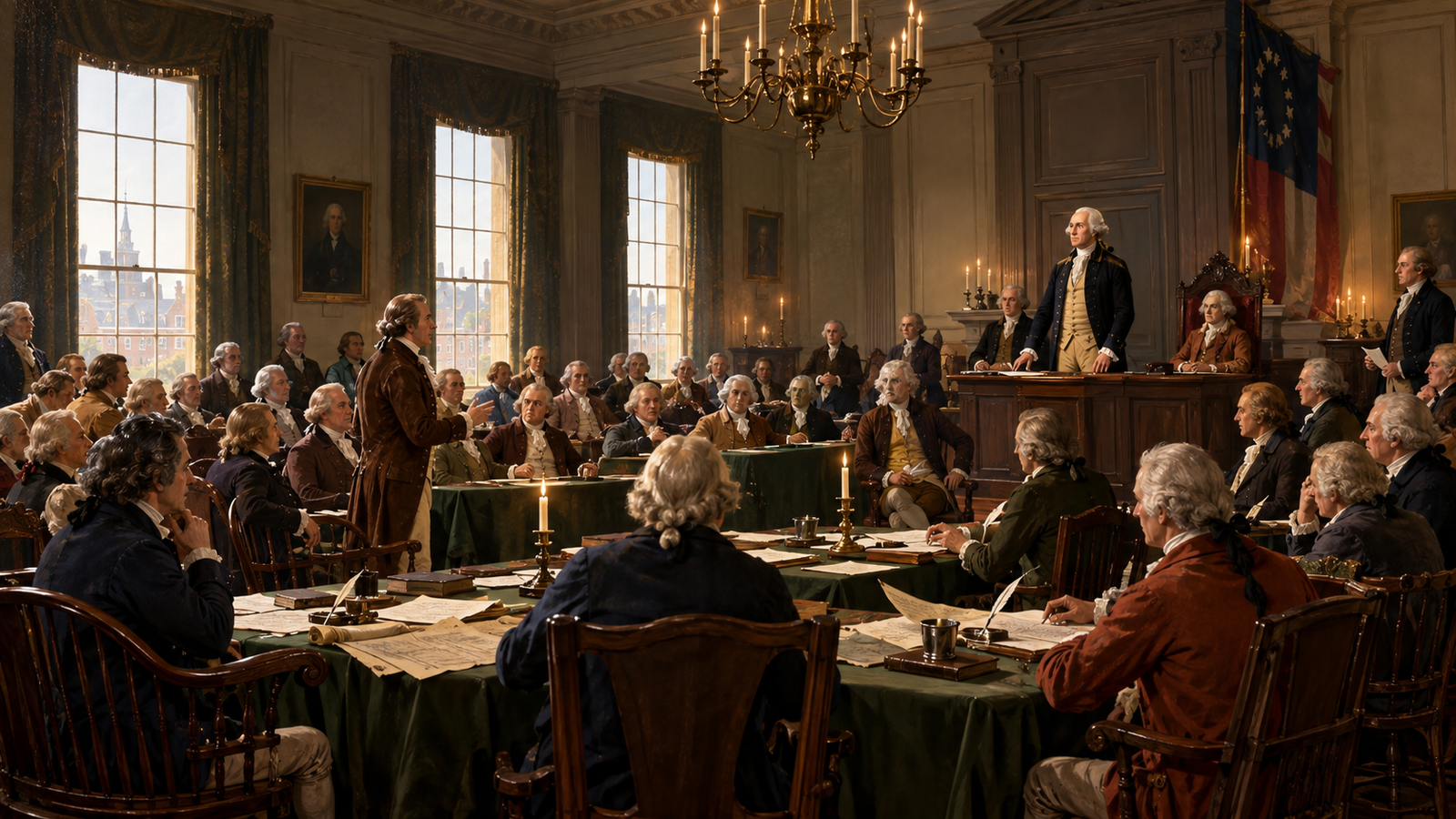
The creation of the United States Constitution was one of the most important moments in American history. After winning independence from Britain, the United States faced a difficult question: How should the new country be governed?
The American Revolution had created an independent nation, but independence alone did not solve the country’s political and economic problems. The new states needed a system of government that could maintain order, manage national affairs, protect the country, and balance the interests of different states and communities.
The Constitution was created to address these challenges. It established the framework of the federal government and remains the foundation of the United States government today.
America After the Revolutionary War
When the Revolutionary War ended in 1783, the United States was a young and fragile nation.
The former thirteen colonies had become independent states, but they were not yet operating under the strong federal system that exists today.
The country had suffered enormous economic and human costs during the war. The national government had limited financial resources, and the states often disagreed about trade, taxation, and other issues.
American leaders realized that winning independence was only the beginning. They now had to build a government capable of holding the new country together.
The Articles of Confederation
Before the Constitution was written, the United States was governed under the Articles of Confederation.
The Articles had been adopted during the Revolutionary War and became fully effective in 1781.
Under this system, the states retained most of their power. The national government was intentionally weak because many Americans feared creating a powerful central authority similar to the British government they had just fought against.
Congress could make decisions on certain national matters, but it had limited ability to enforce those decisions.
One major weakness was that Congress could not directly impose taxes on citizens. It depended heavily on requests for money from the states.
The national government also had difficulty regulating trade between states and dealing effectively with economic problems.
Problems With the Articles of Confederation
The weaknesses of the Articles became increasingly obvious during the 1780s.
The United States faced financial difficulties, including debts from the Revolutionary War.
Individual states sometimes created conflicting trade policies.
The national government also struggled to maintain a strong military and respond effectively to internal unrest.
One event that particularly alarmed American leaders was Shays’ Rebellion in Massachusetts.
Shays’ Rebellion
In 1786 and 1787, farmers in Massachusetts protested economic conditions, including debt and tax policies.
Many of the protesters were struggling to pay their debts and feared losing their property.
Daniel Shays, a former Continental Army soldier, became associated with the movement.
The rebellion eventually involved armed confrontations.
Although the uprising was suppressed, it frightened many political leaders.
To some Americans, Shays’ Rebellion demonstrated that the national government under the Articles of Confederation was too weak to respond effectively to serious unrest.
The event strengthened calls for reform.
Calls for a Stronger Government
American political leaders began discussing ways to improve the national government.
However, there was disagreement about how much power the federal government should have.
Some Americans wanted a stronger national government capable of dealing with national problems.
Others remained concerned that a powerful central government could threaten individual liberty and state authority.
The challenge was to create a system that was strong enough to function effectively while preventing government from becoming too powerful.
The Constitutional Convention
In 1787, delegates from several states gathered in Philadelphia to discuss changes to the Articles of Confederation.
The meeting became known as the Constitutional Convention.
It began on May 25, 1787.
Although the original purpose was to revise the Articles, the delegates eventually decided to create an entirely new framework of government.
The convention lasted several months.
Delegates debated questions involving representation, taxation, executive power, slavery, federal authority, and the relationship between the states and the national government.
George Washington Presides Over the Convention
George Washington was chosen to preside over the Constitutional Convention.
Washington was already one of the most respected figures in the new country because of his leadership during the Revolutionary War.
His presence helped give the convention credibility.
However, Washington did not write the Constitution himself.
Many different delegates contributed to the debates and development of the final document.
James Madison’s Role
James Madison was one of the most influential delegates at the convention.
He had studied political systems and prepared extensively for the meeting.
Madison believed the United States needed a stronger national government but also wanted mechanisms to prevent any one part of government from becoming too powerful.
Because of his major contribution to the convention and later defense of the Constitution, Madison is sometimes called the “Father of the Constitution.”
The Great Compromise
One of the biggest disagreements at the convention concerned representation in Congress.
Large states wanted representation based mainly on population.
Smaller states feared that this system would allow the larger states to dominate the government.
The delegates eventually reached what became known as the Great Compromise.
Congress would have two chambers.
The House of Representatives would be based largely on population.
The Senate would give each state equal representation, with two senators from each state.
This arrangement balanced the interests of large and small states.
The Three-Fifths Compromise
Slavery was one of the most difficult issues discussed at the convention.
Southern states wanted enslaved people counted when determining representation in the House of Representatives.
Northern states objected to giving slaveholding states additional political power based on enslaved people who had no voting rights.
The delegates reached a compromise concerning how enslaved people would be counted for purposes of representation and taxation.
The agreement counted three-fifths of the enslaved population for those calculations.
This compromise did not end slavery. Instead, slavery remained protected within the political structure of the new nation.
The Constitution’s treatment of slavery became one of the major contradictions in American history because the document established a government built around ideas of liberty while slavery continued.
The Question of the Presidency
The delegates also debated how the executive branch should operate.
They decided that the United States would have a president who would serve as the nation’s chief executive.
The president would have important responsibilities, including enforcing federal laws, serving as commander in chief, and conducting certain aspects of foreign policy.
The president would not be a king.
The Constitution established limits on presidential authority and created other branches of government capable of checking executive power.
Separation of Powers
One of the central ideas of the Constitution is separation of powers.
The federal government was divided into three branches:
The Legislative Branch
Congress makes federal laws.
It consists of two chambers:
- The House of Representatives
- The Senate
The Executive Branch
The president leads the executive branch and is responsible for enforcing federal laws.
The executive branch also includes departments and agencies that carry out government responsibilities.
The Judicial Branch
The federal judiciary interprets federal laws and resolves legal disputes.
The Supreme Court became the highest court in the federal system.
The division of power was designed to prevent too much authority from being concentrated in one institution.
Checks and Balances
The Constitution also created a system of checks and balances.
Each branch of government received certain powers that could limit the actions of the other branches.
For example, Congress passes legislation, but the president can veto bills.
Congress can override a presidential veto under certain conditions.
The federal courts can determine whether laws or government actions are consistent with the Constitution.
The president appoints federal judges, but the Senate must approve many of those appointments.
These mechanisms were designed to encourage cooperation and prevent abuse of power.
Federalism
Another major feature of the Constitution is federalism.
Federalism divides government authority between the national government and the states.
The Constitution gives the federal government certain powers while leaving other responsibilities to the states.
This structure was intended to balance national unity with state independence.
Federalism has remained an important part of American political life, and disagreements over the proper balance between federal and state power have continued throughout U.S. history.
The Constitution Is Signed
After months of debate, the delegates reached agreement on the final document.
On September 17, 1787, delegates signed the Constitution.
Thirty-nine delegates signed it.
Some delegates refused to sign because they had concerns about the new government or because they believed the document did not sufficiently protect individual rights.
The Constitution was then sent to the states for ratification.
The Federalist and Anti-Federalist Debate
The Constitution created a major political debate across the states.
Supporters of the Constitution became known as Federalists.
They argued that the country needed a stronger national government to maintain stability, manage economic affairs, provide national defense, and protect the union.
Opponents became known as Anti-Federalists.
They feared that the proposed federal government could become too powerful.
They also criticized the original Constitution for not containing a specific list of individual rights.
The debate became one of the most important political discussions in early American history.
The Federalist Papers
Supporters of the Constitution published a series of essays known as the Federalist Papers.
The essays were written by Alexander Hamilton, James Madison, and John Jay under the shared pseudonym “Publius.”
They explained and defended the proposed Constitution.
The Federalist Papers became important sources for understanding the arguments made in favor of the Constitution during the ratification debate.
The Bill of Rights
To address concerns about individual freedoms, supporters of the Constitution eventually agreed to add amendments protecting important rights.
The first ten amendments became known as the Bill of Rights.
They were ratified in 1791.
The amendments addressed freedoms and protections involving areas such as speech, religion, the press, assembly, criminal procedure, and other individual rights.
The Bill of Rights became a central part of the American constitutional system.
Ratification of the Constitution
The Constitution required approval from nine states before it could take effect among the ratifying states.
New Hampshire became the ninth state to ratify the Constitution on June 21, 1788.
The Constitution therefore reached the required threshold for ratification.
Virginia and New York also ratified it later in 1788, strengthening the new union.
North Carolina ratified in 1789, while Rhode Island became the final state of the original thirteen to ratify, doing so in 1790.
The First Presidential Election
The new government began operating under the Constitution in 1789.
George Washington was unanimously elected as the first president of the United States.
John Adams became the first vice president.
The first Congress also began establishing the institutions necessary to operate the new federal government.
The United States now had a constitutional system that separated government powers among different branches.
Why the Constitution Was Important
The Constitution provided a framework for governing a large and diverse country.
It established the federal government, defined its powers, created the three branches, established relationships between the federal government and states, and created procedures for changing the Constitution through amendments.
Perhaps most importantly, the Constitution was designed to create a government based on written rules rather than the personal authority of a monarch.
However, the Constitution was not perfect.
Many groups were excluded from political participation, and slavery remained deeply embedded in American society.
Women generally could not vote, enslaved people had no political freedom, and Indigenous peoples were not treated as equal participants in the new political system.
The history of the Constitution therefore includes both its important contributions to American government and the major inequalities that existed when it was created.
The Constitution’s Long-Term Influence
The United States Constitution has remained the foundation of the federal government for more than two centuries.
It has been amended over time as American society has changed.
Some amendments expanded civil and political rights, including the abolition of slavery and the extension of voting rights to groups that had previously been excluded.
The Constitution has also been interpreted through decisions made by federal courts, particularly the Supreme Court.
Its principles of separated powers, federalism, representative government, and constitutional rights continue to shape American political life.
The creation of the Constitution was therefore more than a meeting in Philadelphia in 1787. It was an attempt to solve the problems of a new nation and establish a government that could survive for generations.
The document created a stronger union while placing important limits on government authority. At the same time, its compromises left major issues unresolved.
The United States would spend much of the following decades debating what the Constitution meant, who should enjoy its promises of liberty, and how the new nation should develop.
Leave a Reply