
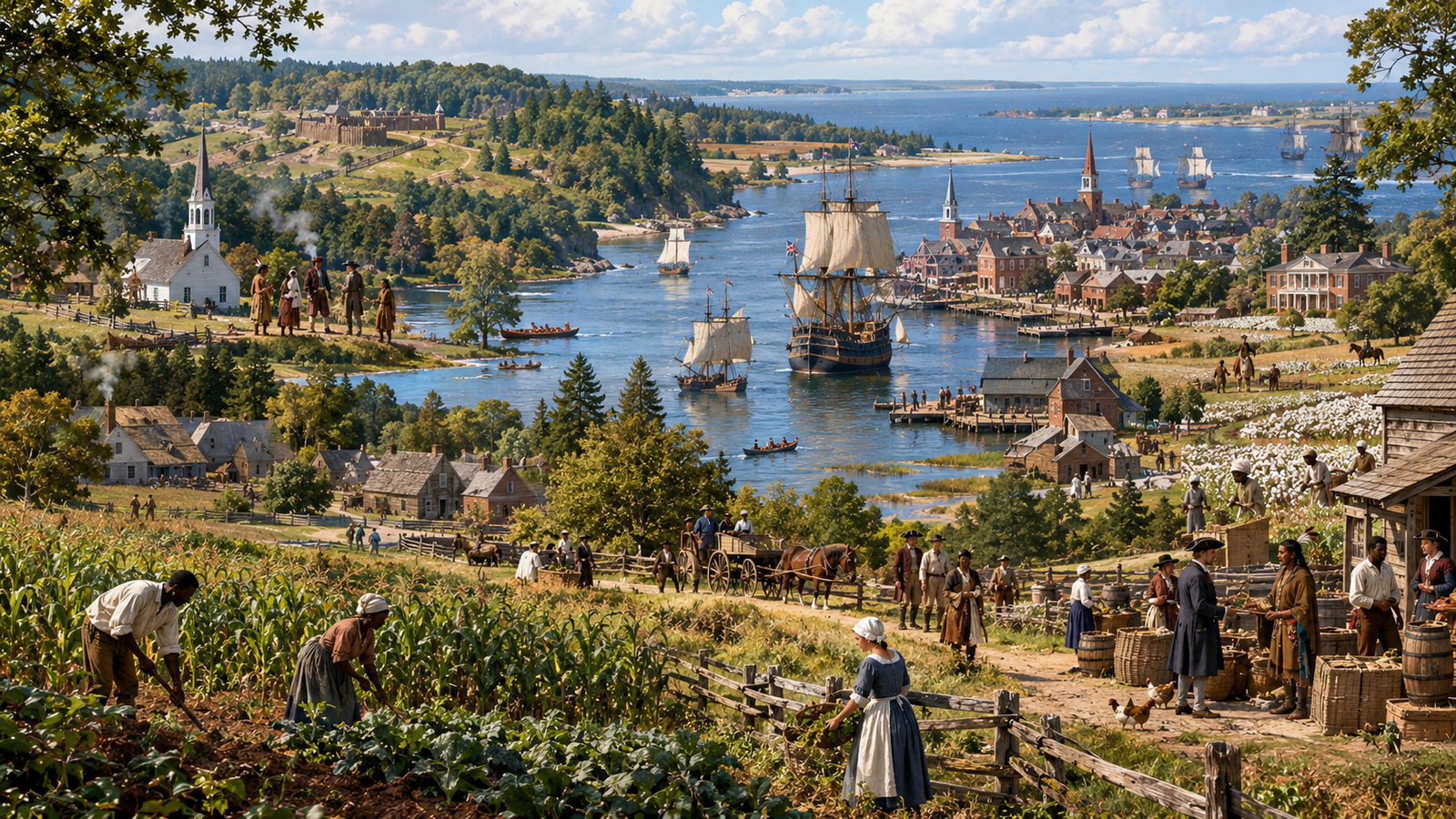
The history of the United States is closely connected to the thirteen British colonies that developed along the eastern coast of North America. These colonies were not created all at once, and they were not identical. Each colony developed at a different time, under different circumstances, and with its own economy, religious traditions, political institutions, and social structure.
By the middle of the 18th century, the thirteen colonies had become important British societies in North America. They had growing populations, farms, towns, ports, businesses, schools, and local governments. Although they were part of the British Empire, colonists increasingly developed a sense of local identity and political independence.
The thirteen colonies eventually became the original states of the United States after the American Revolution. Understanding how these colonies were established helps explain the events that eventually led to American independence.
What Were the Thirteen Colonies?
The thirteen colonies were British colonies located along the Atlantic coast of North America. They were:
- Virginia
- Massachusetts
- New Hampshire
- Maryland
- Connecticut
- Rhode Island
- North Carolina
- South Carolina
- New York
- New Jersey
- Pennsylvania
- Delaware
- Georgia
Historians commonly group them into three regions: New England, the Middle Colonies, and the Southern Colonies.
Each region developed different economic and social characteristics because of differences in geography, climate, natural resources, immigration, and settlement patterns.
The First Permanent English Colony: Virginia
Virginia was the first permanent English colony in North America.
In 1607, English settlers established Jamestown along the James River. The settlement was created by the Virginia Company, a private company that received permission from the English Crown to establish a colony.
The early settlers faced serious difficulties. They struggled with disease, hunger, unfamiliar environmental conditions, and conflicts with Indigenous communities.
The nearby Powhatan Confederacy was a major political power in the region. Relations between the English settlers and Powhatan communities included periods of trade and cooperation as well as increasing tension and conflict.
Virginia eventually developed an economy heavily dependent on agriculture.
Tobacco became particularly important after John Rolfe helped establish tobacco as a profitable export crop. As tobacco production expanded, colonists demanded more land and labor.
This contributed to the expansion of slavery in Virginia and helped create an agricultural economy that would become extremely important to the Southern Colonies.
Massachusetts and the Pilgrims
Massachusetts developed partly through the arrival of English religious groups.
In 1620, the Pilgrims established Plymouth Colony after crossing the Atlantic aboard the Mayflower.
The settlement faced difficult conditions during its early years. The colonists had to adapt to their new environment and find ways to produce enough food.
They also interacted with Indigenous peoples, including members of the Wampanoag Confederation.
A few years later, the Massachusetts Bay Colony was established in 1630 by English Puritans.
The Massachusetts Bay Colony became larger and more economically successful than Plymouth. Boston developed into an important center of colonial life.
Religion played a major role in Massachusetts society. Puritan leaders wanted to create a community based on their religious beliefs.
However, disagreements over religion and political authority eventually led some colonists to leave Massachusetts and establish new colonies.
New Hampshire
New Hampshire developed north of Massachusetts.
English settlements appeared in the region during the 17th century, with fishing, farming, timber, and trade becoming important parts of the economy.
The colony’s location gave it access to forests and waterways, making timber and shipbuilding valuable industries.
New Hampshire eventually became a separate royal colony.
Its population remained smaller than some of the other colonies, but it became an important part of New England.
Connecticut
Connecticut was established partly by colonists who moved westward from Massachusetts.
Thomas Hooker and other settlers founded Hartford in 1636.
Connecticut developed a strong tradition of local government.
One important document associated with the colony was the Fundamental Orders of Connecticut, adopted in 1638–1639. It is often described as one of the earliest written frameworks of government in the English colonies.
Agriculture, trade, and manufacturing later became important to Connecticut’s economy.
Rhode Island
Rhode Island was founded by people seeking greater religious freedom.
Roger Williams was a major figure in its early history. After leaving Massachusetts because of disagreements with colonial authorities, Williams established Providence in 1636.
Rhode Island became known for greater religious tolerance than many neighboring colonies.
Anne Hutchinson, another important figure in early colonial history, also settled in Rhode Island after religious and political conflicts in Massachusetts.
The colony developed around farming, trade, fishing, and maritime activities.
Its tradition of religious liberty became an important part of its historical identity.
The Middle Colonies
The Middle Colonies consisted primarily of:
- New York
- New Jersey
- Pennsylvania
- Delaware
These colonies were known for their diverse populations and economies.
People from different European backgrounds settled in the region, and several different religious groups lived alongside one another.
The Middle Colonies had fertile farmland, major rivers, forests, and access to the Atlantic Ocean.
These advantages helped the region develop agriculture, trade, manufacturing, and shipping.
New York
New York was originally established by the Dutch.
The Dutch founded New Netherland during the 17th century, with New Amsterdam becoming its major settlement.
In 1664, the English captured the colony and renamed it New York in honor of the Duke of York.
New York’s location was strategically important because of the Hudson River.
The river provided access to the interior and helped New York become an important center of trade.
The colony also had a highly diverse population, with people from different European backgrounds and religious traditions.
New York City eventually became one of the most important ports in colonial North America.
New Jersey
New Jersey developed after the English takeover of New Netherland.
The territory was divided among different owners before eventually becoming a separate colony.
Its location between New York and Pennsylvania made it strategically and economically important.
Farming was a major part of the economy, while trade and transportation also developed.
New Jersey attracted settlers from different backgrounds, contributing to the diversity of the Middle Colonies.
Pennsylvania
Pennsylvania was founded by William Penn in 1681.
Penn was a member of the Religious Society of Friends, commonly known as the Quakers.
He wanted Pennsylvania to provide a place where people could practice religion with greater freedom.
Philadelphia became the colony’s major city and an important center of trade.
Pennsylvania developed a strong agricultural economy because of its fertile land.
The colony also attracted immigrants from various parts of Europe, making it one of the most culturally diverse colonies.
Philadelphia eventually became one of the largest and most important cities in British North America.
Delaware
Delaware had a complicated early history because it was influenced by both Dutch and Swedish settlers before coming under English control.
It was closely connected to Pennsylvania for much of the colonial period.
Delaware’s location along the Delaware River provided opportunities for farming, fishing, and trade.
Although geographically small, the colony became one of the thirteen colonies that later declared independence from Britain.
The Southern Colonies
The Southern Colonies generally included:
- Maryland
- Virginia
- North Carolina
- South Carolina
- Georgia
These colonies developed economies that relied heavily on agriculture.
The warmer climate and fertile land allowed colonists to grow crops such as tobacco, rice, and indigo.
Large plantations became especially important in parts of the South.
The growth of plantation agriculture also contributed to the expansion of racial slavery.
Maryland
Maryland was established in 1634 under a charter granted to George Calvert, Lord Baltimore, and his family.
Religious considerations played an important role in the colony’s founding.
Maryland initially offered greater religious freedom to Catholics than many English colonies did.
The colony developed an agricultural economy, with tobacco becoming an important cash crop.
Like Virginia, Maryland eventually became increasingly dependent on enslaved labor as plantation agriculture expanded.
North Carolina
North Carolina developed from settlements connected to Virginia.
The colony’s geography included coastal plains, forests, rivers, and agricultural land.
Small farms were common, although plantations also existed.
Tobacco, timber, naval stores, and other products became important to the economy.
North Carolina’s population grew gradually as settlers moved southward from Virginia and arrived from other areas.
South Carolina
South Carolina developed around the port of Charleston, which became an important center of trade.
The colony’s warm climate supported crops such as rice and indigo.
Large plantations became a major feature of the economy.
The plantation system relied heavily on enslaved Africans, whose forced labor generated enormous wealth for plantation owners and merchants.
Charleston also became one of the most important ports in the Southern Colonies.
Georgia
Georgia was the last of the thirteen colonies to be established.
It was founded in 1732, with the first settlers arriving in 1733.
James Oglethorpe played a major role in establishing the colony.
Georgia was initially created partly as a buffer between the British colonies and Spanish Florida.
The colony also developed agricultural and trade activities.
Over time, Georgia adopted plantation agriculture and became increasingly connected to the economic system of the Southern Colonies.
How the Colonies Were Governed
Although the colonies were controlled by Britain, they had different forms of government.
Some colonies were royal colonies, meaning they were governed under the authority of the British Crown.
Others were proprietary colonies, where individuals or groups received control from the Crown.
There were also colonies with greater control over their own internal affairs.
Colonial governments commonly included elected assemblies.
These assemblies allowed property-owning colonists to participate in local political decisions, although political participation was restricted and did not include everyone.
Women, enslaved people, many poor people, and Indigenous people generally did not have the same political rights as property-owning white men.
The Colonial Economy
The economies of the thirteen colonies differed according to region.
New England relied heavily on fishing, shipbuilding, trade, farming, and maritime industries.
The Middle Colonies were known for grain production, farming, trade, and manufacturing.
The Southern Colonies relied heavily on agricultural exports.
Tobacco was important in Virginia and Maryland.
Rice and indigo became major exports from South Carolina.
The plantation economy created enormous wealth for some colonists while depending heavily on enslaved African labor.
Slavery in the Thirteen Colonies
Slavery became deeply connected to colonial economic development.
Enslaved Africans and their descendants were forced to work on plantations, farms, in households, and in other forms of labor.
By the 18th century, slavery was particularly important in the Southern Colonies.
Enslaved people had no freedom to choose their employment or control their own lives under the colonial slave system.
Despite these conditions, enslaved Africans and their descendants built families, communities, religious traditions, and cultural practices while resisting oppression in many different ways.
Their contributions became a fundamental part of American history.
Relations With Indigenous Peoples
The growth of the colonies took place on lands already inhabited by Indigenous nations.
Colonists and Indigenous peoples sometimes traded and cooperated, but relationships also involved disputes, land pressure, warfare, and forced displacement.
As colonial populations expanded, settlers increasingly occupied Indigenous lands.
This produced conflicts throughout the colonial period.
Indigenous nations also developed their own strategies for dealing with European powers. Some formed alliances, while others resisted colonial expansion.
The history of the thirteen colonies therefore includes both cooperation and conflict between Indigenous peoples and European settlers.
The Growth of Colonial Identity
By the 18th century, the colonies had developed distinct local identities.
A person living in Virginia might think of themselves as a Virginian, while someone in Massachusetts might strongly identify with New England.
At the same time, the colonies shared certain experiences.
They were part of the British Empire, used English legal traditions, traded within the British Atlantic economy, and were connected through political and cultural relationships.
Over time, many colonists began to develop a stronger sense that their interests were different from those of people living in Britain.
The Road Toward the American Revolution
The thirteen colonies remained under British rule for more than a century.
However, tensions increased after the French and Indian War ended in 1763.
Britain had accumulated large debts during the conflict and began seeking additional revenue from its American colonies.
Parliament introduced new taxes and regulations, including the Stamp Act and later the Townshend Acts.
Many colonists opposed these measures because they believed Britain was violating their political rights.
The famous slogan “no taxation without representation” reflected the argument that colonists should not be taxed by a Parliament in which they had no elected representatives.
Disagreements eventually grew into protests, boycotts, political organizations, and violent confrontations.
These tensions ultimately contributed to the American Revolution.
From Thirteen Colonies to Thirteen States
In 1776, representatives of the thirteen colonies declared independence from Great Britain.
The colonies were no longer simply separate British possessions. They began the difficult process of creating an independent country.
The American Revolutionary War lasted from 1775 to 1783.
After the United States won independence, the former colonies became the foundation of the new nation.
The thirteen colonies therefore occupy a central place in American history.
Their development shaped the country’s political institutions, economy, population, regional cultures, and conflicts.
Studying their history also reveals that colonial America was complicated. It involved ambitious settlers, Indigenous nations defending their territories, enslaved Africans struggling under an oppressive system, immigrants seeking new opportunities, religious communities seeking freedom, and political leaders debating the meaning of rights and government.
Leave a Reply