
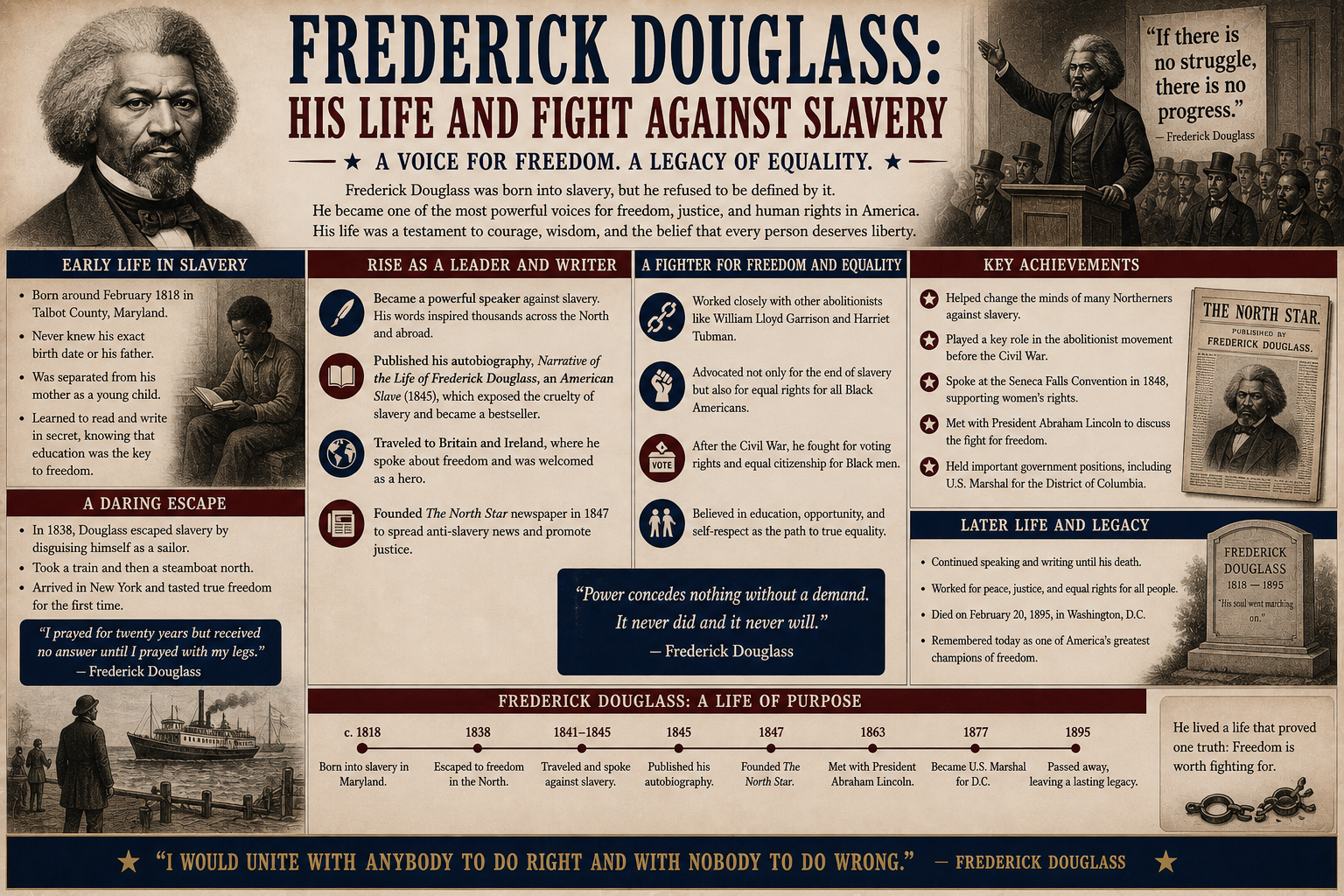
Frederick Douglass was one of the most influential African American leaders of the nineteenth century. Born into slavery, he escaped to freedom and became a powerful writer, speaker, abolitionist, and advocate for equality.
At a time when enslaved people were often denied education and treated as property, Douglass used his ability to read, write, and speak publicly to challenge slavery and demand freedom.
His life was remarkable not only because he escaped slavery but because he dedicated the rest of his life to helping others understand why slavery was wrong and why African Americans deserved full rights.
Early Life in Slavery
Frederick Douglass was born into slavery in Maryland around 1818. His birth name was Frederick Augustus Washington Bailey.
Like many enslaved children, Douglass faced uncertainty from an early age.
He was separated from his mother, Harriet Bailey, when he was very young. His mother lived on another plantation and could only visit him occasionally.
Douglass grew up under a system that denied enslaved people control over their own lives.
He experienced the harsh realities of slavery, including forced labor and the constant possibility of separation from family.
These experiences shaped his understanding of slavery and later influenced his writing and speeches.
Learning to Read
One of the most important moments in Douglass’s life occurred when he began learning to read.
When Douglass was a child, his enslaver’s wife, Sophia Auld, initially began teaching him the alphabet.
Her husband objected, arguing that education would make an enslaved person dissatisfied with slavery.
Douglass later realized that this was exactly why literacy was so powerful.
He secretly continued teaching himself.
He exchanged lessons with white children in Baltimore and used newspapers and other materials to improve his reading and writing.
Education opened a new world to him.
Through reading, Douglass learned more about freedom, human rights, politics, and the arguments used to defend slavery.
He eventually understood that knowledge could be a powerful weapon against oppression.
Resistance to Slavery
As Douglass grew older, he became increasingly determined to resist slavery.
One important experience occurred when he was sent to work for Edward Covey, a man known for disciplining enslaved people harshly.
Douglass described Covey as a “slave breaker.”
After enduring repeated abuse, Douglass fought back against Covey.
Douglass later described the confrontation as a turning point in his life.
Although he remained enslaved afterward, the experience strengthened his determination never to surrender his sense of dignity.
Escape to Freedom
In 1838, Douglass escaped from slavery.
He traveled north using a disguise and assistance from people involved in the antislavery movement.
He eventually reached New York City and then settled in New Bedford, Massachusetts.
After escaping, he changed his surname to Douglass.
Freedom did not mean that his life was suddenly easy.
Under the Fugitive Slave Act and the laws of the time, escaped enslaved people could still be captured and returned.
Douglass therefore remained cautious.
Nevertheless, he was finally able to live outside the direct control of an enslaver.
Becoming an Abolitionist
Douglass soon became involved in the abolitionist movement.
He attended an antislavery meeting in New Bedford and eventually met William Lloyd Garrison, a famous white abolitionist and publisher of The Liberator.
Garrison recognized Douglass’s extraordinary speaking ability.
Douglass began traveling and speaking publicly about slavery.
His firsthand experience gave his speeches enormous power.
He could describe slavery not as an abstract political issue but as something he had personally experienced.
His speeches challenged the arguments of people who claimed that enslaved people were content with their lives or incapable of intellectual achievement.
His First Autobiography
In 1845, Douglass published his first autobiography, Narrative of the Life of Frederick Douglass, an American Slave.
The book became one of the most important firsthand accounts of American slavery.
Douglass described his childhood, his education, the violence of slavery, his resistance, and his escape.
The autobiography helped readers understand the realities of slavery through the experience of someone who had lived through it.
However, publishing the book created a new danger.
Douglass’s identity was now widely known.
Because he was legally still considered a fugitive under U.S. law, there was a risk that slaveholders could attempt to capture him.
His Time in Britain and Ireland
After publishing his autobiography, Douglass traveled to Britain and Ireland.
He gave speeches about slavery and gained supporters overseas.
British supporters eventually helped raise money to secure Douglass’s legal freedom.
He returned to the United States in 1847.
The trip also strengthened Douglass’s confidence as an international public speaker and reformer.
The North Star Newspaper
In 1847, Douglass founded an abolitionist newspaper called The North Star.
Its motto emphasized that “Right is of no Sex—Truth is of no Color.”
Through the newspaper, Douglass discussed slavery, racial discrimination, politics, education, and women’s rights.
The newspaper gave him an independent platform.
Douglass no longer depended entirely on other abolitionists to distribute his ideas.
He could write directly to his readers and participate in national political debates.
Douglass and Abraham Lincoln
Frederick Douglass eventually became an important political adviser and critic of President Abraham Lincoln.
At the beginning of the Civil War, Douglass strongly pushed the government to make emancipation a central goal.
He argued that Black men should be allowed to serve in the Union Army.
When the government began recruiting African American soldiers, Douglass supported the effort and encouraged Black men to enlist.
Two of his sons eventually served in the Union Army.
Douglass met with Lincoln several times during the war.
He admired Lincoln’s leadership but was also willing to criticize him when he believed the president was moving too slowly on emancipation and racial equality.
The Emancipation Proclamation
In 1863, Lincoln issued the Emancipation Proclamation.
The proclamation declared enslaved people in areas under rebellion to be free, subject to its terms.
Douglass welcomed the change but understood that the proclamation did not immediately end slavery everywhere.
He continued pushing for African American military service and equal treatment for Black soldiers.
Douglass believed that African Americans should have the opportunity to fight for the country whose future would determine their freedom.
The service of nearly 200,000 Black soldiers and sailors became an important part of the Union war effort.
Douglass During Reconstruction
After the Civil War, Douglass continued his fight for equality.
The abolition of slavery was a historic achievement, but freedom did not automatically produce equal treatment.
Formerly enslaved people faced discrimination, violence, political opposition, and economic difficulties.
Douglass supported the constitutional amendments that abolished slavery, established citizenship, and protected voting rights.
He also argued that African Americans needed political power to protect the freedoms they had gained.
Voting was therefore extremely important to him.
Douglass and Women’s Rights
Douglass’s activism extended beyond the fight against slavery.
He also supported women’s rights.
He attended the 1848 Seneca Falls Convention, where women’s suffrage was discussed.
Douglass believed that the principles of freedom and equality should apply broadly.
He supported the idea that women should have the right to vote.
His support for women’s rights remained an important part of his reform work.
His Later Career
Douglass held several important government positions after the Civil War.
He served as U.S. Marshal for the District of Columbia and later became the first African American to serve as U.S. Minister Resident and Consul General to Haiti.
He continued writing, speaking, and advocating for civil rights throughout his life.
Douglass also published additional autobiographies, including My Bondage and My Freedom and Life and Times of Frederick Douglass.
These works provide valuable insight into his experiences and the major political changes of the nineteenth century.
Frederick Douglass’s Legacy
Frederick Douglass died in 1895.
By then, he had lived through enormous changes in American history.
He had been born into slavery and died as an internationally respected writer, speaker, and government official.
His life demonstrated the power of education and political activism.
Douglass’s writings also remain important historical sources because they provide firsthand accounts of slavery and the struggle for freedom.
His speeches continue to be studied because they addressed questions that remain relevant: What does freedom mean? Who should have political rights? How should a society respond to injustice?
Why Frederick Douglass Mattered
Douglass was important because he challenged slavery from multiple directions.
He spoke publicly.
He wrote books and newspapers.
He advised politicians.
He supported Black military service.
He advocated for voting rights.
He supported women’s rights.
Most importantly, he insisted that African Americans should be treated as full human beings and citizens.
His life also challenged racist assumptions about Black intelligence.
His ability as a writer and speaker made it impossible for audiences to dismiss the intellectual abilities of formerly enslaved people.
Final Thoughts
Frederick Douglass’s life was a powerful journey from slavery to leadership.
Born into slavery in Maryland, he secretly learned to read and write, resisted the system that controlled him, and escaped to freedom in 1838.
Instead of remaining silent, he became one of America’s most influential abolitionists.
Through his autobiographies, speeches, newspaper, and political activism, Douglass exposed the realities of slavery and demanded freedom and equality.
During the Civil War, he pushed the government toward emancipation and supported the recruitment of African American soldiers.
After the war, he continued fighting for civil rights, voting rights, education, and equality.
Douglass’s story is important because it shows that the struggle against slavery was not simply a political debate between governments and politicians.
Enslaved people themselves fought for their freedom, and people such as Douglass used their voices to challenge an institution that had existed for generations.
His journey from an enslaved child to one of the most respected Black leaders in American history remains one of the most remarkable stories of the nineteenth century.
Leave a Reply