
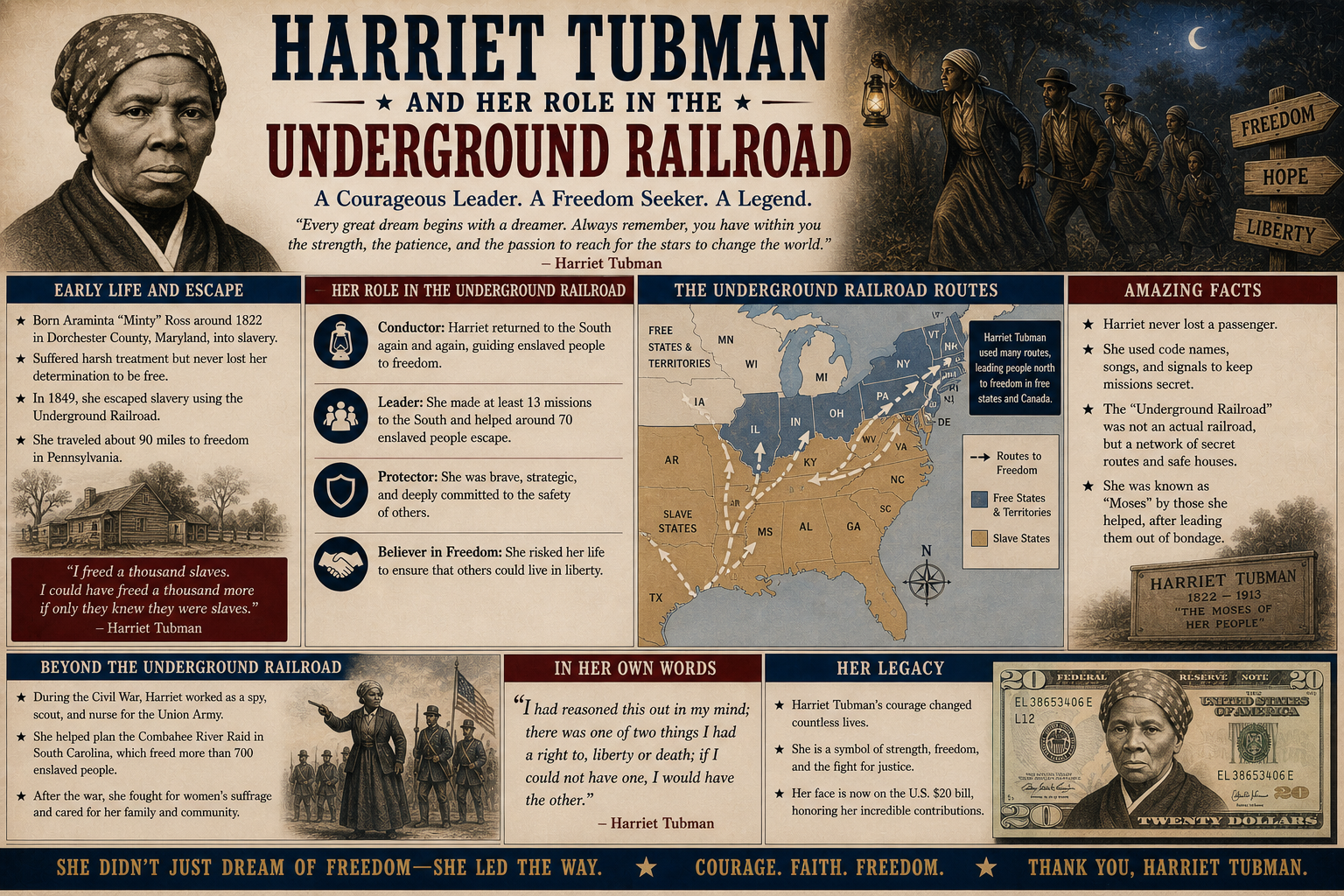
Harriet Tubman is one of the most famous figures in American history. Born into slavery, she escaped to freedom and then repeatedly returned to the South to help other enslaved people escape. Her courage, determination, and willingness to risk her own life made her an important figure in the Underground Railroad and the broader struggle against slavery.
Tubman’s story is remarkable because she did not simply escape slavery and leave it behind. After reaching freedom, she chose to return to dangerous territory to help family members and other enslaved people find their way to freedom.
Her work made her one of the best-known conductors associated with the Underground Railroad.
Who Was Harriet Tubman?
Harriet Tubman was born into slavery in Maryland around 1822. She was originally named Araminta Ross and later adopted the name Harriet, reportedly in honor of her mother.
Her childhood was extremely difficult.
Like other enslaved people, Tubman had very limited control over her own life. She was forced to work from a young age and experienced harsh treatment.
As she grew older, she became increasingly determined to escape.
Tubman understood that running away was extremely dangerous. If captured, she could be severely punished or sold farther away from her family.
Despite these risks, she decided that freedom was worth pursuing.
Tubman’s Escape
In 1849, Tubman escaped from slavery and reached Pennsylvania, a free state.
Her journey was dangerous because slaveholders and slave catchers actively searched for people who escaped.
Reaching Pennsylvania gave Tubman freedom, but it did not eliminate the danger.
The Fugitive Slave Act of 1850 allowed enslavers to pursue escaped enslaved people even in free states and required federal authorities to assist in returning them.
Tubman therefore had to remain cautious.
She eventually traveled farther north and made connections with people involved in the Underground Railroad.
Why Did Tubman Return to the South?
Many people might have chosen to remain safely in the North after escaping slavery.
Tubman made a different choice.
She returned to the South repeatedly to help others escape.
Her first major objective was to help members of her family.
She understood the risks because she had personally experienced slavery and knew what could happen if an escape attempt failed.
Yet she continued.
Her courage was driven partly by her belief that freedom should not be limited to herself.
She wanted her family and other enslaved people to have the same opportunity.
Tubman as a “Conductor”
The Underground Railroad was not a formal organization with offices, employees, or a single leader.
It was a loose network of people who helped enslaved people escape.
Some provided food and shelter.
Others supplied transportation or information.
People who guided freedom seekers from one location to another were often called conductors.
Tubman became one of the most famous conductors.
She traveled along secret routes between safe locations and helped people move toward free states and, increasingly, Canada.
Her journeys required careful planning.
She had to avoid slave catchers, protect the people traveling with her, and make decisions under dangerous circumstances.
The Importance of Secrecy
Secrecy was essential to the Underground Railroad.
Tubman could not simply announce where she was going or who she was helping.
She relied on trusted contacts and safe houses.
People assisting escapees often communicated indirectly to avoid exposing the network.
Tubman also had to consider the possibility of betrayal.
If someone discovered the group’s plans, the escapees could be captured.
The Fugitive Slave Act made the situation even more dangerous because people who assisted freedom seekers could face legal punishment.
How Tubman Helped Escapees
Tubman’s work involved much more than simply telling people where to go.
She had to organize journeys, find safe places to stay, and determine when it was safest to travel.
Many journeys took place at night.
The people traveling with her had to remain quiet and avoid attracting attention.
They might hide in homes, barns, churches, or other safe locations during parts of their journey.
Tubman also had to make difficult decisions when people became frightened.
A person who decided to turn back could potentially reveal the location of the entire group.
Her leadership therefore required courage, planning, and determination.
The Journey to Canada
Because of the Fugitive Slave Act of 1850, Canada became an increasingly important destination for freedom seekers.
An escaped enslaved person who remained in the United States could potentially be captured and returned.
Canada offered greater protection from U.S. slave-catching efforts.
Tubman helped guide people northward and eventually toward Canada.
For many freedom seekers, crossing the international border represented an important step toward permanent freedom.
Tubman herself eventually spent significant time in Canada.
Tubman’s Relationship With Frederick Douglass
Harriet Tubman became connected with other leading abolitionists, including Frederick Douglass.
Douglass had also escaped slavery and became one of the most influential Black abolitionists of the nineteenth century.
The two respected one another.
While Tubman was known especially for her direct work helping people escape, Douglass became famous for his writing, speeches, and political activism.
Their different approaches contributed to the broader abolitionist movement.
Was Tubman Really Responsible for Hundreds of Escapes?
Stories about Harriet Tubman’s work have sometimes become exaggerated over time.
Tubman is often popularly described as having made approximately 19 trips into slave territory and helped around 300 enslaved people escape.
Historians generally agree that she made numerous dangerous journeys and helped many people, but some traditional numbers attributed to her work are difficult to verify precisely.
The exact number does not change the significance of what she accomplished.
Even a single return trip into slave territory was extremely dangerous.
Tubman repeatedly placed herself at risk to help others.
The Rewards Offered for Tubman’s Capture
Because Tubman was considered a serious threat to the slave system, rewards were reportedly offered for her capture.
She had become known among slaveholders as someone who could help enslaved people escape.
Tubman understood that capture could mean severe punishment or death.
Yet she continued her work.
Her ability to avoid capture became part of her reputation.
She used secrecy, trusted contacts, careful planning, and knowledge of the landscape to reduce the risks.
Tubman’s Use of the Natural Environment
The Underground Railroad did not follow a single fixed path.
Tubman and other conductors had to understand the environment around them.
Forests, rivers, roads, farms, towns, and railways could all affect an escape journey.
The North Star became an important symbol of escape and direction.
Tubman and other freedom seekers sometimes traveled at night, using natural landmarks and the night sky to navigate.
These journeys could take days or weeks depending on circumstances.
Tubman During the Civil War
Harriet Tubman’s work did not end when the Civil War began in 1861.
She contributed to the Union war effort in several ways.
She worked as a nurse, cook, scout, and guide.
Her knowledge of the South and her ability to communicate with local Black communities made her particularly valuable to Union forces.
In 1863, Tubman participated in the Combahee River Raid in South Carolina.
The Union operation helped free more than 700 enslaved people.
Tubman’s role demonstrated that her contribution to the struggle against slavery went far beyond the Underground Railroad.
Tubman After the Civil War
After the Civil War and the abolition of slavery, Tubman continued working for social causes.
She supported the rights of formerly enslaved people and became involved in the movement for women’s voting rights.
She also spent much of her later life helping others and supporting her community.
Tubman’s life after the Civil War shows that her commitment to equality did not end with emancipation.
She continued advocating for causes she believed would improve people’s lives.
Harriet Tubman’s Legacy
Harriet Tubman eventually became an enduring symbol of courage and freedom.
Her life has been remembered in books, schools, museums, monuments, and historical studies.
What makes her story especially powerful is the combination of personal courage and service to others.
Tubman had already escaped slavery.
She could have remained in the North and built a private life.
Instead, she repeatedly returned to dangerous areas because she wanted others to experience freedom too.
Her story also reminds us that the Underground Railroad was not simply about famous conductors.
Thousands of ordinary people participated by providing food, shelter, information, transportation, and other forms of assistance.
The movement depended on cooperation.
The Importance of Her Story
Tubman’s story helps us understand slavery from the perspective of resistance.
Enslaved people were not simply waiting for freedom to arrive.
Many actively sought ways to escape and improve their circumstances.
Tubman’s determination illustrates the strength of that desire.
Her work also demonstrates the dangers faced by people who challenged slavery.
Every journey involved uncertainty.
A mistake could lead to capture.
A trusted person could betray the group.
A safe house could be discovered.
Despite these dangers, Tubman continued.
Final Thoughts
Harriet Tubman’s role in the Underground Railroad is one of the most inspiring stories from the period before the American Civil War.
Born into slavery, Tubman escaped to freedom in 1849.
Instead of remaining safely in the North, she returned repeatedly to help family members and other enslaved people escape.
Through careful planning, secrecy, courage, and assistance from a wider network of supporters, she helped freedom seekers travel toward free states and Canada.
The Fugitive Slave Act of 1850 made her work even more dangerous, but it did not stop her.
During the Civil War, Tubman continued fighting against slavery by assisting the Union as a nurse, scout, guide, and other roles.
Her life demonstrates that the struggle against slavery involved much more than politicians and military leaders.
It also involved ordinary people who were willing to take enormous risks for freedom.
Harriet Tubman became one of the most recognizable symbols of that struggle.
Her legacy continues to remind us that freedom can require extraordinary courage, and that one person’s determination can inspire others to resist injustice.
Leave a Reply