
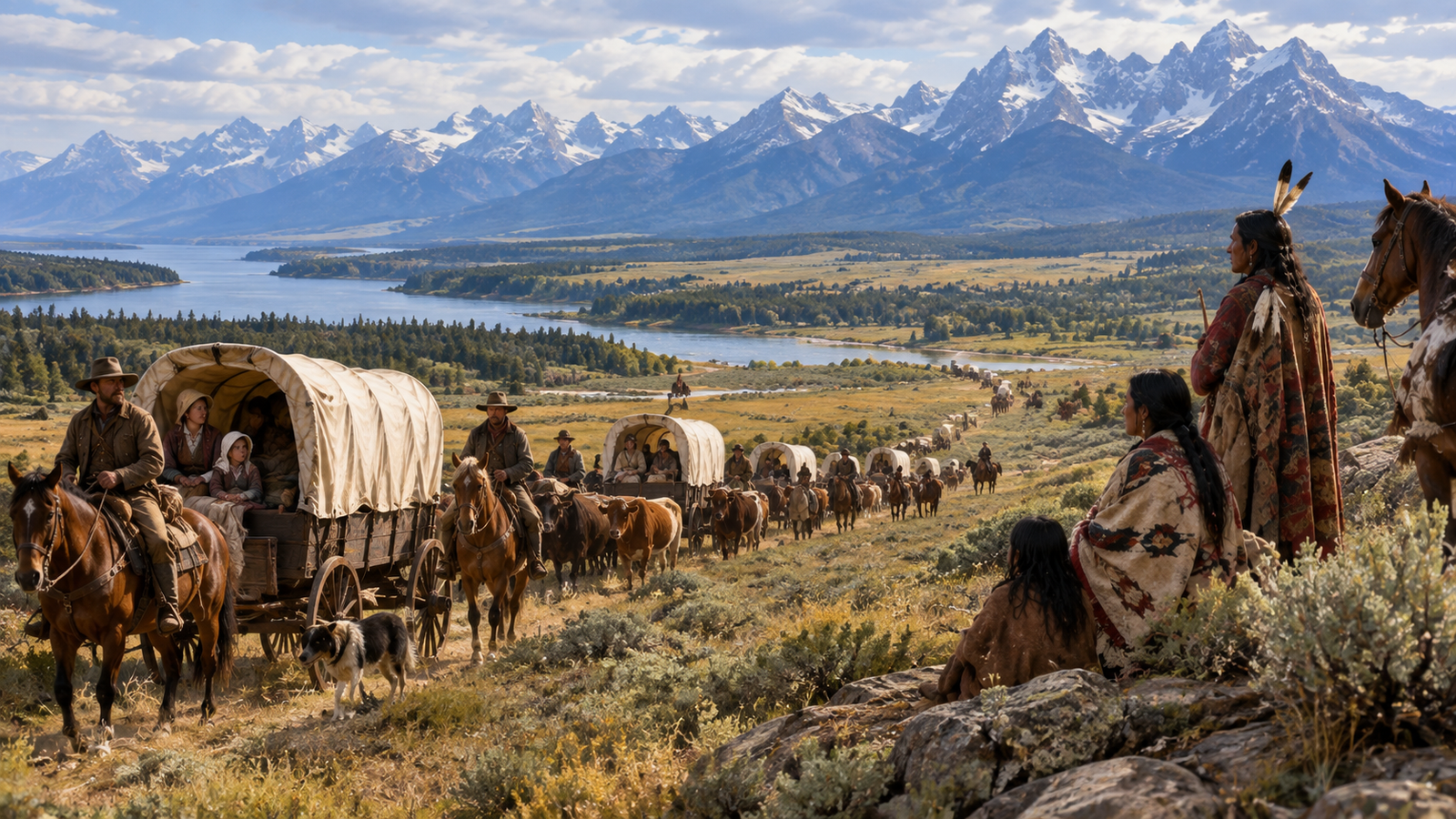
During the nineteenth century, the United States experienced one of the most dramatic periods of territorial expansion in its history. Americans moved westward across the continent, new territories were added to the country, and the United States eventually reached from the Atlantic Ocean to the Pacific Ocean.
This movement is often described as westward expansion. One of the ideas used to justify it was Manifest Destiny.
Manifest Destiny was the belief, popularized in the 1840s, that the United States had a special mission or destiny to expand across the North American continent. Supporters believed American political institutions, settlement, and economic development should spread westward.
However, westward expansion was much more complicated than the idea of simply moving into empty land. The continent was already home to millions of Indigenous people and numerous Native nations. Mexico controlled large areas of the Southwest and California, while Britain had major interests in the Pacific Northwest.
Expansion therefore involved migration, diplomacy, treaties, political disagreements, conflict, economic opportunity, and the displacement of Native peoples.
What Was Manifest Destiny?
The phrase Manifest Destiny became especially popular in the 1840s.
It expressed the belief that American expansion across the continent was natural, justified, or even inevitable.
The idea was connected to several beliefs that were common among many Americans at the time.
Supporters believed that the United States had a republican political system that could spread across new territories. Many also believed that American farmers and settlers needed additional land and that westward settlement would create economic opportunities.
Religion also influenced some supporters of expansion. Some Americans believed that their nation had a special purpose and that expansion was part of a larger mission.
However, not every American supported Manifest Destiny.
Critics questioned whether the United States had the right to take land from other countries or Indigenous peoples. Others worried that expansion would increase the political power of slavery.
America Had Already Been Expanding
Westward expansion did not suddenly begin in the 1840s.
The United States had been expanding for decades.
The Louisiana Purchase of 1803 greatly increased the country’s territory. President Thomas Jefferson purchased approximately 828,000 square miles from France.
The Lewis and Clark expedition soon explored much of the new territory and provided American officials with additional information about the West.
Settlement then continued beyond the Mississippi River.
By the 1840s, large numbers of Americans were already moving farther west.
Why Did People Move West?
There was no single reason why Americans moved west.
For many families, land was a major attraction.
Owning farmland could provide economic independence and the possibility of building a better future.
Other people were attracted by business opportunities.
Merchants, traders, missionaries, miners, and other workers also traveled west.
Some people moved because they wanted to escape economic difficulties in the East.
Religious groups also migrated westward. For example, members of the Church of Jesus Christ of Latter-day Saints moved toward the Great Salt Lake region after facing severe persecution in parts of the eastern United States.
The West therefore attracted people with many different goals.
The Oregon Trail
One of the most famous routes of westward migration was the Oregon Trail.
The trail stretched for roughly 2,000 miles from the Missouri region toward Oregon’s Willamette Valley. The journey could take several months and required careful planning.
Families traveled in wagon groups carrying food, clothing, tools, seeds, and other supplies.
The route crossed plains, rivers, deserts, and mountain passes.
The Bureau of Land Management describes the Oregon Trail as a wagon road of about 2,170 miles from Missouri to Oregon’s Willamette Valley. Thousands traveled the route during the nineteenth century.
Travel was difficult.
Families had to deal with changing weather, limited supplies, difficult terrain, and disease.
Some travelers did not complete the journey.
Despite the dangers, thousands continued west because they believed the opportunities waiting at the destination were worth the risks.
Native Peoples and the Westward Movement
One of the most important facts about westward expansion is that the West was not empty.
Numerous Indigenous nations already lived throughout the Great Plains, Rocky Mountains, Pacific Northwest, Southwest, and California.
These nations had established communities, political systems, trade networks, cultures, and relationships with their lands.
American settlers sometimes traded with Indigenous communities and received assistance with routes, food, and local knowledge.
At other times, competition over land and resources produced serious conflict.
As American settlement increased, Native nations lost control over increasing portions of their ancestral territories.
This made westward expansion a deeply consequential process for Indigenous peoples.
The Oregon Country
The Pacific Northwest became an important area of competition between the United States and Great Britain.
The region was known as the Oregon Country or Oregon Territory in different contexts.
Both countries had interests there.
The territory included a vast area extending from the Pacific coast toward the Rocky Mountains.
The United States and Britain eventually agreed to jointly occupy the region while they negotiated the boundary.
American migration into Oregon increased during the 1840s.
The growing number of American settlers strengthened U.S. claims to the region.
The Oregon Trail became an important route for this migration.
The “54°40′ or Fight” Debate
During the 1840s, some American expansionists demanded that the United States claim the Oregon Country as far north as the latitude of 54°40′.
The slogan “54°40′ or Fight” became associated with those who wanted a much farther northern boundary.
President James K. Polk supported American expansion but did not want a major war with Britain over Oregon.
Instead, his administration negotiated with Britain.
In 1846, the two countries reached an agreement establishing most of the boundary at the 49th parallel, with Vancouver Island remaining under British control.
The U.S. Senate ratified the treaty on June 18, 1846.
The agreement gave the United States control over territory that would eventually include the states of Oregon and Washington and other areas.
This was an important example of expansion through diplomacy rather than war.
Texas and American Expansion
Texas became another major part of the expansion story.
Texas had been part of Mexico.
During the 1830s, increasing numbers of settlers from the United States moved into Texas.
Tensions developed between many settlers and the Mexican government.
In 1836, Texas declared independence and established the Republic of Texas.
The new republic eventually sought annexation by the United States.
However, American politicians disagreed about whether Texas should become part of the country.
One major concern was slavery.
Texas permitted slavery, and adding it to the United States could alter the political balance between free and slave states.
For several years, the United States did not annex Texas.
The situation changed during the presidency of James K. Polk.
Texas was admitted to the Union in 1845.
James K. Polk and Expansion
President James K. Polk was one of the strongest supporters of American territorial expansion.
He became president in 1845 and focused heavily on expanding U.S. territory.
Polk wanted to settle the Oregon boundary dispute with Britain.
He also supported the annexation of Texas.
At the same time, his administration wanted to acquire California and other western lands controlled by Mexico.
Polk’s presidency therefore became closely connected to the idea of Manifest Destiny.
The United States was moving rapidly toward becoming a continental nation.
The Mexican-American War
The biggest and most controversial part of Polk’s expansion policy was the conflict with Mexico.
The United States and Mexico disagreed over the boundary of Texas.
The United States claimed the Rio Grande as the southern boundary of Texas.
Mexico argued that the boundary was farther north at the Nueces River.
President Polk sent American troops into the disputed area.
Fighting broke out in 1846.
The United States declared war against Mexico.
The Mexican-American War lasted from 1846 to 1848.
American forces eventually occupied Mexico City.
The conflict ended with the Treaty of Guadalupe Hidalgo in 1848.
The Mexican Cession
The Treaty of Guadalupe Hidalgo dramatically changed the map of North America.
Mexico recognized the Rio Grande as the boundary of Texas and ceded a huge amount of territory to the United States.
This territory became known as the Mexican Cession.
It included areas that would later become parts or all of California, Nevada, Utah, Arizona, New Mexico, Colorado, and Wyoming.
The acquisition gave the United States a Pacific coastline and brought the country much closer to its later continental boundaries.
The State Department describes the period as one in which the United States pursued expansion through both diplomacy with Britain and war with Mexico.
California and the Pacific Coast
California became particularly important because of its location along the Pacific Ocean.
Before American control, California had been part of Mexico.
After the Mexican-American War, California became part of the United States.
The discovery of gold there in 1848 transformed the region.
News of gold spread rapidly, and thousands of people traveled toward California.
This movement became known as the California Gold Rush.
The sudden population increase helped California move quickly toward statehood.
In 1850, California entered the Union as a free state.
Its admission became part of another major political debate over the future of slavery.
The Gold Rush
The California Gold Rush demonstrated how economic opportunity could accelerate westward migration.
People arrived from the eastern United States and from many other parts of the world.
San Francisco grew rapidly.
New businesses, transportation networks, farms, and towns developed to support the growing population.
However, the Gold Rush also had devastating effects on many Native Californians.
Indigenous communities experienced violence, disease, loss of land, and severe population decline.
The California story therefore demonstrates both the opportunities created by westward expansion and its enormous human costs.
The Debate Over Slavery
Westward expansion created one of the biggest political problems in nineteenth-century America.
Every time the United States acquired new territory, politicians had to consider whether slavery would be permitted there.
The issue had already caused the Missouri Compromise in 1820.
The acquisition of western territories made the debate even more serious.
Many Northerners opposed expanding slavery into the western territories.
Many Southern leaders believed that slaveholding states should be allowed to expand slavery into new territories.
The disagreement became increasingly difficult to solve.
The Wilmot Proviso
During the Mexican-American War, Congressman David Wilmot proposed an amendment known as the Wilmot Proviso.
The proposal sought to prohibit slavery in any territory acquired from Mexico.
It did not become law, but it demonstrated how strongly the issue divided Congress.
The debate over the Wilmot Proviso became part of the growing political struggle between different sections of the country.
Westward expansion was therefore closely connected to the political crisis that eventually led to the Civil War.
Manifest Destiny and Its Critics
Not everyone believed American expansion was justified.
Some Americans argued that the United States was taking land from Mexico unfairly.
Others opposed the expansion of slavery.
Some questioned whether the government should use military force to acquire territory.
Politicians and writers debated whether expansion would strengthen or weaken the country.
The Mexican-American War, in particular, was controversial.
Some critics believed the conflict was an aggressive attempt to acquire Mexican territory.
The debate showed that Manifest Destiny was never universally accepted.
Expansion and Indigenous Displacement
The growth of American territory came at a major cost to Indigenous nations.
As settlers moved west, federal and state governments increasingly claimed Native lands.
Treaties were negotiated, but many were later broken or replaced.
Native nations resisted the loss of their territories through diplomacy, political organization, and armed resistance.
The federal government also established reservations and pursued policies intended to confine Indigenous peoples to particular areas.
The consequences lasted for generations.
Westward expansion therefore cannot be understood only as a story of pioneers and new opportunities. It was also a story of Indigenous displacement and the transformation of lands already occupied and governed by Native peoples.
The Meaning of “West”
The meaning of the American West changed over time.
At first, the West referred to lands beyond the Appalachian Mountains.
Later, it meant the Great Plains and Mississippi Valley.
Eventually, it included the Rocky Mountains, California, Oregon, and the Pacific Coast.
As the United States expanded, the frontier moved farther west.
For many Americans, the frontier represented opportunity.
For others, especially Indigenous peoples and Mexican communities whose lands came under U.S. control, expansion meant major political and social changes.
The United States Reaches the Pacific
By the end of the 1840s, the United States had achieved something that earlier generations could hardly have imagined.
The country stretched across the continent from the Atlantic to the Pacific.
The Oregon settlement with Britain secured much of the Pacific Northwest.
The annexation of Texas expanded the country in the southwest.
The Mexican Cession added enormous territories farther west.
The United States had become a continental power.
But this achievement created new problems.
The country now had to determine how these territories would be governed and whether slavery would expand into them.
The Consequences of Manifest Destiny
Manifest Destiny helped shape the political imagination of nineteenth-century America.
It encouraged many Americans to view westward expansion as a national mission.
It contributed to migration, settlement, economic development, and the growth of the United States.
It also influenced government policies and diplomatic decisions.
But the consequences were not the same for everyone.
Native nations lost enormous amounts of land.
Mexico lost approximately half of its territory through the Texas annexation and the Mexican-American War settlement.
The expansion also intensified the disagreement over slavery.
This disagreement became one of the most important political conflicts in American history.
Why Manifest Destiny Matters Today
Manifest Destiny remains an important concept because it helps explain how the United States became a continental nation.
The country that began along the Atlantic coast eventually expanded across North America.
That expansion involved many different forces: migration, economic opportunity, diplomacy, political ambition, military conflict, treaties, and the desire for land.
It also involved serious consequences.
The history of westward expansion reminds us that national growth can benefit some groups while causing enormous losses for others.
Understanding both sides of the story gives us a more complete picture of nineteenth-century America.
By the middle of the nineteenth century, the United States had expanded dramatically. The dream of reaching the Pacific had become a reality, but the nation now faced a much harder question: how could it remain united when the future of its newly acquired territories was tied to the deeply divisive issue of slavery?
Leave a Reply