
The Election of 1860: How Lincoln’s Victory Changed America
The presidential election of 1860 was one of the most important elections in American history. It took place at a time when the United States was deeply divided over slavery, states’ rights, political power, and the future of the country.
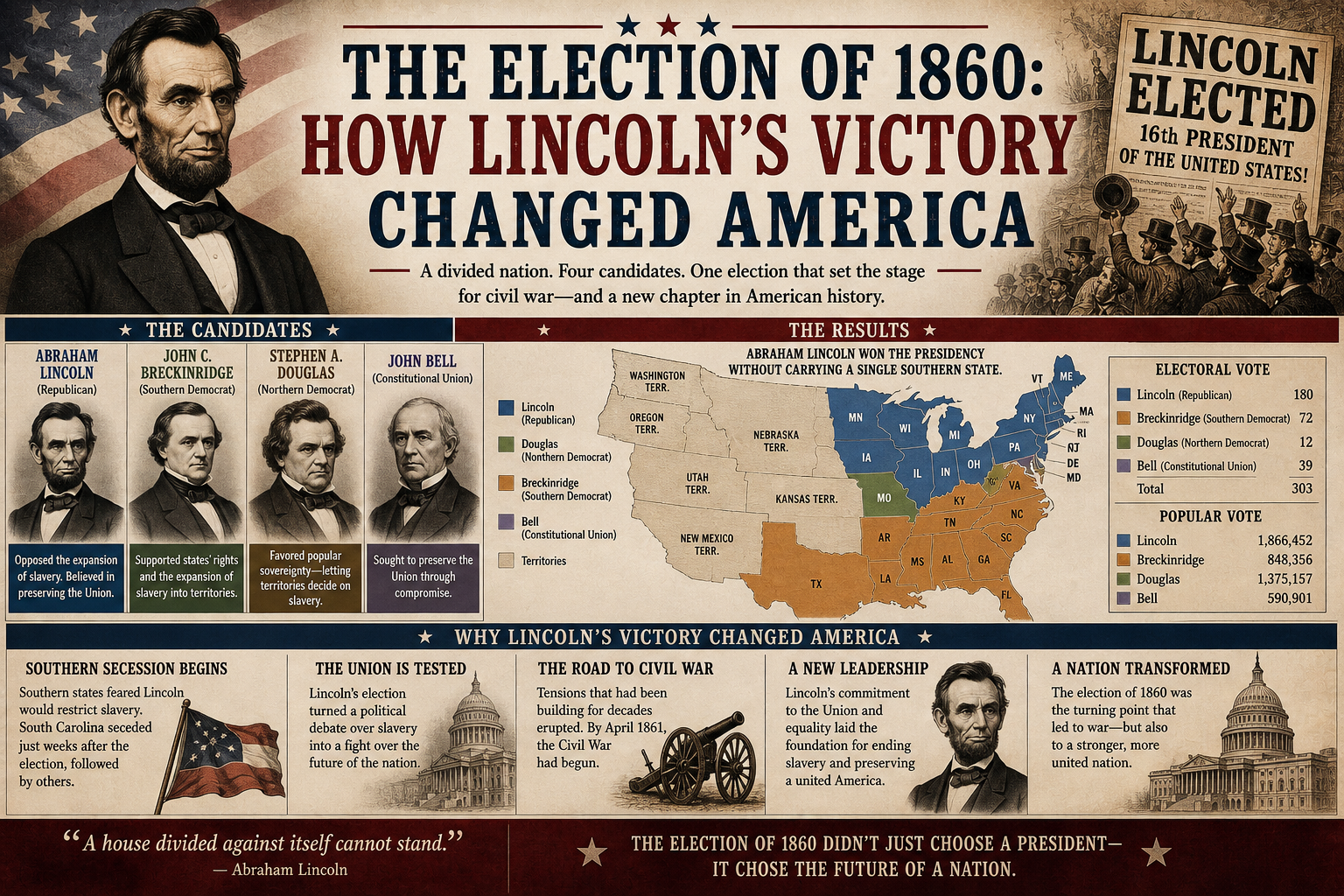
Abraham Lincoln, the Republican candidate, won the election without receiving a single electoral vote from the Deep South. His victory immediately intensified fears among many Southern leaders that slavery was under threat.
Within weeks, South Carolina became the first state to secede from the Union. Other Southern states soon followed, and the country moved toward the Civil War.
But why was Lincoln’s election so controversial, and how did it change America?
America Before the Election
By 1860, tensions between the North and South had been building for decades.
The most important issue was slavery.
Slavery was deeply connected to the economy and social structure of the Southern states, particularly those dependent on plantation agriculture. Many Southern political leaders believed that slavery was protected by the Constitution and that slaveholders had the right to take enslaved people into U.S. territories.
In the North, opposition to slavery’s expansion was becoming increasingly powerful.
The Republican Party had emerged during the 1850s with a central political position: slavery should not be allowed to expand into the western territories.
This did not mean that every Republican wanted immediate abolition of slavery where it already existed. But Republicans generally opposed allowing slavery to spread into new territories.
That position alarmed many Southern politicians.
A Divided Democratic Party
The Democratic Party had traditionally been one of the country’s major political parties.
However, by 1860, Democrats were deeply divided over slavery.
Northern Democrats largely supported Stephen A. Douglas, a senator from Illinois who promoted the idea of popular sovereignty.
Under popular sovereignty, residents of a territory would decide whether slavery would be permitted.
Southern Democrats wanted stronger federal protection for slavery in the territories.
The disagreement became so severe that Democrats held two separate presidential conventions.
Northern Democrats eventually nominated Stephen Douglas.
Southern Democrats nominated John C. Breckinridge, the sitting vice president.
This division weakened the Democratic Party and helped create the political conditions for Lincoln’s victory.
The Constitutional Union Party
A fourth major political force also appeared in the election.
The Constitutional Union Party was formed by politicians who wanted to avoid the increasingly bitter conflict over slavery.
The party nominated John Bell of Tennessee.
Bell campaigned on preserving the Union and following the Constitution, hoping to attract voters who were tired of sectional conflict.
Although the party won several Southern states, it could not prevent the country from becoming increasingly divided.
Abraham Lincoln’s Campaign
Abraham Lincoln was not initially considered the obvious Republican candidate.
Several prominent Republicans were interested in the nomination.
However, Lincoln had become nationally known following his debates with Stephen Douglas during the 1858 Illinois Senate campaign.
Lincoln argued strongly against the expansion of slavery.
He believed that allowing slavery to spread into the territories would put the country on a dangerous path.
During his campaign, Lincoln also tried to reassure voters that he did not intend to use federal power to immediately abolish slavery in states where it already existed.
His central political position was opposition to the expansion of slavery.
The Election Results
The election took place on November 6, 1860.
The result was a major victory for Lincoln.
He received about 40 percent of the popular vote but won a majority of the electoral votes.
His strongest support came from Northern states.
Lincoln won no electoral votes in the states that would soon form the Confederacy.
The election therefore demonstrated just how geographically divided American politics had become.
The country was no longer simply divided between two political parties.
It was increasingly divided along sectional lines.
Why Southern Leaders Were Alarmed
Lincoln’s victory frightened many Southern political leaders.
They believed the Republican Party’s opposition to the expansion of slavery could eventually lead to attacks on slavery itself.
Some feared that if slavery could not expand into new territories, its political and economic future would eventually become weaker.
Others believed that Lincoln’s election demonstrated that the South was losing its influence within the federal government.
The fact that Lincoln won without Southern electoral support made the situation particularly alarming.
Southern leaders questioned whether their interests could continue to be protected within the Union.
South Carolina Secedes
Lincoln’s election did not immediately begin the Civil War.
Instead, it triggered a political crisis.
On December 20, 1860, South Carolina became the first state to secede from the Union.
Its leaders argued that the election of Lincoln and the growth of the Republican Party threatened the institution of slavery.
Other Southern states followed.
Mississippi, Florida, Alabama, Georgia, Louisiana, and Texas seceded before Lincoln took office.
Several additional states seceded after fighting began in 1861.
The Formation of the Confederacy
In February 1861, representatives from several seceding states created the Confederate States of America.
Jefferson Davis was chosen as its president.
The Confederacy established its own government and claimed independence from the United States.
The federal government, however, rejected the idea that states could legally leave the Union.
Lincoln faced an enormous challenge even before taking office.
The country had two competing governments claiming authority over the same territory.
Lincoln’s Inauguration
Lincoln was inaugurated as president on March 4, 1861.
In his inaugural address, he attempted to reassure Southern states that he did not intend to interfere with slavery where it already existed.
At the same time, he firmly rejected secession.
Lincoln argued that the Union was permanent and that no state could simply leave it.
His speech reflected the difficult balance he was trying to maintain.
He wanted to preserve the Union without immediately turning the political crisis into a war.
Fort Sumter
The crisis eventually became military.
Fort Sumter, located in Charleston Harbor, South Carolina, was occupied by Union troops.
Confederate forces demanded that the Union garrison surrender.
On April 12, 1861, Confederate forces opened fire on the fort.
The Union garrison surrendered the next day.
The attack marked the beginning of the Civil War.
Lincoln then called for volunteers to suppress the rebellion.
The conflict quickly expanded.
Lincoln’s Election and the Civil War
It is important to understand that Lincoln’s election was not the sole cause of the Civil War.
The roots of the conflict went back decades.
Slavery, territorial expansion, political disagreements, economic differences, and disputes over federal authority had already divided the country.
However, Lincoln’s election became the immediate political trigger for secession.
Southern leaders interpreted the result as evidence that their political influence was declining and that the future of slavery was becoming uncertain.
The Republican victory therefore transformed years of political tension into a direct constitutional crisis.
The Election Changed American Politics
The election of 1860 permanently changed the country’s political landscape.
The Democratic Party had split into competing Northern and Southern factions.
The Republican Party emerged as a powerful national political force, although its support was concentrated in the North.
The election also demonstrated that a candidate could win the presidency without meaningful support from one major section of the country.
That sectional divide would become central to the Civil War.
Lincoln’s Presidency
Lincoln’s presidency would become closely associated with the survival of the Union and the eventual destruction of slavery.
At the beginning of the war, Lincoln’s primary stated objective was preserving the Union.
As the conflict continued, however, emancipation became increasingly central to the Union war effort.
In 1863, Lincoln issued the Emancipation Proclamation, declaring enslaved people in areas under rebellion to be free, subject to its terms.
The war ultimately led to the abolition of slavery throughout the United States through the Thirteenth Amendment.
Lincoln himself was assassinated in April 1865, only days after the major Confederate surrender at Appomattox.
The Broader Significance
The election of 1860 demonstrates how elections can reveal deep divisions within a society.
Lincoln won according to the constitutional rules of the time, but many Southern leaders rejected the political outcome.
The result shows that democracy depends not only on elections but also on whether opposing groups are willing to accept political outcomes and continue resolving disagreements through constitutional institutions.
In 1860, that political system was under extraordinary pressure.
The disagreement over slavery had become so intense that compromise was increasingly difficult.
Final Thoughts
The election of 1860 was a turning point in American history.
Abraham Lincoln won the presidency as the Republican candidate, largely through support from Northern states. His victory demonstrated the growing political strength of opposition to the expansion of slavery.
For many Southern leaders, however, the election represented a serious threat to the future of slavery and their political influence.
South Carolina seceded just weeks later, followed by several other Southern states.
The creation of the Confederacy and the attack on Fort Sumter eventually transformed the political crisis into the American Civil War.
Lincoln’s victory did not create all the divisions that caused the war. Those divisions had developed over many decades.
But the election exposed how far apart the two sections of the country had become.
It also set Abraham Lincoln on a path that would make him one of the most important figures in American history.
His presidency would ultimately be defined by the struggle to preserve the Union, the transformation of the war into a fight against slavery, and the enormous task of rebuilding the nation after four years of devastating conflict.
Leave a Reply