
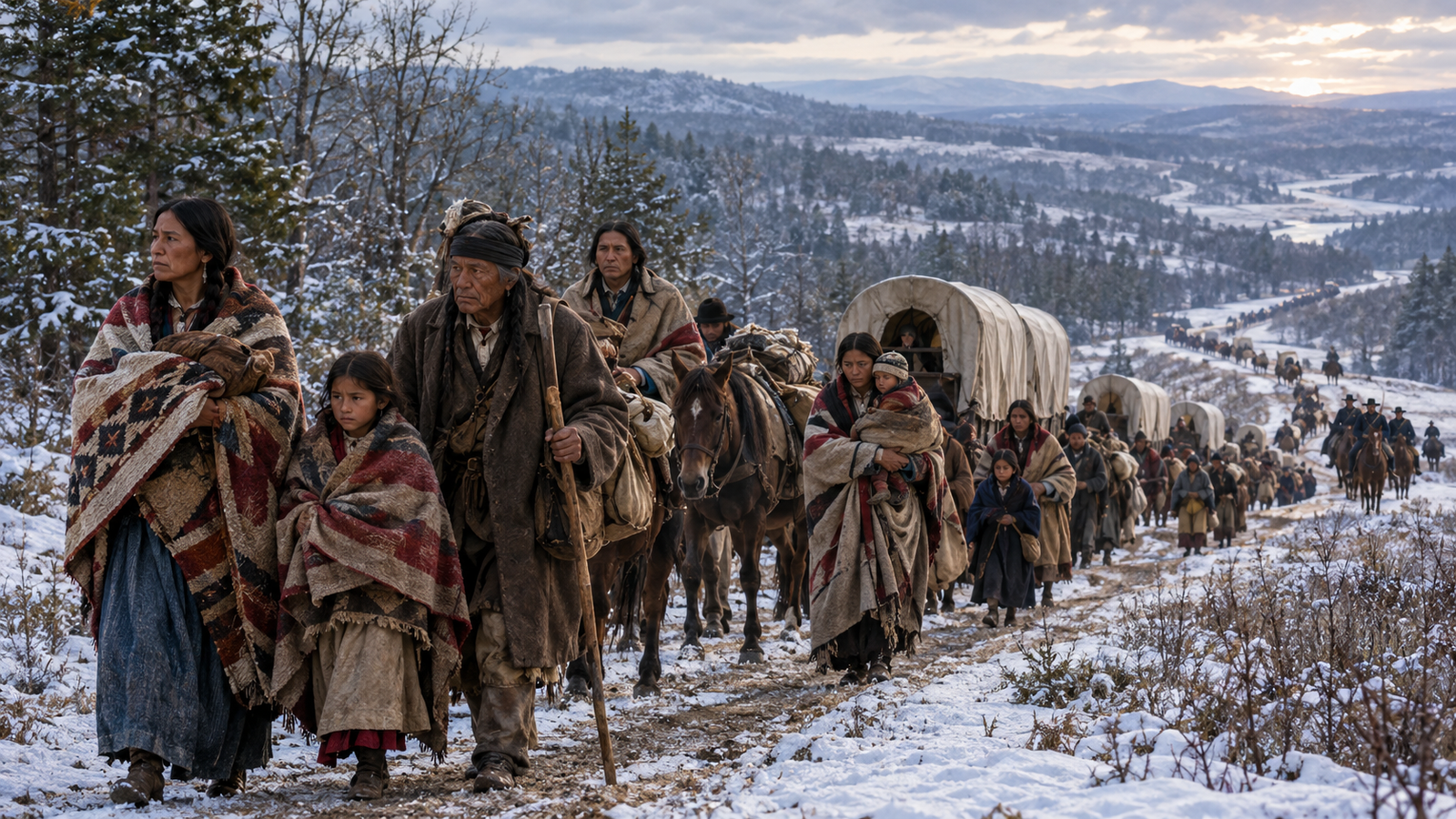
The history of the United States includes periods of major expansion, political development, and economic growth, but it also includes events that caused enormous suffering and loss. One of the most important examples was the forced removal of Native American communities from their ancestral lands during the nineteenth century.
The Indian Removal Act of 1830 was a major federal law that gave the U.S. government authority to negotiate the removal of Native American nations living east of the Mississippi River to lands farther west. Although the law described removal largely through the language of treaties and exchanges, the reality was often very different. Native nations faced intense pressure, broken agreements, military force, and the loss of their homelands.
The most famous episode connected to this policy was the Trail of Tears, particularly the forced removal of the Cherokee people from the southeastern United States to what was then called Indian Territory, largely in present-day Oklahoma.
The story of Indian removal is important because it shows how American westward expansion affected Native nations and how conflicts over land, sovereignty, and federal authority shaped the country’s history.
Native Nations Before Indian Removal
Native American peoples had lived across North America for thousands of years before the United States was established.
By the early nineteenth century, the southeastern United States was home to numerous Native nations with their own governments, languages, cultures, economies, and traditions.
Among the nations that became especially associated with Indian removal were the Cherokee, Creek, Choctaw, Chickasaw, and Seminole. These nations are often collectively called the Five Tribes or Five Civilized Tribes, although the historical label is now recognized as reflecting the attitudes of many white Americans at the time.
These Native nations had developed different relationships with European settlers and the growing United States.
Some adopted elements of European-American society while maintaining their own political and cultural identities.
The Cherokee, for example, developed a written language created by Sequoyah, established a national government, and published a newspaper.
Despite these developments, many white Americans continued to view Native lands as territories that should eventually be opened to American settlement.
Why Did Americans Want Native Lands?
During the early nineteenth century, the population of the United States was growing rapidly.
Farmers, settlers, land speculators, and state governments wanted access to additional land.
The southeastern United States was particularly attractive because of its fertile agricultural land.
Cotton production was expanding rapidly, especially after the invention and widespread use of the cotton gin.
The growth of cotton farming also increased the demand for enslaved labor.
As plantation agriculture expanded, land became increasingly valuable.
Native nations controlled large areas of land that American settlers and state governments wanted to acquire.
This created growing conflict.
The Question of Native Sovereignty
One of the most important issues was whether Native nations were independent political communities with the right to govern their own territories.
Many Native nations had their own governments and legal systems.
The Cherokee Nation, for example, adopted a written constitution in 1827.
However, some states claimed that Native nations living within their boundaries should be subject to state laws.
Native leaders strongly resisted this idea.
They argued that their treaties with the United States recognized their territorial and political rights.
The conflict therefore involved more than land.
It was also a struggle over sovereignty.
Andrew Jackson and Indian Removal
Andrew Jackson became president in 1829.
Jackson had long supported policies that encouraged the removal of Native Americans from lands desired by white settlers.
He argued that moving Native nations west of the Mississippi River would reduce conflict between Native communities and American settlers.
Supporters of removal claimed that Native nations would be able to preserve their cultures in new territories farther west.
Native leaders and their supporters, however, strongly disagreed.
They argued that their ancestral lands were their homes and that existing treaties should be respected.
The Indian Removal Act of 1830
In 1830, Congress considered a bill that would authorize the federal government to negotiate agreements for the removal of Native nations living east of the Mississippi River.
The legislation was controversial.
Supporters believed removal would make more land available to American settlers.
Opponents argued that forcing Native peoples from their homelands was unjust and violated existing agreements.
After a difficult political debate, Congress passed the Indian Removal Act.
President Andrew Jackson signed it into law on May 28, 1830.
The law did not technically authorize the government simply to take every Native territory by force.
Instead, it gave the president authority to negotiate treaties in which Native nations would exchange their lands in the East for lands west of the Mississippi.
In practice, however, the process often involved enormous pressure.
Native Resistance to Removal
Native nations did not simply accept removal.
Their leaders used courts, diplomacy, petitions, political organization, and other methods to defend their territories.
The Cherokee Nation became one of the strongest examples of organized resistance.
Some Cherokee leaders believed that using American-style legal and political institutions could help protect their sovereignty.
They established a constitutional government and pursued legal action against state and federal policies.
Their efforts eventually produced one of the most important Supreme Court cases in early American history.
Worcester v. Georgia
In Worcester v. Georgia, the Supreme Court considered whether the state of Georgia had authority over Cherokee territory.
The Court ruled in 1832 that Georgia could not impose its laws within Cherokee territory in the way the state attempted to do.
Chief Justice John Marshall argued that the Cherokee Nation had a distinct political relationship with the federal government.
The decision was a significant legal victory for the Cherokee.
However, the ruling did not stop the larger political movement toward removal.
The federal government’s response to the decision remains an important part of the historical debate over executive power, Native sovereignty, and the authority of the Supreme Court.
The Treaty of New Echota
The Cherokee Nation remained divided over how to respond to removal pressure.
A group of Cherokee representatives signed the Treaty of New Echota in 1835.
The treaty agreed to exchange Cherokee lands in the Southeast for territory farther west.
However, the treaty was opposed by many Cherokee people and leaders, including John Ross, the principal chief of the Cherokee Nation.
Ross and many others argued that the representatives who signed the treaty did not have authority to surrender Cherokee lands on behalf of the entire nation.
Despite the opposition, the U.S. government treated the treaty as valid.
This ultimately led to the forced removal of thousands of Cherokee people.
The Beginning of Forced Removal
After negotiations failed to produce voluntary relocation on the scale the government wanted, federal troops were used to remove Cherokee families from their homes.
In 1838, under President Martin Van Buren, soldiers and state forces were involved in the forced removal.
Cherokee families were gathered into temporary detention camps before being sent west.
They were separated from their homes, farms, communities, and familiar landscapes.
The journey west became known as the Trail of Tears.
The Trail of Tears
The Trail of Tears refers particularly to the forced migration of the Cherokee people from the Southeast to Indian Territory.
Thousands of Cherokee people were forced to travel long distances.
They faced harsh weather, shortages of food, disease, and difficult conditions.
Many people died during the removal and journey.
The exact number of deaths varies among historical estimates, but historians generally agree that several thousand Cherokee people died as a result of the removal process.
The Trail of Tears therefore became a lasting symbol of the human cost of forced removal.
Removal of Other Native Nations
The Cherokee were not the only Native nation affected.
The Choctaw were among the first major southeastern nations removed under the broader federal removal policy.
The Creek were also forced from much of their territory.
The Chickasaw were removed as well.
The Seminole resisted removal more strongly and became involved in the Second Seminole War, which lasted from 1835 to 1842.
Each Native nation experienced removal differently.
Some groups left through negotiated agreements.
Others resisted.
Some people remained in their original homelands despite removal policies.
The overall process, however, resulted in enormous losses of Native territory across the southeastern United States.
The Role of the Federal Government
The federal government played a central role in Indian removal.
Presidents, Congress, federal officials, military forces, and treaty negotiators all participated in the process.
However, state governments also played an important role.
Georgia, Alabama, Mississippi, and other states wanted control over Native lands within their claimed boundaries.
The conflict between state governments and Native nations therefore became connected to a broader question:
Who had authority over Native territories?
The federal government’s treaties with Native nations often recognized certain rights, while state governments sometimes attempted to ignore or override those agreements.
This conflict contributed to the pressure for removal.
The Connection to Cotton Expansion
The growth of cotton agriculture was one of the economic forces behind the demand for southeastern land.
Cotton had become extremely profitable.
New cotton-growing regions required large amounts of land.
The expansion of cotton plantations was closely connected to the expansion of slavery.
As Native nations were removed, land became available for American settlement and plantation agriculture.
This does not mean every person supporting removal was motivated by cotton, but economic interests were an important part of the larger pressure for Native lands.
Life in Indian Territory
The land west of the Mississippi River that Native nations were moved to was often described by American officials as a permanent home.
In reality, the situation was more complicated.
The territory was already inhabited by other Indigenous peoples.
Moving one Native nation into another Indigenous nation’s territory could create new tensions.
The relocated communities also had to rebuild their governments, farms, schools, churches, and economic systems.
Despite the enormous disruption, many Native nations rebuilt their institutions and maintained their identities.
They did not disappear.
Native American Resilience
It is important not to tell the story of Indian removal only as a story of suffering.
Native communities demonstrated remarkable resilience.
After removal, many rebuilt their political institutions and communities.
The Cherokee established schools and newspapers and continued developing their government.
Other Native nations similarly rebuilt their societies in Indian Territory.
Their cultures, languages, traditions, and political identities survived despite the enormous pressures they experienced.
Native American history therefore includes both the tragedy of dispossession and the continuing strength of Indigenous communities.
The Long-Term Consequences
Indian removal had lasting consequences for the United States.
Millions of acres of Native land were transferred to American control.
Settlers moved into areas that had previously belonged to Native nations.
Agricultural production expanded.
The policy also contributed to the rapid growth of states in the Southeast.
At the same time, Native nations lost enormous portions of their ancestral territories.
The effects of removal continued across generations.
Families lost homes and communities.
Traditional relationships with particular lands were disrupted.
Political conflicts between the United States and Native nations continued throughout the nineteenth century.
Why the Trail of Tears Is Remembered
The Trail of Tears remains one of the most well-known events in Native American history because it represents the consequences of a government policy that placed territorial expansion ahead of Native communities’ claims to their homelands.
It also demonstrates that American expansion was not simply a peaceful movement of settlers into unused land.
Much of the land that became part of the expanding United States was already inhabited and governed by Indigenous peoples.
The history of the Trail of Tears reminds us that treaties, court decisions, political promises, and government policies could have enormous consequences for real families and communities.
The Legacy of Indian Removal
The Indian Removal Act remained an important part of American history long after Andrew Jackson left office.
It helped establish a pattern in which the federal government acquired Native lands and moved Indigenous communities farther west.
Later policies would continue to reduce Native landholdings and challenge Indigenous sovereignty.
At the same time, Native nations continued to resist, adapt, and preserve their cultures.
Today, the Trail of Tears is remembered through museums, historic sites, educational programs, memorials, and the continuing work of Native communities.
The story is a reminder that the growth of the United States came with serious consequences for the people who already lived on the land.
Understanding Indian removal provides a fuller picture of nineteenth-century America. It shows the tension between national expansion and Indigenous sovereignty, the economic forces behind the desire for land, and the lasting impact of government decisions on Native American communities.
Leave a Reply