
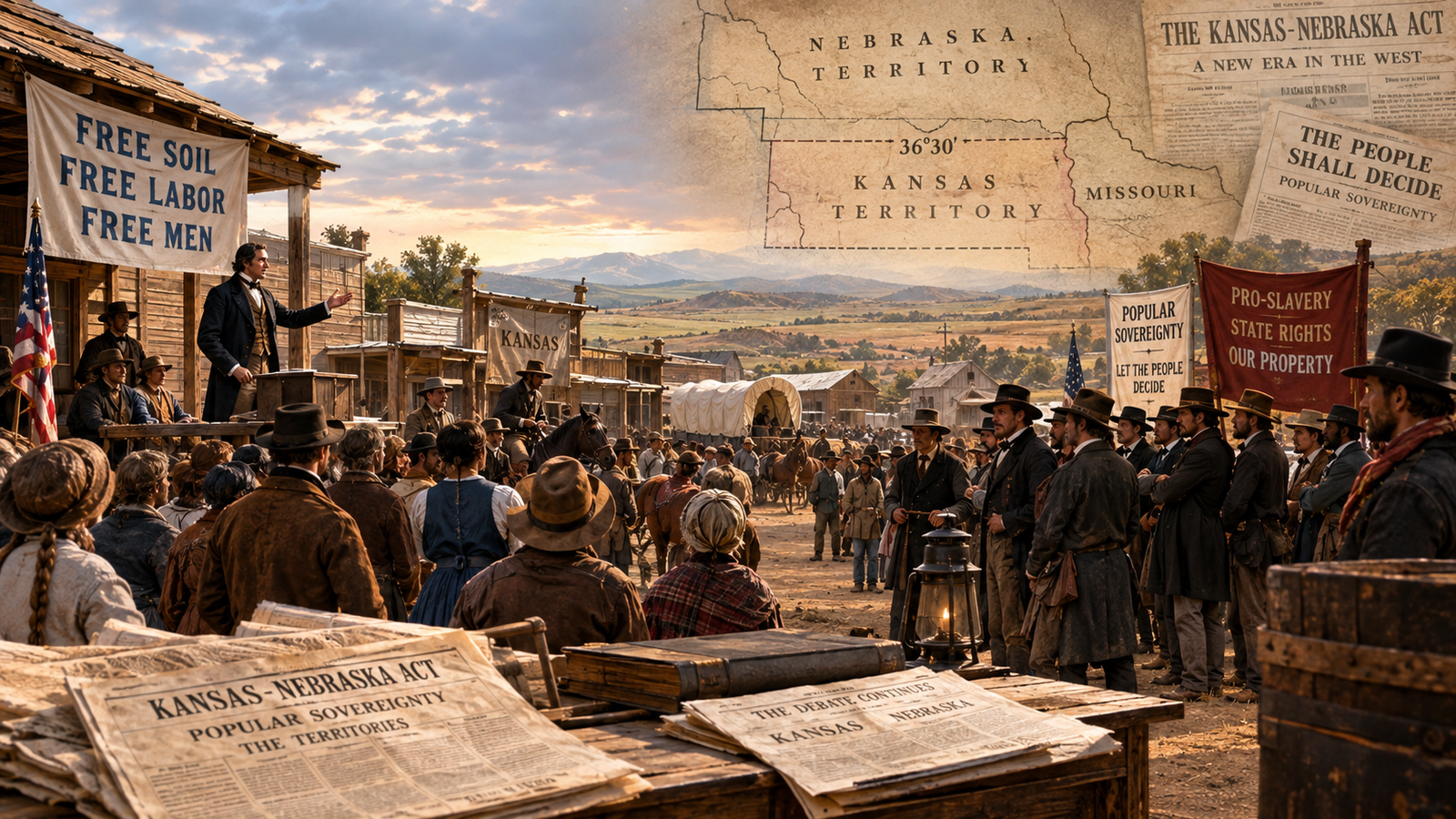
By the early 1850s, the United States was becoming increasingly divided over one major question: Should slavery be allowed to expand into the western territories? The country had repeatedly tried to settle this issue through political compromises, but each compromise seemed to create new problems.
The Kansas-Nebraska Act of 1854 became one of the most important turning points in this growing conflict. The law created the territories of Kansas and Nebraska and allowed settlers to decide whether slavery would be permitted through a policy called popular sovereignty. It also effectively repealed the Missouri Compromise’s restriction on slavery north of 36°30′ latitude.
Instead of peacefully solving the slavery question, the law helped turn Kansas into a center of political conflict and violence. The struggle became known as Bleeding Kansas, and it showed how difficult it had become for Americans to settle the slavery question through normal political processes.
The Background to the Kansas-Nebraska Act
The story begins with the rapid expansion of the United States during the first half of the nineteenth century.
The Louisiana Purchase of 1803 had added enormous territory to the United States. As Americans moved westward, new territories eventually needed to become states. This created a serious political problem because the admission of a new state could affect the balance between free states and slave states.
The Missouri Compromise of 1820 had attempted to manage this problem. Missouri entered the Union as a slave state while Maine entered as a free state. Congress also established a geographic restriction that generally prohibited slavery north of the 36°30′ line in the Louisiana Purchase territory, with Missouri being an exception.
For several decades, the compromise helped reduce some of the political pressure surrounding slavery.
But by the 1850s, westward expansion had made the question more difficult again.
New communities were developing in the territory west of Missouri and Iowa. Politicians began discussing how these lands should be organized and eventually admitted into the Union.
One of the most important politicians involved was Stephen A. Douglas, a senator from Illinois.
Douglas supported the idea of popular sovereignty. Under this approach, the people living in a territory would decide whether slavery would be permitted rather than having Congress make the decision directly.
It was presented as a democratic solution.
However, there was a major problem.
Kansas was located north of the 36°30′ line, meaning that under the Missouri Compromise, slavery would normally have been prohibited there.
The Kansas-Nebraska Act would change that.
What Was the Kansas-Nebraska Act?
The Kansas-Nebraska Act was officially titled “An Act to Organize the Territories of Nebraska and Kansas.”
Stephen Douglas introduced the legislation in Congress in January 1854. The proposal divided the region west of Missouri into two territories: Kansas and Nebraska.
The law was passed by Congress and signed by President Franklin Pierce on May 30, 1854.
Its most controversial feature was popular sovereignty.
Instead of Congress deciding whether slavery would exist in the territories, settlers would determine the issue.
The law also declared the Missouri Compromise restriction to be inoperative.
This immediately angered many people in the North.
To many antislavery Americans, the law represented a major reversal. A restriction that had existed since 1820 was now being removed.
The National Archives describes the act as reopening the national struggle over slavery in the western territories.
Why Kansas Became the Center of the Conflict
Kansas was particularly important because of its location.
It bordered Missouri, a slave state.
That meant people from Missouri could easily travel into Kansas.
At the same time, antislavery supporters in the North were determined to prevent Kansas from becoming a slave state.
Organizations such as the New England Emigrant Aid Company encouraged settlers who supported a free Kansas to move into the territory. Proslavery supporters from Missouri and other areas also moved into Kansas or became involved in its elections.
Not everyone who moved to Kansas was primarily interested in slavery. Many settlers simply wanted land, farming opportunities, businesses, or a new life in the West. The Kansas Historical Society notes that many settlers came for ordinary economic opportunities rather than to participate in the political struggle.
Nevertheless, the national slavery debate quickly overshadowed many other aspects of life in the territory.
Kansas became a test.
If antislavery settlers controlled the territory, Kansas might enter the Union as a free state.
If proslavery supporters controlled it, Kansas could become a slave state.
Both sides understood the importance of the outcome.
The Rush to Kansas
After the Kansas-Nebraska Act became law, people with different political beliefs rushed into Kansas.
Free-state supporters established communities including Lawrence and Topeka.
Proslavery supporters also organized settlements and political groups.
The competition became especially intense during elections.
The idea behind popular sovereignty was that the people would peacefully vote to determine Kansas’s future.
But the elections did not unfold as smoothly as supporters of the law had hoped.
Proslavery forces from neighboring Missouri crossed into Kansas during the territorial election. They became known as “Border Ruffians” by many of their opponents.
Their involvement contributed to accusations of election interference and fraud.
The result was a deeply disputed political system.
A proslavery legislature was established, while many antislavery settlers rejected its legitimacy and supported rival political institutions.
Instead of one united territorial government, Kansas became divided between competing groups claiming to represent the people.
The National Park Service notes that rival territorial governments, disputed elections, and conflicts over land contributed to the violence.
The Rise of “Bleeding Kansas”
As the political dispute continued, tensions became increasingly dangerous.
People were threatened because of their political beliefs. Property was destroyed, communities became divided, and armed groups formed.
This period became known as Bleeding Kansas.
The term refers to the violent conflict that took place in Kansas Territory during the years before the Civil War.
The conflict involved three major groups:
- Proslavery supporters
- Free-State supporters
- Abolitionists
These groups did not always agree with one another.
For example, some Free-State settlers opposed slavery’s expansion but did not necessarily support complete racial equality. Abolitionists generally took a stronger position against slavery itself.
This distinction is important because the conflict was more complicated than simply “North versus South.”
Kansas contained people with different political beliefs, and many ordinary settlers were caught in the middle.
The Sack of Lawrence
One of the most famous events of Bleeding Kansas occurred in May 1856.
Lawrence had become an important center of the Free-State movement.
Proslavery forces attacked the town on May 21, 1856. Buildings were damaged, and printing presses associated with antislavery newspapers were destroyed.
The event became known as the Sack of Lawrence.
News of the attack spread throughout the country.
For many Northerners, it became evidence that proslavery forces were willing to use intimidation and violence to control Kansas.
The conflict soon became even more serious.
John Brown and the Pottawatomie Attack
One of the most controversial figures associated with Bleeding Kansas was John Brown.
Brown was a militant opponent of slavery who believed that slavery was a profound moral wrong.
After the Sack of Lawrence, Brown and his followers carried out an attack at Pottawatomie Creek in May 1856. Five proslavery men were killed.
The incident became one of the most remembered events of Bleeding Kansas.
Brown later became nationally famous for his 1859 raid on Harpers Ferry, an event that further intensified the national conflict over slavery.
His activities in Kansas demonstrated how the struggle over slavery was moving beyond speeches, elections, and congressional debates.
Violence Spreads
The conflict in Kansas did not end after these events.
Political disagreements continued to produce confrontations between opposing groups.
Different communities became associated with different political positions. Fort Scott, for example, contained strongly divided groups, with proslavery supporters and Free-State supporters occupying different areas and institutions.
The violence was not always large-scale fighting.
It included threats, destruction of property, attacks on political opponents, and killings.
The Kansas Historical Society estimates that roughly 56 people were killed in various conflicts connected with the slavery question between 1854 and 1861, while historians have debated the exact number of deaths.
This is important because Bleeding Kansas was not a conventional war with clearly defined armies and battlefields.
Much of the conflict consisted of smaller confrontations and political violence.
The Importance of the Election Crisis
The central question remained: Would Kansas become a free state or a slave state?
The territorial government supported by proslavery forces attempted to establish a constitution that protected slavery.
Free-State supporters rejected these efforts and developed their own political institutions.
Kansas eventually went through several proposed constitutions during this turbulent period.
The disagreement demonstrated a major weakness in the idea of popular sovereignty.
The policy assumed that settlers could peacefully decide the slavery question through voting.
But if groups believed the result would determine the future of slavery, they had enormous incentives to manipulate elections and prevent their opponents from gaining control.
Instead of settling the slavery issue, popular sovereignty helped make Kansas a battleground.
The Republican Party Emerges
The Kansas-Nebraska Act also had consequences far beyond Kansas.
Many Northern politicians strongly opposed the expansion of slavery into the western territories.
Opposition to the Kansas-Nebraska Act helped bring together different political groups and contributed to the formation of the Republican Party during the 1850s.
The new party opposed the expansion of slavery into the territories.
The National Archives notes that opponents of the Kansas-Nebraska Act helped found the Republican Party and that the act pushed the country closer to civil war.
This was an important change in American politics.
The older political system was beginning to break apart.
The Whig Party collapsed, while Republicans became increasingly powerful in the North.
The country was becoming more politically divided along sectional lines.
Why Bleeding Kansas Mattered to the Whole Country
Kansas was only one territory, but what happened there had national consequences.
Americans across the country followed the events through newspapers and political speeches.
For Northerners, the violence could be presented as evidence that slavery threatened democratic government.
For many Southerners, Northern opposition to slavery’s expansion could be viewed as an attack on Southern political interests.
The conflict therefore increased distrust between the North and South.
Bleeding Kansas also demonstrated that political disagreements over slavery were becoming increasingly difficult to contain.
The National Park Service describes the violence as a warning of the much larger conflict that would soon come.
Kansas Finally Becomes a Free State
The struggle continued for several years.
Kansas eventually entered the Union as a free state on January 29, 1861.
By then, however, the United States was already approaching the Civil War.
Southern states began seceding after Abraham Lincoln’s election in 1860.
Kansas’s admission as a free state came just months before the Civil War began.
The long conflict in Kansas had therefore become part of the larger national crisis.
The Legacy of the Kansas-Nebraska Act
The Kansas-Nebraska Act was supposed to provide a democratic solution to the question of slavery in the western territories.
Instead, it helped make the problem worse.
By repealing the Missouri Compromise’s restriction and introducing popular sovereignty, the law opened Kansas to a fierce political struggle.
People from opposing sides moved into the territory. Elections became disputed. Rival governments appeared. Violence followed.
Bleeding Kansas demonstrated that the slavery question had become more than a disagreement between politicians.
It had become a national crisis affecting elections, political parties, newspapers, communities, and individual families.
The conflict also helped strengthen the Republican Party and contributed to the political environment that eventually produced Abraham Lincoln’s election in 1860.
Most importantly, Bleeding Kansas showed that compromise was becoming increasingly difficult.
The United States had spent decades trying to maintain a political balance between free and slave states. But by the mid-1850s, the disagreements were becoming too deep for another simple compromise to solve.
Kansas became an early warning of what was coming.
Only a few years later, the political conflict that had produced violence in Kansas would become a full-scale national Civil War.
Leave a Reply