
The Louisiana Purchase of 1803 was one of the most important land deals in American history. With a single agreement, the United States acquired a huge area of land from France and nearly doubled the size of the young nation. The purchase changed the future of the United States by opening the way for westward exploration, settlement, trade, and eventually the creation of many new states.
At the time, however, nobody could know exactly how important the agreement would become. The United States was still a young country, and its leaders were trying to understand how to protect its growing population and economy. Control of the Mississippi River and the port of New Orleans was especially important because farmers and merchants in the western parts of the country depended on these waterways to move their goods.
The Louisiana Purchase solved some immediate problems while creating new questions about territory, government, Native nations, slavery, and the future expansion of the United States.
What Was the Louisiana Purchase?
The Louisiana Purchase was an agreement between the United States and France in which the United States purchased approximately 828,000 square miles of territory in 1803.
The United States paid France $15 million for the territory. At roughly three cents per acre, the deal gave the United States an enormous amount of land for a relatively small amount of money by later standards.
The territory stretched westward from the Mississippi River toward the Rocky Mountains. Its exact boundaries were not completely clear at the time, and some areas were later disputed or changed through other agreements.
The land eventually became all or parts of many present-day U.S. states, including Louisiana, Missouri, Arkansas, Iowa, Oklahoma, Kansas, Nebraska, South Dakota, North Dakota, Montana, Wyoming, Colorado, and parts of other states.
This meant that the purchase was not simply about adding one new state. It created a massive area through which the United States could expand for generations.
Why Was New Orleans So Important?
To understand why President Thomas Jefferson was interested in the Louisiana Territory, it is important to understand the importance of the Mississippi River.
In the early United States, roads were limited and transportation over long distances was difficult. Farmers living west of the Appalachian Mountains needed affordable ways to transport crops and other goods to markets.
The Mississippi River provided a natural transportation route.
Goods could travel down the Mississippi toward the Gulf of Mexico and then reach international markets. The port of New Orleans was particularly valuable because ships could carry products from the interior of North America to other parts of the world.
Jefferson worried that a powerful European country controlling New Orleans could restrict American trade.
The situation became more concerning when Spain, which controlled Louisiana for much of the eighteenth century, transferred the territory back to France.
Jefferson believed that a French presence in North America could threaten American interests.
France Returns to North America
France had once controlled a large part of North America. However, after losing important wars and territories, French influence on the continent declined.
By the beginning of the nineteenth century, Napoleon Bonaparte was attempting to strengthen French power in Europe and overseas.
In 1800, Spain agreed to transfer Louisiana back to France through a secret agreement known as the Third Treaty of San Ildefonso.
The transfer worried American leaders.
The United States did not want a powerful France controlling territory next to the Mississippi River and the Gulf of Mexico. Jefferson believed that the safest solution would be for the United States to gain control of New Orleans.
At first, Jefferson did not necessarily expect to purchase the entire Louisiana Territory.
He mainly wanted to secure American access to New Orleans and the Mississippi River.
Thomas Jefferson and the Louisiana Question
Thomas Jefferson became president of the United States in 1801.
He believed strongly in the importance of agriculture and wanted American farmers to have access to western land and transportation routes.
Jefferson also believed that the United States could grow peacefully if it had enough land for future generations.
However, the possibility of France controlling Louisiana created a major concern.
Jefferson instructed American representatives in Europe to explore the possibility of purchasing New Orleans.
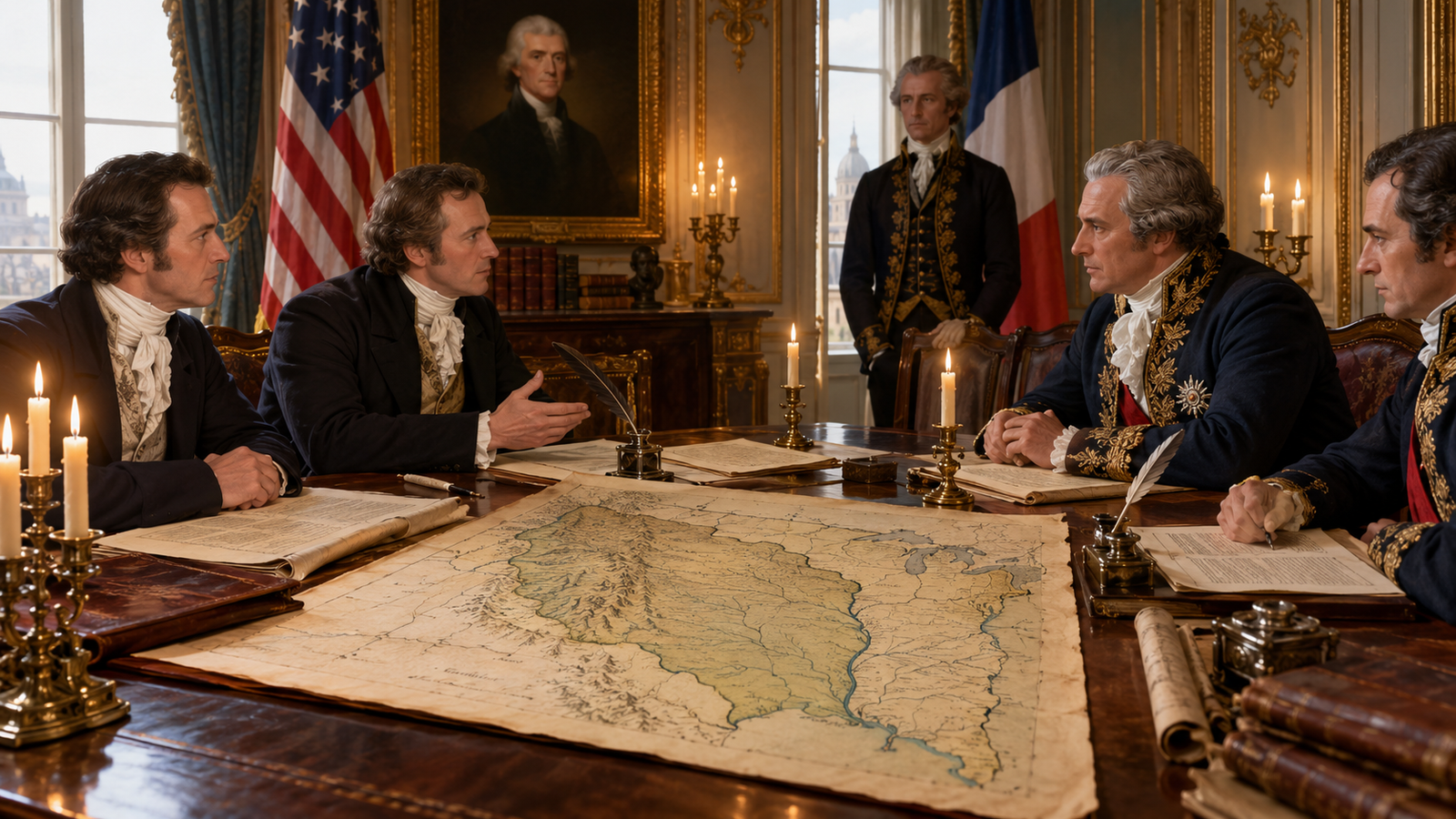
Robert Livingston, the American minister to France, began negotiations in Paris.
Later, James Monroe was sent to help with the negotiations.
Neither man expected the talks to result in the purchase of such a huge territory.
The Haitian Revolution Changed Napoleon’s Plans
One important factor behind the Louisiana Purchase was the Haitian Revolution.
At the time, the French colony of Saint-Domingue, located on the Caribbean island of Hispaniola, was extremely valuable. It was one of the world’s major producers of sugar and coffee.
Enslaved people in Saint-Domingue launched a revolution against French colonial rule.
The revolution eventually led to the creation of independent Haiti in 1804.
French leader Napoleon Bonaparte had hoped to restore French control over Saint-Domingue and use the Caribbean colony as a base for French influence in the Americas.
Those plans failed.
French forces suffered major difficulties, and the loss of Saint-Domingue reduced the usefulness of maintaining a large French territory in North America.
Without a strong Caribbean base, Louisiana became less valuable to Napoleon.
At the same time, Napoleon needed money to support France’s military activities in Europe.
These circumstances helped create an opportunity for the United States.
An Unexpected Offer
In 1803, Livingston and Monroe were prepared to negotiate for New Orleans and perhaps additional land.
Instead, French officials made a surprising proposal.
France offered to sell the entire Louisiana Territory.
The American negotiators had to make an important decision.
They had not been given specific instructions from Jefferson to purchase such a massive territory. Nevertheless, they recognized that the opportunity might never come again.
They agreed to the purchase.
The treaty was signed on April 30, 1803.
The price was $15 million.
The United States had suddenly acquired one of the largest territorial additions in its history.
Jefferson Faced a Constitutional Problem
Although Jefferson supported the purchase, he was concerned about whether the Constitution gave the federal government clear authority to acquire new territory through a treaty.
Jefferson was known for believing in a strict interpretation of the Constitution.
The Constitution did not specifically say that the president could simply purchase huge areas of foreign territory.
This created a difficult situation for him.
Jefferson considered proposing a constitutional amendment to make the purchase clearly legal.
However, he ultimately decided that delaying the agreement could cause France to reconsider the deal.
The national interest, in his view, was too important to risk losing the opportunity.
The United States therefore moved forward with the agreement.
Congress Approves the Purchase
The treaty was sent to the U.S. Senate.
The Senate approved the treaty in October 1803.
The formal transfer of Louisiana took place later that year. On December 20, 1803, American officials took control of New Orleans.
The United States had officially expanded far beyond its original boundaries.
The purchase represented a major change in the country’s geographic and political future.
How Much Land Did America Gain?
The Louisiana Purchase added approximately 828,000 square miles to the United States.
That was roughly equal to the size of the existing United States at the time.
In other words, the country almost doubled its territory in one transaction.
The purchase also gave Americans access to huge areas of forests, plains, rivers, mountains, and natural resources.
However, it is important to understand that this was not empty land waiting for Americans to occupy.
Many Indigenous nations already lived throughout the region.
They had their own governments, cultures, languages, trade networks, territories, and relationships with the land.
The United States would later negotiate treaties with many Indigenous nations, but expansion frequently involved pressure, broken agreements, warfare, and the forced removal of Indigenous communities.
Therefore, the Louisiana Purchase should be understood as a major expansion of U.S. territory, but not as the simple acquisition of an unoccupied wilderness.
Exploring the New Territory
After the purchase, Jefferson wanted Americans to learn more about the newly acquired land.
In 1804, he sent an expedition led by Meriwether Lewis and William Clark.
Their mission became known as the Lewis and Clark Expedition.
They traveled from the Missouri River across the continent toward the Pacific Ocean.
The expedition collected information about geography, plants, animals, rivers, and Indigenous nations.
The explorers also searched for practical transportation routes and opportunities for future trade.
Their journey became one of the best-known exploration stories in American history.
A young Indigenous woman named Sacagawea, who was associated with the Hidatsa and Shoshone communities, joined the expedition and contributed to communication and travel during important parts of the journey.
The expedition returned in 1806 after traveling thousands of miles.
Its reports gave American leaders more information about the western part of the continent.
The Impact on Westward Expansion
The Louisiana Purchase dramatically changed the possibilities for American expansion.
Before 1803, the United States was largely concentrated along the Atlantic coast and the lands east of the Mississippi River.
After the purchase, American leaders could look much farther west.
Over the following decades, settlers moved into different parts of the newly acquired territory.
New towns and farms appeared.
Roads and transportation routes expanded.
Trade increased.
Eventually, new territories were organized and many new states entered the Union.
The purchase therefore became an important foundation for what Americans later called westward expansion.
The Purchase and the Question of Slavery
The expansion also created a serious political problem.
The United States already had disagreements between states where slavery was legal and states where slavery had been abolished or was being restricted.
Adding enormous amounts of western territory raised a difficult question:
Would slavery be allowed in the new territories?
This question became increasingly important as settlers moved west.
Political leaders began arguing over whether new states would enter the Union as free states or slave states.
The debate eventually contributed to major political compromises, including the Missouri Compromise of 1820.
The expansion of the United States therefore did not simply increase the country’s size. It also intensified political disagreements that would continue for decades.
The Louisiana Purchase and Native Nations
Another major consequence involved the Indigenous peoples already living throughout the territory.
The Louisiana Territory included the homelands of numerous Indigenous nations.
These communities had lived in the region long before the United States existed.
The arrival of American settlers increased pressure on Indigenous lands.
The federal government negotiated treaties with various nations, sometimes exchanging land for money, goods, or promises.
However, many treaties were later violated or replaced as American settlement expanded.
Over time, Indigenous nations experienced increasing loss of territory and political power.
The story of the Louisiana Purchase therefore includes both American territorial growth and the difficult history of Indigenous dispossession.
Why Did France Sell Louisiana?
Napoleon’s decision to sell Louisiana was influenced by several factors.
First, France’s plans in the Caribbean had suffered major setbacks because of the Haitian Revolution.
Second, Napoleon needed financial resources for his European military campaigns.
Third, maintaining and defending such a large territory in North America would have been difficult.
Selling Louisiana allowed France to receive a large amount of money immediately.
For the United States, the agreement was an opportunity to secure the Mississippi River and gain enormous amounts of territory.
Both sides therefore believed they could benefit from the transaction.
A Turning Point in American History
The Louisiana Purchase changed the United States in ways that went far beyond the original agreement.
It strengthened American control of the Mississippi River and New Orleans.
It expanded the nation’s territory dramatically.
It encouraged exploration and settlement.
It created opportunities for farming and trade.
It also created difficult political questions about slavery, Indigenous sovereignty, and the future limits of American expansion.
Over the next several decades, the United States would continue expanding westward through treaties, purchases, annexations, wars, and other political agreements.
The Louisiana Purchase was one of the most important early steps in that larger process.
By 1803, the United States had been an independent country for only a few decades. Yet the decision made by Jefferson and the American negotiators in Paris transformed the country’s possibilities almost overnight.
The enormous territory purchased from France would eventually become home to millions of Americans and form parts of many states across the central and western United States.
The Louisiana Purchase: How the United States Doubled Its Territory in 1803
The Louisiana Purchase of 1803 was one of the most important land deals in American history. With a single agreement, the United States acquired a huge area of land from…
Leave a Reply