
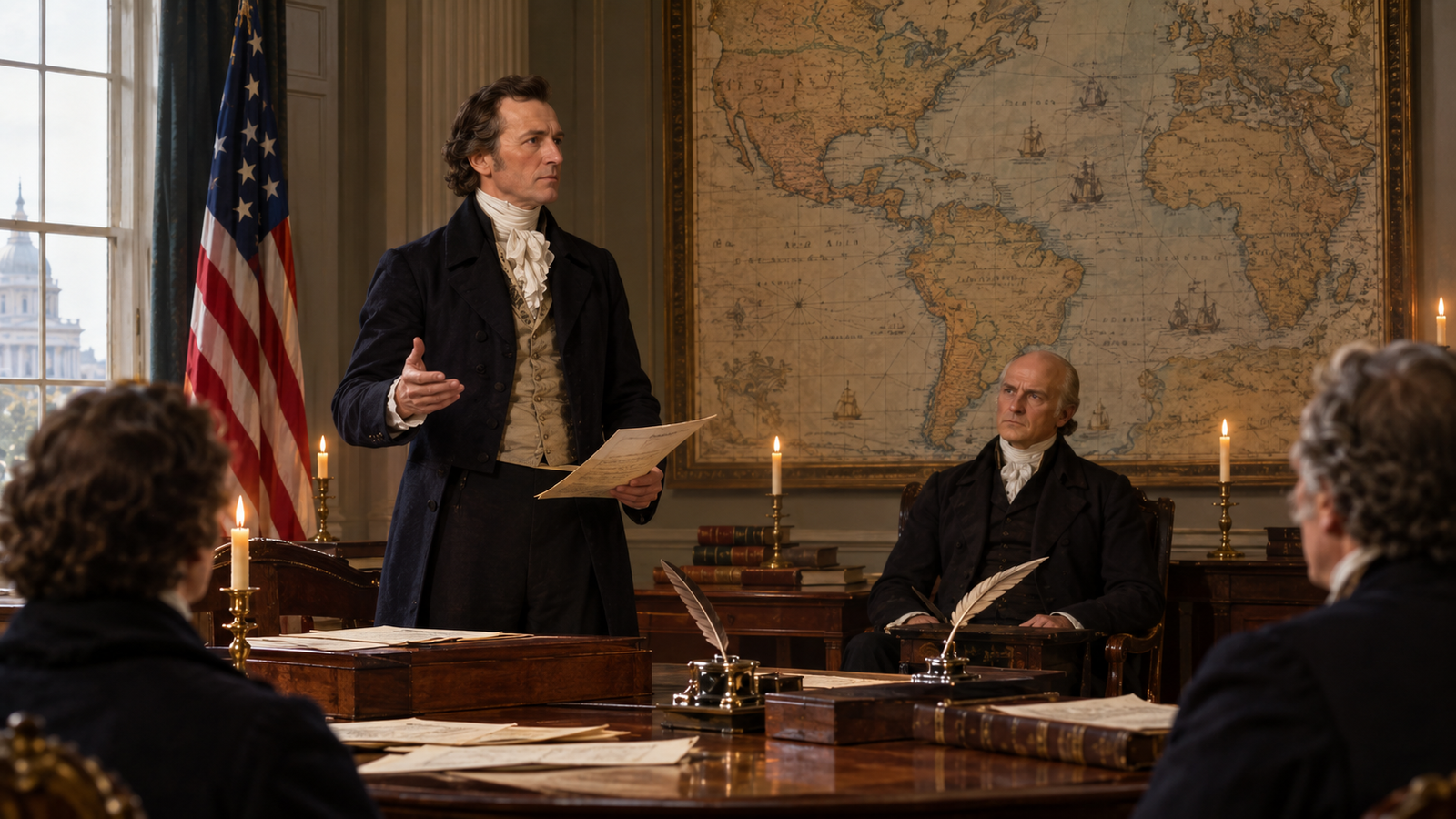
The Monroe Doctrine was one of the most important foreign-policy ideas in the early history of the United States. Announced by President James Monroe in 1823, it warned European powers against creating new colonies or interfering in the independent nations of the Americas.
At the time, the United States was still a relatively young country. European empires remained powerful, and Spain, France, Britain, and other European countries had important interests throughout the Western Hemisphere.
The Monroe Doctrine reflected a growing belief among American leaders that the Americas should not become a place where European powers could freely expand their political influence.
Although the doctrine was initially more of a political statement than a military policy, it became increasingly important in American foreign relations. Over the following decades, presidents and diplomats repeatedly referred to it when discussing European involvement in the Western Hemisphere.
What Was the Monroe Doctrine?
The Monroe Doctrine was a foreign-policy principle announced by President James Monroe on December 2, 1823, during his annual message to Congress.
The basic idea was that European powers should not establish new colonies or attempt to interfere in the independent nations of the Americas.
At the same time, the United States said it would generally avoid interfering in the internal affairs or wars of European countries.
This created a basic division of interests.
Europe would largely remain focused on European affairs, while the United States argued that the Western Hemisphere should not be subjected to new European colonization.
The doctrine did not mean that the United States immediately controlled the Americas. Rather, it expressed an American position about how international relations in the Western Hemisphere should develop.
Why Was the Monroe Doctrine Created?
To understand the Monroe Doctrine, it is necessary to look at what was happening in the Americas during the early nineteenth century.
Several Spanish colonies in Latin America were fighting for independence.
Revolutionary movements had challenged Spanish control in places such as Mexico, Venezuela, Colombia, Chile, and Argentina.
Many of these movements eventually succeeded in establishing independent governments.
American leaders welcomed the creation of independent nations in the Western Hemisphere, but they were concerned that European powers might attempt to restore colonial rule.
Spain had lost control over much of its former empire, but European governments were still powerful enough to potentially intervene.
The United States therefore wanted to discourage European governments from trying to rebuild their colonial empires in the Americas.
Latin American Independence Movements
During the early 1800s, Spain faced major political and military challenges.
Many people in Spanish-controlled territories wanted independence.
Leaders such as Simón Bolívar became important figures in the independence movements in northern South America.
Other revolutionary leaders helped independence movements across the continent.
The process was complicated and different in each region.
Some territories gained independence after long military struggles, while others experienced political changes that eventually led to independence.
By the early 1820s, several new independent nations had emerged.
The United States recognized some of these new governments.
American leaders saw an opportunity to build relationships with the independent countries of Latin America.
However, there was also concern that European powers might intervene.
The Threat of European Intervention
After the Napoleonic Wars ended in Europe, several European monarchies wanted to restore political stability and strengthen traditional royal governments.
Some European powers were concerned about revolutionary movements and republican governments.
There was a possibility that European governments could support Spain in an attempt to regain control over some of its former colonies.
This possibility worried American leaders.
The United States did not have the military power to challenge all of Europe’s major empires directly.
However, President Monroe believed that the United States should make its position clear.
James Monroe and His Presidency
James Monroe became the fifth president of the United States in 1817.
His presidency came during a period of growing national confidence.
The War of 1812 had ended only a few years earlier.
The United States was expanding economically and geographically.
American leaders were also becoming more interested in the country’s role in international affairs.
Monroe believed that the United States should avoid unnecessary involvement in European conflicts while protecting American interests in the Western Hemisphere.
His administration therefore paid close attention to developments in Latin America.
John Quincy Adams’ Role
Although the Monroe Doctrine is named after James Monroe, John Quincy Adams played a major role in developing the policy.
Adams was Monroe’s secretary of state.
He had extensive experience in diplomacy and believed that the United States should establish an independent foreign policy.
Adams was cautious about simply following Britain’s lead.
Britain had also opposed the possibility of European powers restoring Spanish colonial control because British merchants benefited from trade with independent Latin American countries.
British officials suggested that Britain and the United States should make a joint declaration.
The United States ultimately decided to make its own statement.
This was important because it allowed the American government to establish its own position rather than simply joining a British diplomatic initiative.
The Monroe Doctrine’s Main Principles
The Monroe Doctrine contained several important ideas.
European Colonization
The United States declared that the American continents should not be considered open territory for future European colonization.
This was especially significant because European powers still controlled several colonies in the Western Hemisphere.
The United States was essentially warning European governments not to create new colonies in the region.
European Interference
The doctrine also warned European powers against interfering with independent countries in the Americas.
If European governments attempted to impose their political systems on newly independent American nations, the United States considered this a serious concern.
American Non-Interference in Europe
The United States also stated that it would not interfere in existing European colonies or generally become involved in European political conflicts.
This was an important part of the doctrine.
The United States was not claiming that Europe had no interests at all in the Western Hemisphere. Instead, it was drawing a line against new European political expansion.
The Famous Message to Europe
Monroe’s message to Congress contained a strong warning.
He essentially argued that any attempt by European powers to extend their political system into the Americas would be viewed as dangerous to the peace and security of the United States.
The statement was significant because it showed that the United States was beginning to think about the Western Hemisphere as an area where it had important security interests.
However, the United States did not have the military strength of Britain or the major European powers.
This raises an important question:
Could the United States actually enforce the Monroe Doctrine?
At the time, its ability to do so was limited.
Britain’s Powerful Navy
One reason the Monroe Doctrine was taken seriously was Britain’s Royal Navy.
Britain had one of the world’s strongest naval forces.
British leaders did not want European competitors to regain exclusive control of Latin American markets.
Britain’s economic interests therefore happened to align with some of the goals expressed by Monroe.
Although Britain did not officially enforce the Monroe Doctrine as an American policy, British naval power helped discourage European military intervention in the region.
This meant the doctrine’s influence initially depended partly on international circumstances rather than American military strength alone.
Was the Monroe Doctrine a Law?
No.
The Monroe Doctrine was not a law passed by Congress.
It was a statement of American foreign policy.
It was included in President Monroe’s annual message to Congress.
The doctrine therefore did not automatically give the president unlimited authority to use military force.
Its importance came from the political principle it established.
Later American presidents would interpret and expand the doctrine in different ways.
The Doctrine and American Nationalism
The Monroe Doctrine also reflected growing American nationalism.
After independence, American leaders wanted the United States to be recognized as a legitimate and independent power.
The country had already fought Britain twice.
It had developed its own government, economy, and diplomatic relationships.
The Monroe Doctrine showed that the United States was beginning to define its own interests beyond its immediate borders.
It was a statement that American leaders believed European powers should not decide the political future of the Western Hemisphere without considering American interests.
The Doctrine Did Not End European Colonialism
It is important not to misunderstand the Monroe Doctrine.
It did not remove European colonies from the Americas.
Britain continued to control Canada.
Spain still controlled some territories.
France and other European countries also maintained interests and possessions in the Western Hemisphere.
The doctrine mainly opposed new European colonization and political intervention in independent American nations.
It was therefore a warning about future expansion rather than an immediate demand that every European country leave the Western Hemisphere.
The Monroe Doctrine and Mexico
The doctrine became particularly relevant during later conflicts involving Mexico.
In the nineteenth century, European powers sometimes became involved in Mexican affairs.
One major example occurred in the 1860s when France intervened in Mexico and supported the establishment of an empire under Maximilian.
The United States was dealing with its own Civil War at the time and was initially unable to respond strongly.
After the Civil War, the American government increased pressure on France to withdraw.
French forces eventually left Mexico.
The episode demonstrated that the principles associated with the Monroe Doctrine could become important when European governments attempted to establish political influence in Latin America.
The Roosevelt Corollary
The Monroe Doctrine changed significantly in the twentieth century.
In 1904, President Theodore Roosevelt announced what became known as the Roosevelt Corollary.
Roosevelt argued that the United States had the right to intervene in Latin American countries in certain circumstances, particularly when political instability or financial problems might invite European intervention.
This was a major expansion of the original doctrine.
The original Monroe Doctrine mainly warned European powers against intervention.
The Roosevelt Corollary gave the United States a much more active role in the affairs of countries in the Western Hemisphere.
This policy became controversial because American interventions sometimes generated resentment in Latin America.
Relations With Latin American Countries
The Monroe Doctrine had a complicated legacy in Latin America.
Some Latin American leaders welcomed American opposition to European colonialism.
They understood the importance of preventing European powers from restoring old colonial systems.
However, others became concerned as the United States increased its own influence in the region.
When the United States intervened politically or militarily in Latin American countries, critics sometimes argued that Washington was replacing European influence with American influence.
This created a difficult contradiction.
The United States had originally argued that foreign powers should not dominate the Americas, yet later American policies sometimes involved significant U.S. involvement in neighboring countries.
The Doctrine During the Cold War
The Monroe Doctrine continued to influence American foreign policy during the twentieth century.
During the Cold War, the United States strongly opposed the expansion of Soviet influence in the Western Hemisphere.
The Cuban Revolution became especially important.
After Fidel Castro’s government developed close relations with the Soviet Union, American leaders viewed Cuba as a major strategic concern.
The Cuban Missile Crisis of 1962 demonstrated how seriously the United States regarded the presence of a rival superpower close to its territory.
Although the Cold War was very different from the situation of 1823, American leaders continued to refer to the basic principle that outside powers should not establish threatening military or political influence in the Western Hemisphere.
Why the Monroe Doctrine Matters
The Monroe Doctrine became one of the longest-lasting principles in American foreign policy.
It helped establish the idea that the United States considered the Western Hemisphere an important area of national security.
It also reflected the country’s growing confidence during the nineteenth century.
At the time it was announced, the United States was not yet a global superpower.
It had a relatively small population compared with major European nations and lacked their military resources.
Yet American leaders were already beginning to think beyond the country’s original borders.
The doctrine represented an important step toward a more independent and assertive American foreign policy.
The Long-Term Legacy
The Monroe Doctrine has been interpreted differently throughout American history.
Its original purpose was mainly to discourage new European colonization and intervention in the independent countries of the Americas.
Later presidents expanded its meaning to justify stronger American involvement in the Western Hemisphere.
Because of these changing interpretations, the doctrine has both supporters and critics.
Supporters argue that it helped protect the independence of countries in the Americas from European intervention.
Critics point out that later U.S. governments sometimes used the doctrine to justify intervention in Latin American countries.
The Monroe Doctrine therefore represents both American resistance to European imperialism and the growth of American power in the Western Hemisphere.
From its beginning in 1823, it became more than a single presidential statement. It developed into a recurring idea in American foreign policy and helped shape how the United States viewed its relationship with Europe and the nations of the Americas.
Leave a Reply