
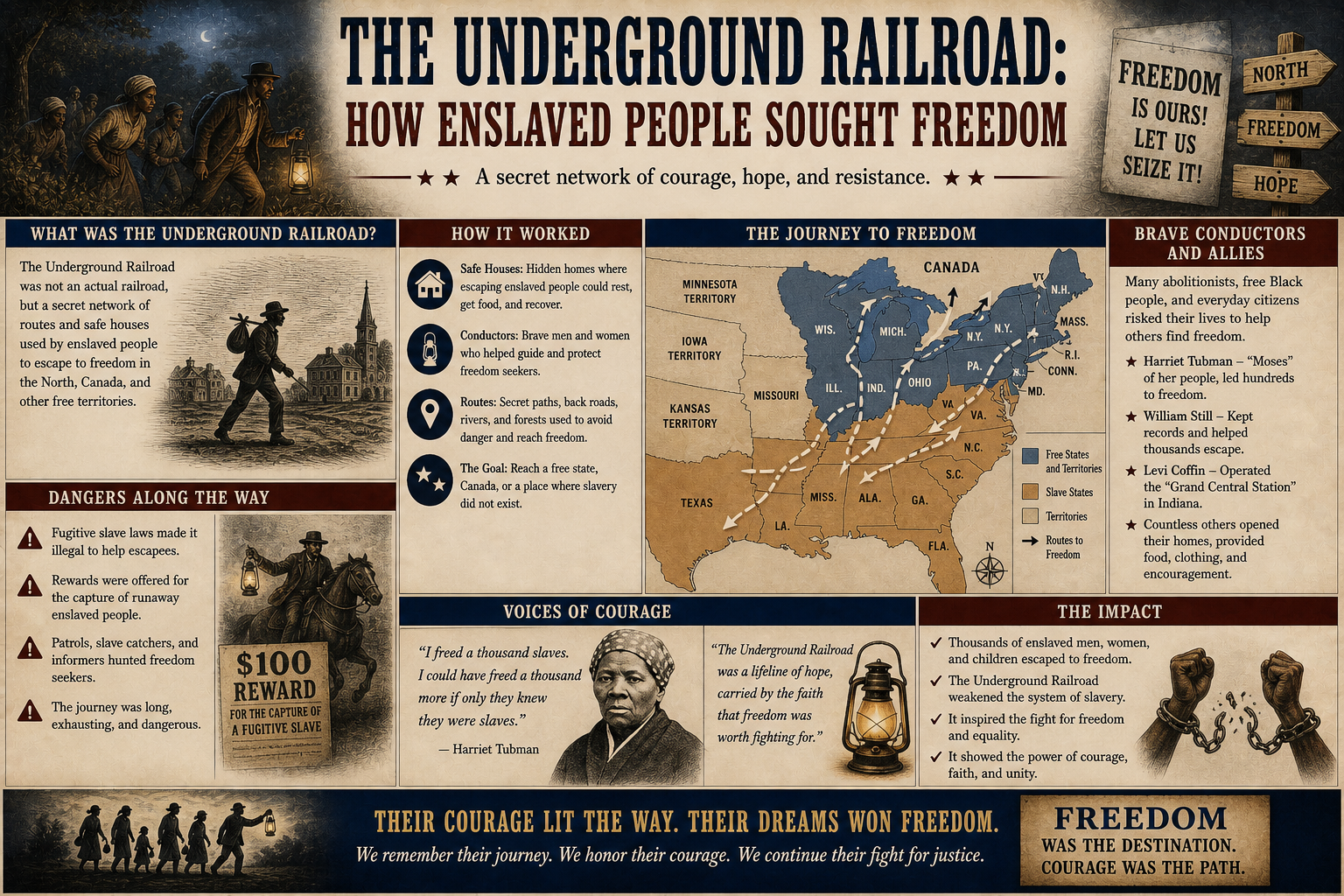
The Underground Railroad was one of the most remarkable resistance movements in American history. It was not an actual railroad, and it did not operate underground in the literal sense. Instead, it was a secret network of people, homes, churches, communities, and routes that helped enslaved people escape from slavery and move toward places where they could live more freely.
For enslaved people, escaping was extremely dangerous. They could be captured, imprisoned, beaten, or returned to slavery. People who helped them could also face serious punishment.
Despite these dangers, thousands of enslaved people attempted to escape. Their determination to seek freedom became an important part of the broader struggle against slavery in the United States.
What Was the Underground Railroad?
The term Underground Railroad became widely used during the nineteenth century to describe organized efforts to help enslaved people escape.
The network had no single leader or central organization.
Instead, it consisted of many individuals and groups who played different roles.
Some people provided food and clothing. Others offered temporary shelter. Some helped guide escapees between locations, while others provided money, transportation, or information.
People involved in the network sometimes used railroad language to keep their activities secret.
Safe places could be called “stations,” people who helped could be described as “conductors,” and those seeking freedom could be called “passengers.”
These terms helped disguise the real purpose of their activities.
Why Did Enslaved People Escape?
The reasons people escaped were deeply personal.
Enslaved people wanted freedom for themselves and their families.
Slavery separated husbands from wives, parents from children, and siblings from one another. Enslaved people were also subjected to forced labor, physical punishment, restrictions on movement, and the constant threat of being sold.
For many, escaping offered the possibility of controlling their own lives.
Some escapees wanted to reach family members who had already escaped.
Others wanted to move to free states or Canada, where they believed they would have a better chance of remaining free.
It is important to remember that escape was incredibly difficult.
Leaving meant saying goodbye to loved ones, familiar communities, and everything a person knew.
The Dangers of Escape
An enslaved person attempting to escape faced enormous risks.
Slaveholders and professional slave catchers searched for fugitives.
Dogs were sometimes used to track escapees.
People could also be betrayed by individuals who wanted the rewards offered for capturing escaped enslaved people.
The Fugitive Slave Act of 1850 made the situation even more dangerous.
The law strengthened federal enforcement of fugitive slave claims and imposed penalties on people who helped escaped enslaved people.
This meant that even after reaching a free state, an escaped person could still be captured and returned to slavery.
For this reason, many escapees continued northward toward Canada.
Harriet Tubman
One of the most famous figures associated with the Underground Railroad was Harriet Tubman.
Born enslaved in Maryland around 1822, Tubman escaped to Pennsylvania in 1849.
She later returned to the South many times to help family members and other enslaved people escape.
Tubman became known as a “conductor” on the Underground Railroad.
She traveled through dangerous territory, relying on secrecy, courage, and assistance from people along the way.
Tubman is believed to have helped numerous enslaved people reach freedom.
Her work made her one of the best-known figures in the American antislavery movement.
The Role of Free Black Communities
Free Black Americans played an extremely important role in helping escaped enslaved people.
Black communities in Northern states established churches, mutual aid organizations, and community networks that could provide shelter and assistance.
People such as William Still in Philadelphia helped document the stories of escaped enslaved people and assisted individuals seeking freedom.
These communities faced considerable danger.
Helping an escapee could result in arrest, financial penalties, or violence.
Nevertheless, many Black Americans continued to provide assistance.
Their contribution to the Underground Railroad was essential.
The Role of Abolitionists
White abolitionists also participated in the Underground Railroad.
Some opposed slavery on religious or moral grounds.
Others believed that the federal government and American society had a responsibility to end slavery.
Quakers, members of other religious groups, and individual antislavery activists often provided assistance.
One well-known figure was Thomas Garrett, a Delaware abolitionist who helped many enslaved people escape.
Another was Levi Coffin, a Quaker from Indiana who became known for his involvement in helping freedom seekers.
The network therefore included people from different backgrounds who were united by opposition to slavery.
Routes to Freedom
There was no single route on the Underground Railroad.
Different escapees traveled in different directions depending on where they began and what assistance was available.
Some traveled north through free states such as Pennsylvania, Ohio, Indiana, and Illinois.
Others crossed into Canada.
The Great Lakes were particularly important because they provided routes toward Canadian territory.
Cities such as Philadelphia, New York, Boston, and Detroit became important centers for antislavery activity.
However, routes were constantly changing.
People involved in the network had to adapt because slave catchers and authorities were always searching for escapees.
Canada as a Destination
Canada became an especially important destination after the Fugitive Slave Act of 1850.
The law meant that escaping to a free state did not necessarily guarantee permanent safety.
An escaped person could still be legally pursued and returned.
Crossing the international border into Canada offered greater protection from U.S. slave-catching efforts.
Thousands of freedom seekers eventually settled in Canada.
Communities developed in places such as Ontario, where formerly enslaved people built new lives.
For many, reaching Canada represented the final stage of a long and dangerous journey.
The Underground Railroad Was Not Always Secret in the Same Way
The Underground Railroad is often portrayed as a highly organized secret operation with clearly marked stations and routes.
In reality, it was much less centralized.
Some people helped only occasionally.
Others dedicated much of their lives to assisting freedom seekers.
Communication could happen through personal contacts, churches, community organizations, and trusted individuals.
Because the network was decentralized, there was no complete list of participants.
This also made it harder for authorities to destroy the entire movement.
Resistance Beyond Escape
Escaping was only one form of resistance to slavery.
Enslaved people resisted slavery in many other ways.
Some slowed their work, damaged equipment, secretly learned to read, maintained family and cultural traditions, negotiated with enslavers, or resisted physically.
Others escaped temporarily or permanently.
These actions demonstrated that enslaved people were not passive victims of slavery.
They constantly sought ways to protect their families, preserve their dignity, and gain greater control over their lives.
The Underground Railroad and the Abolitionist Movement
The Underground Railroad became closely connected to the broader abolitionist movement.
Abolitionists used newspapers, speeches, books, and public meetings to expose the realities of slavery.
Stories told by formerly enslaved people helped convince many Northerners that slavery was not simply a political disagreement.
It was a system that denied millions of people basic freedom.
The experiences of people who escaped also became powerful evidence against slavery.
Their stories were shared through newspapers, books, speeches, and abolitionist organizations.
The Fugitive Slave Act Increased Resistance
The Fugitive Slave Act of 1850 was intended to strengthen slaveholders’ ability to recover escaped enslaved people.
Instead, it encouraged some Northerners to become more actively involved in resistance.
People who had previously paid little attention to slavery sometimes became angry when federal authorities attempted to capture alleged fugitives in their communities.
The law therefore had an unintended effect.
Rather than ending the escape network, it encouraged some people to make greater efforts to help freedom seekers reach Canada.
The Personal Cost of Freedom
It is easy to focus on famous figures such as Harriet Tubman and overlook the ordinary people who took enormous risks.
Every person who helped an escapee faced possible consequences.
A farmer might hide someone in a barn.
A family might provide food.
A church might offer shelter.
A conductor might guide someone through unfamiliar territory.
These actions could seem small, but together they formed a network capable of helping people move toward freedom.
The Underground Railroad depended on trust.
One mistake could put many people in danger.
Did the Underground Railroad Cause the Civil War?
The Underground Railroad did not cause the Civil War.
However, it contributed to the growing national debate over slavery.
Southern slaveholders viewed escapes as a serious economic and political problem.
They demanded stronger federal laws to protect their ability to recover enslaved people.
Many Northerners increasingly opposed those demands.
The disagreement became part of the larger sectional conflict.
By the 1850s, slavery had become one of the central issues dividing the United States.
Events such as Bleeding Kansas, the Dred Scott decision, John Brown’s raid, and Abraham Lincoln’s election further intensified the crisis.
The Underground Railroad’s Legacy
The Underground Railroad became a powerful symbol of resistance and the pursuit of freedom.
It demonstrated that enslaved people actively fought against the conditions imposed upon them.
It also showed that ordinary people could challenge an unjust institution, even when doing so involved serious personal risks.
The stories of Underground Railroad participants have continued to influence American history and culture.
Harriet Tubman, in particular, became an enduring symbol of courage and determination.
Her life demonstrates that freedom was not simply something granted to enslaved people.
Many enslaved people actively pursued it, despite extraordinary dangers.
Final Thoughts
The Underground Railroad was a loose and decentralized network that helped enslaved people escape slavery during the nineteenth century.
It was not a literal railroad, but a system of people and communities who provided assistance along dangerous routes toward freedom.
Enslaved people who escaped showed extraordinary courage.
Free Black communities, abolitionists, religious groups, and other supporters also played important roles.
The Fugitive Slave Act of 1850 made escape even more dangerous, but it also encouraged some people to resist slavery more openly.
The Underground Railroad did not end slavery by itself.
However, it became an important part of the broader struggle against slavery and helped expose the enormous determination of enslaved people to control their own lives.
Its history reminds us that freedom has often been pursued by people willing to take extraordinary risks.
For those who traveled its routes, freedom was not an abstract political idea.
It was the hope of living safely, keeping families together, making personal choices, and finally controlling one’s own future.
Leave a Reply