
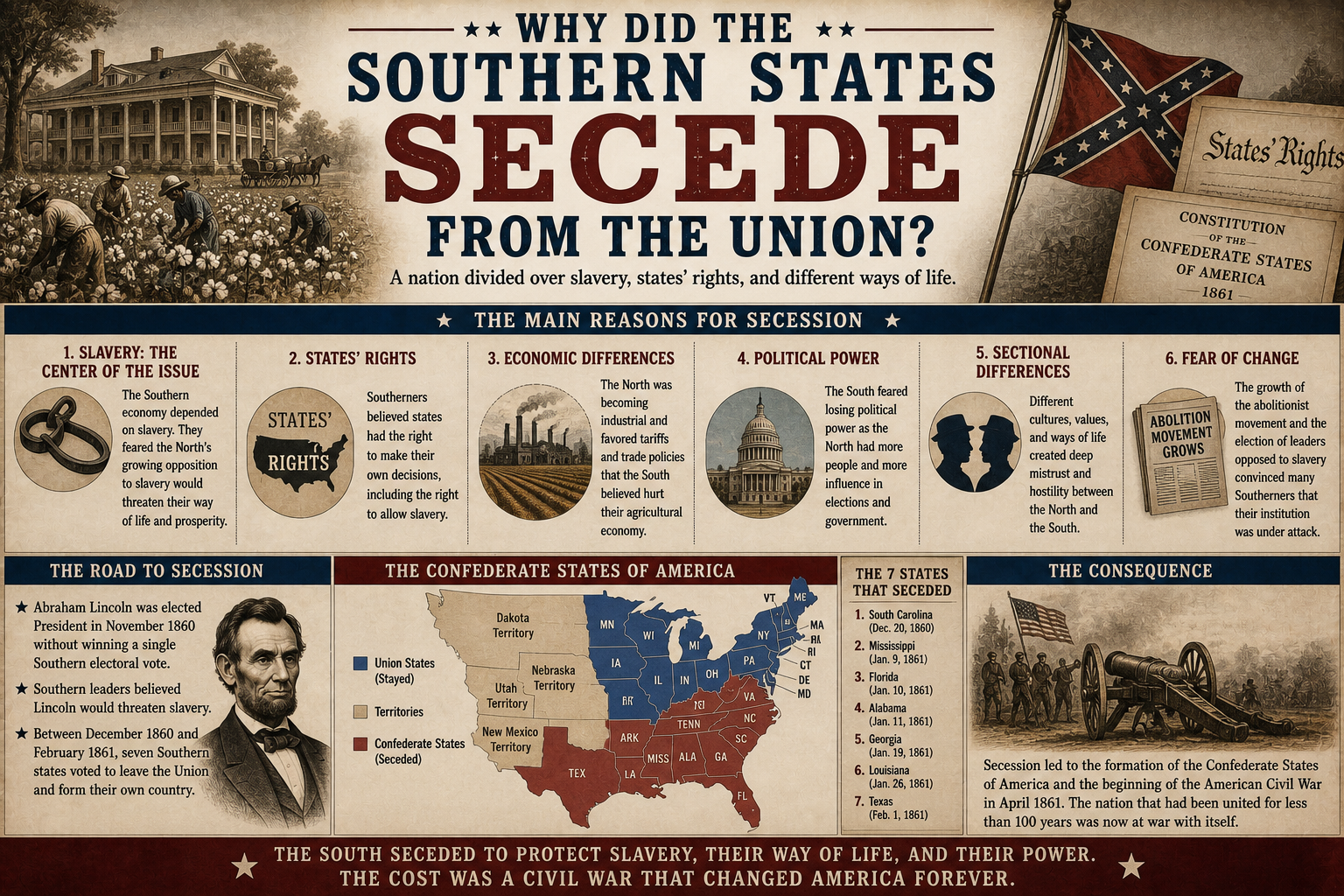
The secession of the Southern states was one of the most important events in American history. Between December 1860 and June 1861, eleven Southern states left the United States and formed the Confederate States of America.
Their decision came after decades of political and social conflict, especially over slavery and its expansion into new territories.
The election of Abraham Lincoln in November 1860 was the immediate political trigger for secession, but the causes went much deeper. Disagreements over slavery, states’ rights, federal power, economic interests, political control, and the future of the western territories had been growing for years.
Understanding why Southern states seceded helps explain how the United States went from political disagreement to civil war.
1. Slavery Was at the Center of the Crisis
The most important reason for secession was slavery.
By 1860, slavery was deeply connected to the economy and social structure of the Southern states. Enslaved labor was particularly important to the production of cotton, tobacco, sugar, and other agricultural products.
Southern slaveholders believed that slavery was essential to their economic system and way of life.
At the same time, opposition to slavery’s expansion was becoming increasingly powerful in the North.
The disagreement became especially serious when Americans debated whether slavery should be allowed in new territories acquired as the country expanded westward.
The question was no longer simply whether slavery would continue where it already existed.
It was whether slavery would spread.
2. The Expansion of Slavery
The United States expanded rapidly during the nineteenth century.
New territories and states created repeated political battles over whether they would permit slavery.
The Missouri Compromise of 1820 temporarily addressed the issue.
The Compromise of 1850 attempted another settlement.
The Kansas-Nebraska Act of 1854 then allowed settlers in Kansas and Nebraska to decide the slavery question through popular sovereignty.
These efforts repeatedly failed to provide a permanent solution.
Violence broke out in Kansas between pro-slavery and antislavery settlers.
The situation demonstrated that Americans were becoming increasingly willing to fight over the future of slavery.
3. The Rise of the Republican Party
The Republican Party emerged in the 1850s as a political movement opposed to the expansion of slavery into the western territories.
Republicans did not all agree about what should happen to slavery where it already existed.
However, they generally opposed allowing it to spread into additional territories.
This became a major source of concern in the South.
Many Southern political leaders believed that preventing slavery from expanding would eventually weaken the institution.
They feared that if the South could no longer expand slavery into new areas, it would eventually lose political influence.
4. The Election of Abraham Lincoln
The presidential election of 1860 was the immediate trigger for secession.
Abraham Lincoln, the Republican candidate, won the election.
His position was that slavery should not expand into the territories.
Although Lincoln did not initially campaign for the immediate abolition of slavery in states where it already existed, many Southern leaders viewed his victory as a serious threat.
Lincoln received almost no electoral support from the Deep South.
His victory therefore demonstrated that a candidate could become president largely through Northern support.
For many Southern politicians, this raised fears about their future political influence.
5. Fear of Losing Political Power
The South was increasingly concerned that it was becoming a permanent political minority.
The free states of the North had grown faster in population than the slave states.
Population mattered because it affected representation in the House of Representatives and the Electoral College.
As the North grew, Southern political leaders feared that the federal government would increasingly reflect Northern interests.
The election of Lincoln seemed to confirm those fears.
Some Southern leaders believed that leaving the Union was preferable to remaining in a political system where they believed their interests would eventually be outvoted.
6. States’ Rights
Southern leaders frequently justified secession using the language of states’ rights.
They argued that states had entered the Union voluntarily and therefore retained important powers.
According to this argument, a state could leave the Union if the federal government violated the rights it believed it possessed.
States’ rights was a genuine constitutional argument of the period.
However, it is important to understand what specific right was at the center of the conflict.
In the secession documents and political statements of several Southern states, slavery and the protection of slaveholding were repeatedly identified as major reasons for secession.
The debate over states’ rights was therefore closely connected to the question of slavery.
7. Economic Differences
The Northern and Southern economies were different.
The North had developed a larger industrial and commercial economy, with growing cities, factories, railroads, and financial institutions.
The South remained heavily dependent on agriculture, particularly cotton production.
Cotton exports generated enormous wealth for Southern slaveholders.
These economic differences contributed to disagreements over federal policies, including tariffs and trade.
Southern leaders often feared that Northern political interests would lead to policies that favored Northern industries.
Economic disagreements therefore added another layer to the sectional conflict.
However, economics cannot be separated completely from slavery because enslaved labor was central to the Southern plantation economy.
8. The Fugitive Slave Issue
The disagreement over escaped enslaved people also increased tensions.
The Fugitive Slave Act of 1850 required federal authorities and citizens to assist in returning escaped enslaved people to their enslavers.
Many Northerners opposed the law.
Some Northern states passed laws designed to protect alleged fugitives and limit state cooperation with federal enforcement.
Southern slaveholders viewed this resistance as evidence that Northern states were refusing to respect constitutional protections for slavery.
The issue became another source of distrust.
9. The Dred Scott Decision
The Supreme Court’s Dred Scott decision in 1857 made the political situation even more complicated.
The Court ruled against Dred Scott and held, among other things, that Congress could not prohibit slavery in federal territories.
The decision was welcomed by many Southern slaveholders but strongly criticized by many Northerners.
Republicans argued that the decision threatened their ability to prevent slavery from expanding.
The ruling therefore made political compromise more difficult.
10. John Brown’s Raid
In October 1859, abolitionist John Brown led an armed raid on the federal arsenal at Harpers Ferry, Virginia.
Brown hoped to seize weapons and encourage an uprising against slavery.
The raid failed, and Brown was captured and executed.
Many Southerners were deeply frightened by the event.
They saw it as evidence that violent abolitionism could threaten their communities.
Although Brown acted independently, his raid increased Southern fears about antislavery movements in the North.
11. The First State to Secede
After Lincoln’s election, South Carolina became the first state to leave the Union.
On December 20, 1860, its convention formally adopted an ordinance of secession.
South Carolina’s declaration was followed by other Southern states.
Mississippi, Florida, Alabama, Georgia, Louisiana, and Texas seceded before Lincoln’s inauguration.
The Confederate States of America was formed in February 1861.
Jefferson Davis became its president.
12. Why Did Some Southern States Wait?
Not every Southern state immediately seceded.
The Upper South was generally more cautious.
States such as Virginia, North Carolina, Tennessee, and Arkansas initially remained in the Union.
They were reluctant to leave without a direct military confrontation.
The situation changed after Confederate forces attacked Fort Sumter in April 1861.
President Lincoln called for troops to suppress the rebellion.
This convinced several Upper Southern states that the federal government was preparing to use military force against the seceded states.
They then joined the Confederacy.
13. Secession Did Not Immediately Mean War
Secession itself was a political act.
The first states to leave the Union did so before the Civil War officially began.
Both sides initially hoped that the crisis might still be resolved.
However, disagreements over federal property and military installations made peaceful separation increasingly difficult.
Fort Sumter became the decisive turning point.
When Confederate forces attacked the Union-held fort on April 12, 1861, the political crisis became an armed conflict.
Was Secession Mainly About Slavery?
This question has been debated, but the historical evidence is clear that slavery was central to the secession crisis.
Several Southern states explicitly identified the protection of slavery as a major reason for leaving the Union.
The Confederate Constitution itself protected slavery.
Political leaders in the Confederacy repeatedly discussed the importance of slavery to their new nation.
States’ rights was part of the argument, but the specific right most urgently being defended was the right to maintain and protect slavery.
The two issues therefore cannot be treated as completely separate.
The Consequences of Secession
The decision to secede had enormous consequences.
The United States entered its bloodiest conflict.
The Civil War lasted from 1861 to 1865 and resulted in enormous loss of life.
The Union was ultimately preserved.
Slavery was abolished through the Thirteenth Amendment in 1865.
The Fourteenth and Fifteenth Amendments later transformed the constitutional rights of African Americans.
The political
Leave a Reply